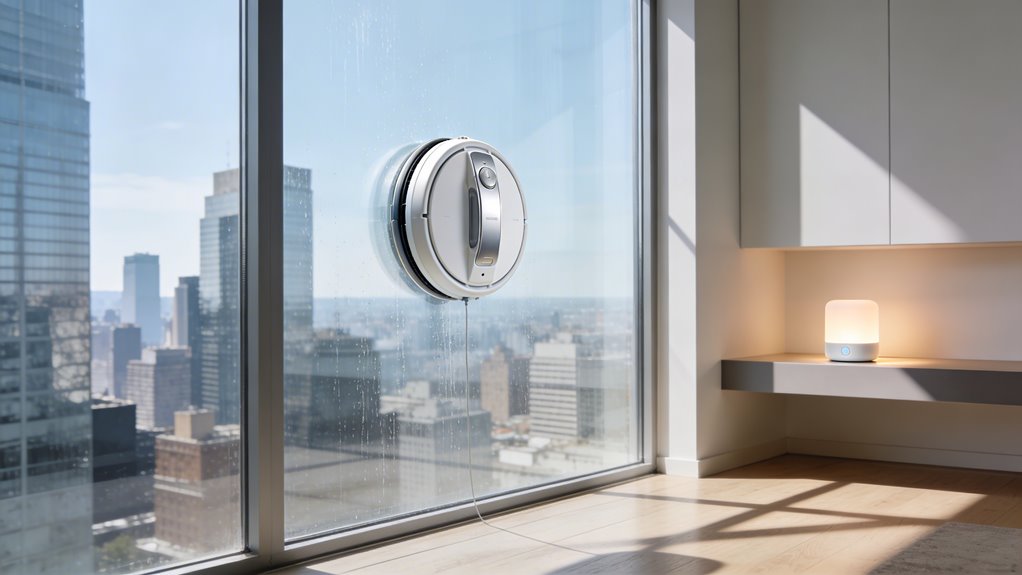
Robot window cleaners solve a specific maintenance problem: reaching and cleaning large or elevated glass surfaces without manual effort or scaffolding.
We evaluated five models against the demands of flat glass coverage, suction consistency across surface conditions, battery and cord limitations, frame clearance for narrow installs, and safety redundancy for unsupervised operation.
This review is written for homeowners managing multiple large windows who need reliable, repeatable results without constant supervision.
The five models reviewed are the BNZ K1, Tosima W5, ECOVACS WINBOT MINI2, W2S, and W2 PRO.
Each is assessed on technical specifications rather than marketing claims.
By the end, you will know which model best matches your window size, power source preference, and safety requirements.
Key Points
- The ECOVACS WINBOT W2 PRO offers plugged-in continuous operation, triple-nozzle spray with doubled water pressure, and a 12-stage protection system for streak-free results.
- The ECOVACS WINBOT W2S uses WIN-SLAM 4.0, TruEdge frame precision, and three wide-angle nozzles with microfiber pads to tackle fingerprints and light grime.
- The ECOVACS WINBOT MINI2 suits small or awkwardly framed windows, offering five cleaning modes and WIN-SLAM 4.0, though heavy water marks need manual pre-treatment.
- The Tosima W5 features bidirectional ultrasonic spray, edge-detection that reduces spray near frames, and auto-adjusting suction between 2400–3200 Pa for consistent cleaning.
- The BNZ K1 delivers AI-guided grid navigation and dual auto-spray across a 6-inch cleaning path, best suited to large flat glass surfaces.
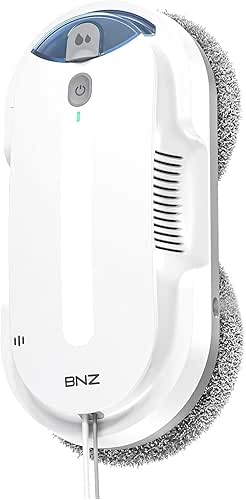
| BNZ K1 Smart Window Cleaning Robot (White) |
|
Budget-Friendly Pick | Battery Life: 35 minutes | Auto-Spray System: Dual auto-spray; 0.5L water tank | Navigation: AI path planning | VIEW LATEST PRICE | Read Our Analysis |
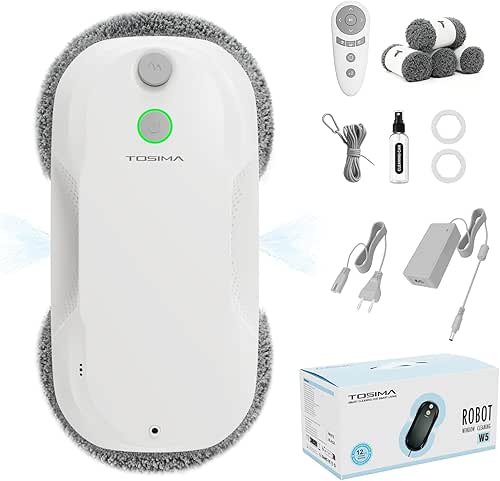
| Tosima W5 Window Cleaning Robot with Auto-Spray |
|
Best Value | Battery Life: 40 minutes | Auto-Spray System: Bidirectional ultrasonic atomization; visible 65ml external tank; sprays twice per movement | Navigation: Smart navigation | VIEW LATEST PRICE | Read Our Analysis |
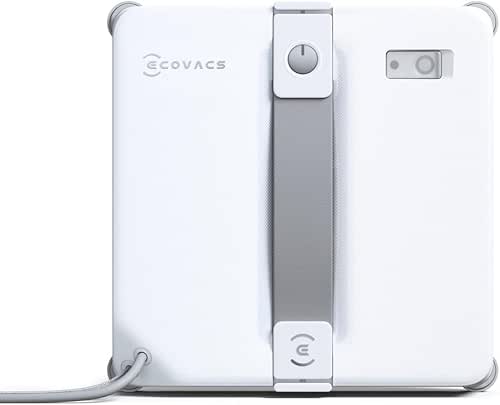
| ECOVACS WINBOT MINI2 Window Cleaning Robot |
|
Best for Small Windows | Battery Life: Not specified | Auto-Spray System: Not specified | Navigation: WIN-SLAM 4.0 intelligent path planning | VIEW LATEST PRICE | Read Our Analysis |
| ECOVACS WINBOT W2S Window Cleaning Robot |
|
Best Edge Precision | Battery Life: 110 minutes | Auto-Spray System: Triple wide-angle nozzle spray system | Navigation: WIN-SLAM 4.0 intelligent mapping and route planning | VIEW LATEST PRICE | Read Our Analysis |
| ECOVACS WINBOT W2 PRO Portable Window Cleaning Robot |
|
Best Overall | Battery Life: 110 minutes (battery mode) | Auto-Spray System: Triple wide-angle nozzle spray; 100% increased water pressure | Navigation: WIN-SLAM 4.0 intelligent path planning | VIEW LATEST PRICE | Read Our Analysis |
More Details on Our Top Picks
-
BNZ K1 Smart Window Cleaning Robot (White)
BNZ K1 Smart Window Cleaning Robot | *Best for Large Glass Surfaces*
The BNZ K1 is an autonomous window-cleaning robot designed for users managing large, flat glass surfaces such as floor-to-ceiling windows or wide mirrors.
Key Features:
- Twin turbo motors with dual auto-spray and a 0.5-liter water tank
- 6-inch cleaning path per pass with AI-guided grid navigation
- Frameless edge detection prevents the unit from leaving the glass surface
One limitation is that battery life is 35 minutes, which may require a mid-job recharge on larger windows.
This suits property owners or facilities staff handling expansive glass panels who need automated coverage without manual supervision.
- Battery Life:35 minutes
- Auto-Spray System:Dual auto-spray; 0.5L water tank
- Navigation:AI path planning
- Safety System:Multiple safety protections; frameless edge detection
- Cleaning Pads:HEPA filter included
- Surface Compatibility:Glass, windows, mirrors
- Additional Feature:Twin turbo drive motors
- Additional Feature:0.5L water capacity
- Additional Feature:AI path planning
-
Tosima W5 Window Cleaning Robot with Auto-Spray
The Tosima W5 is a window cleaning robot for homeowners managing frequently soiled windows who want automated operation. Its bidirectional ultrasonic spray distributes water evenly across the surface. The edge-detection system reduces spray output near window borders to protect frames. Suction adjusts automatically between 2400 and 3200 Pa based on detected dirt levels. One limitation is that the 40-minute battery cap restricts coverage across large or multiple windows without interruption. This suits homeowners with standard-sized windows who want consistent, low-effort cleaning cycles without manually monitoring the process.
Word count: 88
- Battery Life:40 minutes
- Auto-Spray System:Bidirectional ultrasonic atomization; visible 65ml external tank; sprays twice per movement
- Navigation:Smart navigation
- Safety System:Triple safety system; air pressure sensor; AI-powered edge detection
- Cleaning Pads:8 rags included
- Surface Compatibility:All smooth surfaces including glass
- Additional Feature:Ultrasonic atomization spray
- Additional Feature:65ml visible water tank
- Additional Feature:2400–3200 Pa suction
-
ECOVACS WINBOT MINI2 Window Cleaning Robot
ECOVACS WINBOT MINI2
The WINBOT MINI2 is a compact window-cleaning robot designed for narrow panes, small frames, and tight spaces that standard-sized window robots cannot access.
Key Features:
- Slim chassis dimensions allow navigation of window frames that wider units cannot fit
- WIN-SLAM 4.0 path-planning technology maps cleaning routes and detects edges automatically
- Five cleaning modes: Deep, Fast, Spot, Precision, and one additional mode for varied soil levels
One limitation is that heavy water marks require manual pre-treatment before use, as the robot cannot remove them independently.
Suited to users with small or awkwardly framed windows who want automated cleaning without manual path management.
- Battery Life:Not specified
- Auto-Spray System:Not specified
- Navigation:WIN-SLAM 4.0 intelligent path planning
- Safety System:Multiple safety protection systems; automatic edge detection
- Cleaning Pads:Not specified
- Surface Compatibility:Large windows, glass doors, mirrors, frameless glass
- Additional Feature:Five intelligent cleaning modes
- Additional Feature:Fits narrow/small panes
- Additional Feature:No ladder required
-
ECOVACS WINBOT W2S Window Cleaning Robot
ECOVACS WINBOT W2S
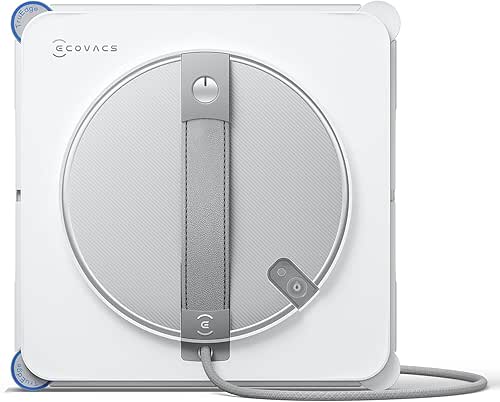
The ECOVACS WINBOT W2S is a window-cleaning robot designed for owners of high-rise properties or large glass surfaces who want to avoid manual cleaning at height. Its 10-level safety system integrates suction hold, a physical safety rope, anti-slip drive wheels, and real-time edge detection. WIN-SLAM 4.0 maps and executes cleaning routes autonomously, while TruEdge technology positions the unit within millimeters of the window frame. Three wide-angle spray nozzles paired with rinsable microfiber pads handle fingerprint smears and light surface grime.
One limitation is that heavily soiled glass requires multiple passes to achieve a clean result.
At 3.1 kg, this suits high-rise residents or commercial property managers who prioritize safety over portability.
- Battery Life:110 minutes
- Auto-Spray System:Triple wide-angle nozzle spray system
- Navigation:WIN-SLAM 4.0 intelligent mapping and route planning
- Safety System:10-level safety system; real-time edge detection; safety rope; anti-slip drive
- Cleaning Pads:Rinsable microfiber pads
- Surface Compatibility:Flat framed glass, mirrors, glass doors, shower glass
- Additional Feature:TruEdge edge-to-edge cleaning
- Additional Feature:Triple wide-angle nozzles
- Additional Feature:110-minute battery life
-
ECOVACS WINBOT W2 PRO Portable Window Cleaning Robot
ECOVACS WINBOT W2 PRO — Best for Large Windows
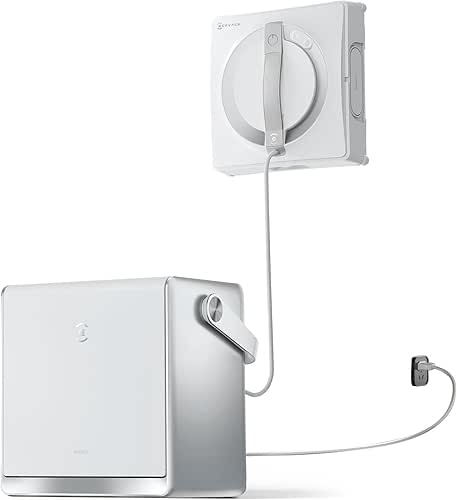
The ECOVACS WINBOT W2 PRO is a robotic window cleaner designed for homeowners with large or hard-to-reach glass surfaces. Plugged-in mode delivers continuous operation independent of battery charge. The triple-nozzle spray system doubles water pressure to improve dirt dissolution. WIN-SLAM 4.0 path planning increases cleaning efficiency by 30% and supports frameless and tilting windows. The 12-stage protection system combines hardware and software anti-fall safeguards.
One limitation is that the multi-functional station adds significant bulk, making it unsuitable for compact storage spaces.
Best suited to owners of large or multi-story glazing who prioritize uninterrupted runtime.
- Battery Life:110 minutes (battery mode)
- Auto-Spray System:Triple wide-angle nozzle spray; 100% increased water pressure
- Navigation:WIN-SLAM 4.0 intelligent path planning
- Safety System:12-stage protection system; anti-fall; intelligent climbing system
- Cleaning Pads:Wet cloth/pad; rinsable during use
- Surface Compatibility:Glass, including floor-to-ceiling, small, frameless, and tilting windows
- Additional Feature:Multi-functional charging station
- Additional Feature:Plugged-in continuous mode
- Additional Feature:12-stage protection system
Factors to Consider When Choosing a Robot Window Cleaner
Picking the right robot window cleaner comes down to a handful of specs that actually affect day-to-day use. You’ll want to check suction power, since that determines whether the unit stays anchored on vertical glass without slipping, and battery life, because a short runtime means the robot may cut out mid-panel on larger windows. Safety features like anti-fall sensors and a tether cable, surface compatibility with framed or frameless glass, and the navigation system’s path-planning logic round out the key factors worth comparing before you buy.
Suction Power Matters
Suction power determines whether a robot window cleaner maintains contact with vertical glass during operation. Measured in Pascals, higher ratings provide stronger adhesion on tall or exposed panes where gravity increases the risk of slippage. Adjustable suction ranges allow pressure increases on heavily soiled glass and reductions on frameless or delicate panes, lowering motor strain and slip risk. Higher suction draws more power, reducing battery runtime on cordless models. Suction alone is not a sufficient safety system — anti-drop sensors and a tether rope provide secondary protection on large vertical surfaces where adhesion can fail.
Battery Life Considerations
Battery life determines how much glass surface area a robot window cleaner can cover in a single session. Advertised runtimes are typically measured at idle or minimum load — activating the spray system or increasing suction reduces that figure by 20–30% under real operating conditions. A runtime of 30–40 minutes covers a small residential array or a single touch-up pass. Continuous multi-panel jobs or large façades require 90 minutes or more, making models with a corded backup mode a practical choice. Confirm whether the unit supports fast charging or partial-charge cycling without capacity loss, as this affects long-term performance across hundreds of cleaning cycles.
Safety Features Included
Effective safety systems in robot window cleaners depend on multiple redundant mechanisms working in concert. Strong suction, a physical tether, and a backup power supply form the core layer — the backup supply maintaining hold if battery or mains power is interrupted. Edge detection, whether optical or ultrasonic, should halt movement within millimeters of a frameless border. Redundant sensors tracking air pressure and motor current identify suction loss before it results in a fall. Real-time path monitoring, automatic fault shutdown, and low-power alerts — audible or visual — provide additional response time. A tether alone, without vacuum redundancy, leaves one failure mode unaddressed.
Surface Compatibility Range
Surface compatibility determines whether a robot window cleaner can complete a cleaning path without stalling, missing edges, or damaging the glass surface. Key criteria include supported surface types — framed glass, frameless glass, mirrors, smooth tiles, and shower panels — as well as orientation capability, covering vertical panes, horizontal skylights, or flat tabletop surfaces. Coated glass requires attention, as low-E and hydrophobic treatments can degrade with incompatible cleaning sprays. Large frameless panels require stronger suction ratings and reliable edge-detection to prevent falls. Textured or segmented glass remains a consistent weak point across most models, and smooth surfaces are the only reliable baseline for consistent performance.
Navigation and Path Planning
Path planning and navigation technology determine how completely and efficiently a robot window cleaner covers a pane. Systems using SLAM or AI-based mapping chart the surface before cleaning begins, then follow a systematic route that reduces missed strips and unnecessary battery drain compared to random-movement designs. Edge-detection algorithms identify frame boundaries, stopping spray application at the correct point and triggering reversal to protect both the frame and the unit. Sensor fusion — drawing on vision, ultrasonic, infrared, and pressure inputs — maintains stable adhesion through tight turns on vertical glass. Effective units also adjust their route geometry to irregular pane shapes rather than applying one fixed pattern universally.
Water Spray System
Spray system design determines whether cleaning solution reaches glass evenly or produces streaks and dry patches. Continuous mist, pulsed atomization, and directed nozzles each distribute liquid at different flow rates and droplet sizes, affecting how effectively they lift grime from the surface.
Reservoir capacity has direct operational consequences. A tank under 100ml requires frequent refilling on standard windows, while reservoirs in the 250–400ml range typically complete multiple panes per cycle. Sensor-driven or adjustable spray control matches output to detected soil levels, reducing both solution waste and residue buildup. Edge-aware spray disablement prevents pooling near frames, which can cause drip marks on sills. Nozzles and reservoirs should be tool-free removable for rinsing, as partial clogs reduce spray consistency within a few cleaning cycles.
App and Remote Control
App and Remote Control
Effective control of a robot window cleaner depends on the quality of its app, remote, and connectivity options. Most models include both a physical remote for immediate commands and a smartphone app for scheduling, mode adjustments, and status monitoring. Confirm the app supports your current iOS or Android version before purchasing, as some older OS versions lose compatibility after firmware updates. Check whether the app delivers those updates automatically, since navigation algorithms improve incrementally across versions. Verify the connection method as well: Wi-Fi supports broader range and cloud backup, Bluetooth limits operation to close proximity, and proprietary RF falls between the two. Weak connectivity can interrupt a cleaning cycle mid-run.
Weight and Portability
Weight and portability determine how practical a window-cleaning robot is for daily use. Units in the 3–5 kg range grip vertical glass more reliably due to greater contact pressure, but repeated carrying up stairs increases physical strain over time. Models in the 1.5–2 kg range are easier to reposition between panes and floors, though they rely more heavily on suction strength or a tether cable to maintain stability. A compact footprint allows the device to navigate panes that wider units cannot reach. Battery packs add measurable weight, so check the loaded figure, not just the base unit spec. An integrated handle or compatible carry case reduces handling effort when moving the robot between locations.
Frequently Asked Questions
Can Robot Window Cleaners Work Effectively in Freezing Cold Temperatures?
Robot window cleaners are not designed to operate effectively in freezing temperatures. Cold conditions degrade suction performance, reduce battery life, and cause cleaning fluid to freeze. Operating these devices below 32°F risks permanent damage to their components.
How Long Do Robot Window Cleaner Suction Pads Typically Last?
Suction pads typically last 3–6 months before needing replacement, depending on how often the robot is used. Regular inspection for signs of wear is essential, as degraded pads reduce suction strength and increase the risk of the robot falling. Replace them promptly at the first sign of deterioration.
Are Robot Window Cleaners Safe to Use During Light Rain?
Robot window cleaners are generally not safe to use during light rain, as moisture can damage electrical components and compromise suction grip. Always check your model’s IP rating and follow the manufacturer’s weather guidelines before operating it outdoors.
Can Robot Window Cleaners Clean Skylights or Overhead Glass Surfaces?
Some robot window cleaners can clean skylights and overhead glass surfaces, but only models that explicitly support inverted or horizontal cleaning. Some models are designed to handle overhead surfaces safely, while others may lose suction and fall when positioned horizontally. Check whether your specific model lists skylight or inverted-surface support before attempting this.
Do Robot Window Cleaners Require a Specific Type of Cleaning Solution?
Most robot window cleaners work with distilled water or a diluted, streak-free glass cleaner — no specialized solution is required. Some manufacturers recommend avoiding harsh chemicals to protect internal components, so checking your model’s manual is advisable.
Conclusion
The ECOVACS WINBOT W2 PRO Omni leads this roundup with 5,500 Pa suction and a 12-stage protection system that combines hardware anti-fall sensors, a composite safety tether rated to 100 kg tensile strength, and real-time edge detection. Its dual power modes allow continuous plugged-in operation or 110-minute cordless sessions, which no other model in this roundup matches. For buyers prioritizing a lower entry cost over full automation, the BNZ K1 handles standard framed windows at a fraction of the investment. Watch the full ranked video breakdown on the ProGadgetPicks YouTube channel for a side-by-side comparison of all five products. For cleaning robots that tackle floors alongside your windows, see our Best Robot Vacuum Mop Combos roundup on ProGadgetPicks.

Michael Haralson spent 15 years at Nokia Mobile Phones across six progressive global roles covering product marketing, sales operations, corporate strategy, and business development in Europe, China, and Asia Pacific. He evaluated hundreds of technology products and partnerships, managed roadmap sessions with operators including Vodafone, AT&T, and China Mobile, and launched 50+ products internationally. After Nokia Mobile Phones, he founded JetSpark Robotics with IBM Watson and Intel partnerships.
He currently writes on AI simulation, multi-sensor fusion, and synthetic data for a defense technology company. His 30+ published technical articles cover the same sensor architectures (LiDAR, RADAR, cameras, infrared) found inside the smart home products he evaluates. He holds four IBM AI certifications.
His approach: technology changes fast, so he takes a snapshot of what’s currently available in each product category, evaluates the set against real use cases, and picks the ones worth your money for the next two years. Because smart home products are multi-year investments that need to work with the rest of your home, he pays particular attention to interoperability — whether a product plays well with the other technology already in your house. He holds four IBM AI certifications and founded a robotics startup with IBM Watson and Intel partnerships.