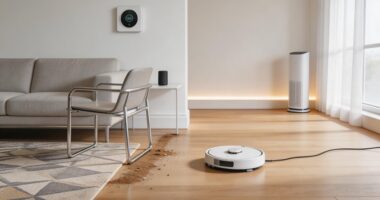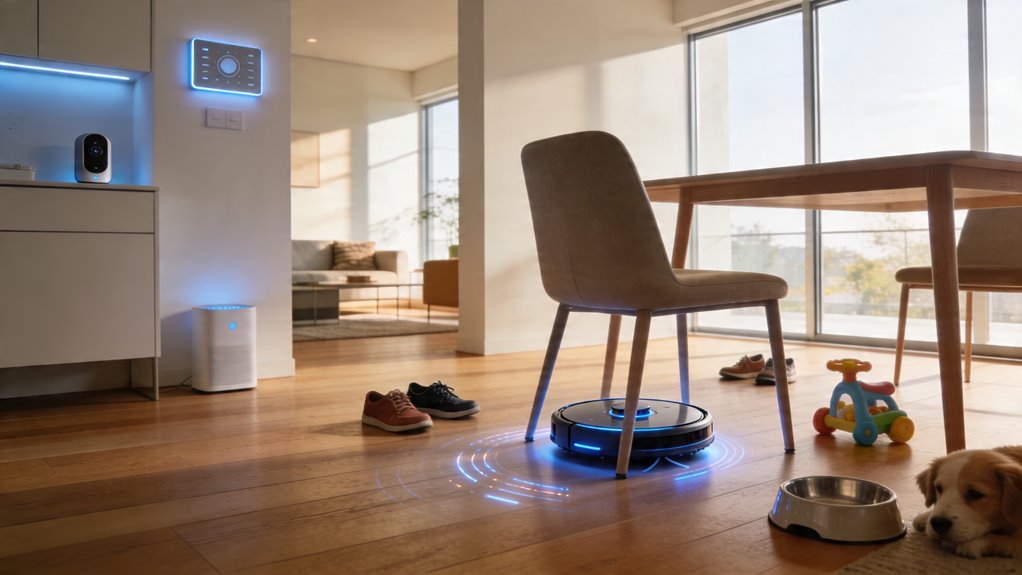
Charging cords, pet messes, socks, and children’s toys are the everyday clutter that separates a robot vacuum that actually finishes a clean from one that gets stuck or spreads a mess across the floor. True obstacle avoidance is a sensor-stack question, not a marketing label.
We evaluated five robot vacuums against the specific demands of real-world obstacle navigation: sensor type (AI vision vs. structured light vs. LiDAR-only), object classification depth, detection range, and third-party verification of real-world avoidance performance.
The five models reviewed — the Shark AI Ultra Robot Vacuum with Self-Empty Base, Roborock Qrevo (QV35A), Roborock Q10 S5+, Dreame L10s Ultra, and eufy E25 — were assessed on independently documented obstacle-avoidance performance, not on brand claims.
By the end of this guide, you will know which model has the strongest quantified obstacle-avoidance result, which mid-tier picks genuinely earn their AI-vision label, and where each unit’s detection gaps become practical liabilities.
Key Points
- LiDAR navigation delivers centimeter-level precision for mapping, room segmentation, and no-go zones, making it the most reliable obstacle avoidance technology available.
- Combining LiDAR with RGB cameras or 3D structured light adds object classification, improving detection accuracy beyond what single-sensor systems provide.
- The Shark AI Ultra uses 360° LiDAR, enabling accurate navigation and obstacle detection even in low-light conditions.
- The Roborock Q10 S5+ features PreciSense LiDAR with multi-floor mapping, supporting consistent obstacle avoidance across large, complex home layouts.
- The Dreame L10s Ultra uses RGB camera and 3D structured light, offering strong object classification without relying on traditional LiDAR hardware.
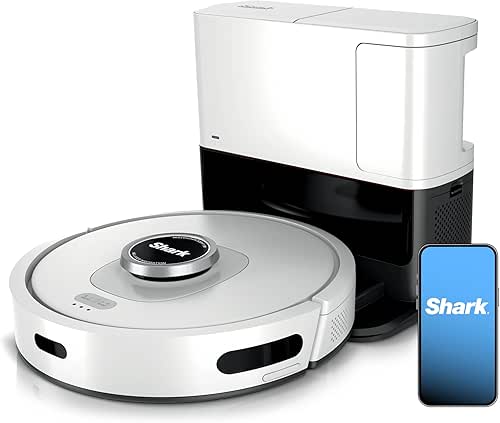
| #5- Shark AI Ultra Robot Vacuum with Self-Empty Base |
|
Budget LiDAR Pick | Suction Power: Not specified in Pa; described as powerful suction for carpets and hard floors | Self-Empty Capacity: Bagless XL base holds up to 60 days of debris | Mopping System: None; vacuum only | VIEW LATEST PRICE | Read Our Analysis |
| #4-Roborock Qrevo Robot Vacuum and Mop (QV35A) |

|
Best Mopping Performance | Suction Power: 8,000 Pa HyperForce suction | Self-Empty Capacity: 2.7 L sealed dust bag; 7–9 weeks capacity | Mopping System: Dual spinning mops at 200 RPM; 30 adjustable water levels; 10 mm lift for carpets | VIEW LATEST PRICE | Read Our Analysis |
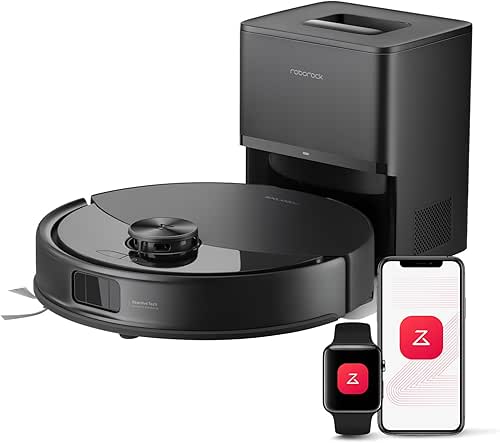
| #3-Roborock Q10 S5+ Robot Vacuum and Mop |
|
Best for Large Homes | Suction Power: 10,000 Pa HyperForce suction | Self-Empty Capacity: 2.7 L dust bag; up to 70 days hands-free cleaning | Mopping System: VibraRise 2.0 dual-zone sonic vibration; up to 3,000 scrubs/min; 8 mm auto mop lift | VIEW LATEST PRICE | Read Our Analysis |
| #2-Dreame L10s Ultra Self-Emptying Robot Vacuum & Mop |

|
Most Fully Automated | Suction Power: 5,300 Pa suction | Self-Empty Capacity: 3 L dust bag; up to 60 days hands-free cleaning | Mopping System: Dual rotary mops at 180 RPM; 2.5 L water tank; mop lift when returning to base | VIEW LATEST PRICE | Read Our Analysis |
| #1-eufy E25 Robot Vacuum and Mop Combo |

|
Best Overall | Suction Power: 20,000 Pa suction | Self-Empty Capacity: 3 L dust bag; approximately 75 days capacity | Mopping System: HydroJet roller mop refreshes 2×/s; 10.8 mm mop lift; 2.5 L capacity | VIEW LATEST PRICE | Read Our Analysis |
More Details on Our Top Picks
-
Shark AI Ultra Robot Vacuum with Self-Empty Base
Shark AI Ultra Robot Vacuum with Self-Empty Base
Designed for pet owners who want automated floor cleaning with minimal manual intervention.
- 360° LiDAR navigation maps the home and operates in low-light conditions
- Self-cleaning brushroll resists hair wrap mechanically, reducing manual maintenance
- 60-day bagless dock capacity with 120-minute battery runtime and automatic resume after recharging
One limitation is that the onboard dustbin holds only 0.27 gallons, making frequent dock transfers essential in high-shedding households.
Suits pet owners who prioritize low-touch maintenance and can accommodate a larger dock unit in their space.
- Suction Power:Not specified in Pa; described as powerful suction for carpets and hard floors
- Self-Empty Capacity:Bagless XL base holds up to 60 days of debris
- Mopping System:None; vacuum only
- Navigation Type:360° LiDAR with AI-powered smart mapping and object detection
- Battery Runtime:Up to 120 minutes
- Voice Assistant Support:Amazon Alexa and Google Assistant
- Additional Feature:Matrix Clean grid pattern
- Additional Feature:60-day bagless base
- Additional Feature:120-min battery runtime
-
Roborock Qrevo Robot Vacuum and Mop (QV35A)
Best for Mopping Performance
The Roborock Qrevo (QV35A) is a robot vacuum and mop designed for households that prioritize floor-washing results over basic vacuuming. Dual spinning mops operate at 200 RPM with 10 mm pad lift to clear low-pile carpet. Suction reaches 8,000 Pa, and the full-rubber brush reduces hair tangles. The dock washes, dries, and refills mop pads automatically, storing waste in a 2.7 L sealed bag lasting 7–9 weeks. One limitation is that it only supports 2.4 GHz Wi-Fi, which may require a router configuration check. This suits households with hard floors who want automated mop maintenance without manual pad cleaning.
- Suction Power:8,000 Pa HyperForce suction
- Self-Empty Capacity:2.7 L sealed dust bag; 7–9 weeks capacity
- Mopping System:Dual spinning mops at 200 RPM; 30 adjustable water levels; 10 mm lift for carpets
- Navigation Type:PreciSense LiDAR 360° scanning; multi-floor mapping up to 4 levels
- Battery Runtime:Not specified
- Voice Assistant Support:Amazon Alexa and Google Assistant (via third-party voice control devices)
- Additional Feature:Dual 200 RPM mops
- Additional Feature:10 mm carpet mop lift
- Additional Feature:4-floor multi-map support
-
Roborock Q10 S5+ Robot Vacuum and Mop
Roborock Q10 S5+
The Roborock Q10 S5+ is a high-capacity robot vacuum and mop designed for owners of large, multi-floor homes with pets.
- 10,000 Pa HyperForce suction with PreciSense LiDAR multi-floor mapping
- VibraRise 2.0 mop delivers 3,000 strokes per minute and lifts 8 mm on carpet detection
- 2.7 L dust bag supports approximately 70 days between emptying cycles
One limitation is that it requires a 2.4 GHz Wi-Fi network, which may cause connectivity issues with older or dual-band routers.
This suits large-home pet owners who want infrequent maintenance and reliable floor-type transitions without manual input.
- Suction Power:10,000 Pa HyperForce suction
- Self-Empty Capacity:2.7 L dust bag; up to 70 days hands-free cleaning
- Mopping System:VibraRise 2.0 dual-zone sonic vibration; up to 3,000 scrubs/min; 8 mm auto mop lift
- Navigation Type:PreciSense LiDAR 360° scanning; multi-level map support
- Battery Runtime:Not specified
- Voice Assistant Support:Amazon Alexa and Google Home
- Additional Feature:3,000 scrubs/min mopping
- Additional Feature:Ultrasonic carpet detection
- Additional Feature:JawScraper anti-tangle brush
-
Dreame L10s Ultra Self-Emptying Robot Vacuum & Mop
Runner-Up Obstacle Avoidance
The Dreame L10s Ultra is a fully automated robot vacuum and mop for users who want minimal ongoing involvement in floor maintenance.
Key Features:
- Dock performs five autonomous functions: dust collection, mop washing, hot-air drying, water refilling, and solution dispensing
- 3 L dust bag capacity, supporting up to 60 days between empties
- Dual rotary mops operate at 180 RPM, with navigation using RGB camera and 3D structured light
One limitation is that the base station stands 25.2 inches tall, making it incompatible with low-clearance furniture spaces or compact utility areas.
This suits households where ongoing maintenance time is the primary concern.
- Suction Power:5,300 Pa suction
- Self-Empty Capacity:3 L dust bag; up to 60 days hands-free cleaning
- Mopping System:Dual rotary mops at 180 RPM; 2.5 L water tank; mop lift when returning to base
- Navigation Type:RGB camera plus 3D structured light; fast mapping and room segmentation; multi-floor support
- Battery Runtime:Up to 210 minutes
- Voice Assistant Support:Amazon Alexa
- Additional Feature:RGB + 3D structured light
- Additional Feature:2-hour hot-air mop drying
- Additional Feature:210-min battery runtime
-
eufy E25 Robot Vacuum and Mop Combo
eufy E25 Robot Vacuum and Mop Combo — Best Overall
The eufy E25 is a full-featured robot vacuum and mop combo suited to multi-room households with mixed floor types. Key features: laser-guided navigation stores up to five floor plans; 20,000 Pa suction clears embedded dirt, pet hair, and allergens; the HydroJet roller mop refreshes with clean water twice per second. The dock auto-empties, washes the mop, hot-air dries it at 50°C, and refills the tank. One limitation is that it operates on 2.4 GHz Wi-Fi only, which can reduce reliability in larger homes. This suits households wanting a single device to vacuum and mop with minimal manual intervention.
- Suction Power:20,000 Pa suction
- Self-Empty Capacity:3 L dust bag; approximately 75 days capacity
- Mopping System:HydroJet roller mop refreshes 2×/s; 10.8 mm mop lift; 2.5 L capacity
- Navigation Type:Laser-guided precision mapping; remembers up to 5 floor plans; auto floor switching
- Battery Runtime:Up to 125 minutes (vacuum + mop, standard mode)
- Voice Assistant Support:Amazon Alexa, Google Assistant, and Siri
- Additional Feature:HydroJet always-clean mop
- Additional Feature:CornerRover extending arm
- Additional Feature:5 floor plan memory
Factors to Consider When Choosing a Robot Vacuum With Obstacle Avoidance
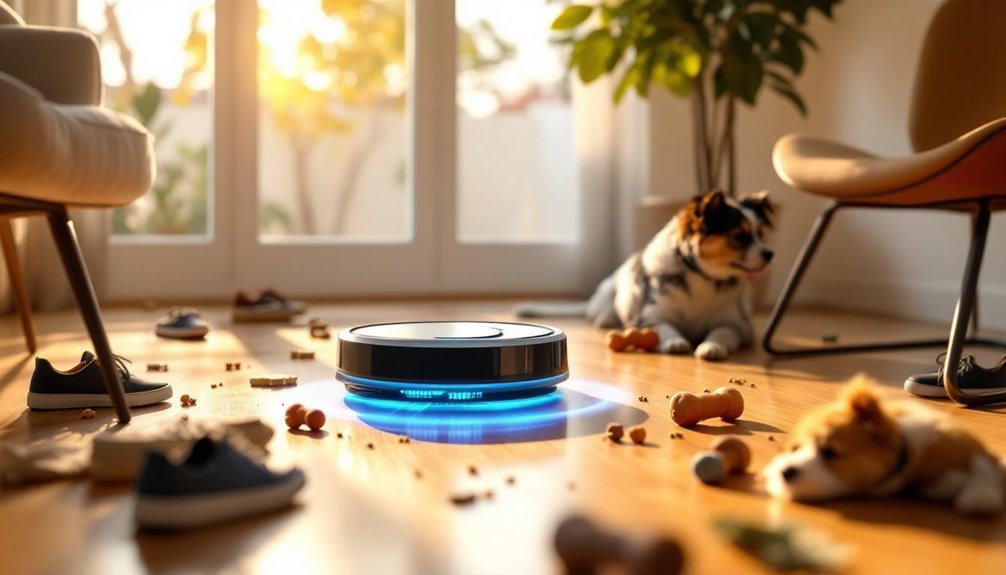
Picking the right robot vacuum comes down to a few key factors, and obstacle avoidance is just the starting point. You’ll also want to look at navigation accuracy, suction power levels, whether the unit mops, and how much the self-emptying base can hold before you need to deal with it. Getting these details right means the vacuum actually fits your home — not just a spec sheet.
Obstacle Detection Technology
Obstacle detection capability determines how effectively a robot vacuum navigates a real home environment. This section covers the sensor technologies used — LiDAR, cameras, structured-light, and ultrasonic — and explains the practical tradeoffs between detection range, object classification, and processing requirements.
LiDAR uses 360-degree laser scanning to map rooms with centimeter-level accuracy, operating independently of ambient light and supporting long-range path planning. Camera and AI systems add object recognition, enabling the vacuum to distinguish a charging cord from a shoe and select an appropriate response. Structured-light and ultrasonic sensors handle close-range detection and height estimation. Camera-based classification requires more processing power and degrades in low-light conditions. LiDAR performs consistently in darkness but provides no object identification. Effective navigation combines real-time sensing to halt the vacuum at obstacles with persistent mapping to prevent repeated path errors.
Navigation and Mapping Accuracy
Mapping accuracy determines how reliably a robot vacuum covers a space without missing sections or making redundant passes. LiDAR-based 360° scanning achieves centimeter-level precision, enabling consistent room segmentation and repeatable cleaning paths. Combining LiDAR with RGB or structured-light sensors adds object classification, allowing the robot to distinguish a charging cord from a chair leg and reduce unnecessary stops. Map refresh frequency affects performance in changing environments — robots that update maps regularly navigate cluttered rooms more accurately than those operating from outdated data. Multi-floor homes require per-floor map storage, and no-go zones and virtual walls depend on underlying map accuracy to function reliably.
Suction Power Levels
Suction Power Levels
Suction power is measured in Pascals (Pa) or airflow watts (AW), with most robot vacuums ranging from a few hundred to 10,000 Pa. Higher ratings improve extraction of embedded dirt and pet hair from carpet fibers. For mixed-floor homes, adjustable suction modes are more useful than peak power figures alone. A robot that drops to a lower setting on hardwood extends battery runtime, then increases suction automatically on carpet through boost sensing. Strong suction draws more battery power and raises operating noise. Effective edge cleaning also depends on side brush design and anti-tangle roller construction, not suction alone.
Mopping Capabilities
Mopping performance depends on hardware design, water control, mop-lift clearance, and dock maintenance features.
Spin mops rotating at several hundred RPM remove dried residue more effectively than a stationary dragged pad. Adjustable water flow lets the robot deliver appropriate moisture levels for hardwood versus tile, reducing the risk of surface damage. Tank capacity determines session length — a larger reservoir avoids mid-clean refills on bigger floor plans. An automatic mop-lift of 8–10mm keeps carpet dry when the robot transitions from hard floor. Dock-based mop washing with hot-air drying limits bacterial growth between runs. Removable, washable pads and selectable modes — spray, vibration, spin — improve results on stubborn spots.
Self-Emptying Base Capacity
Self-emptying base capacity determines how long a robot vacuum can operate without manual intervention. Most bases hold between 2.4 and 4 liters, supporting roughly 6–12 weeks between empties in an average household. Homes with shedding pets should expect that interval to shorten considerably, making a larger base a practical necessity rather than an optional upgrade. Match the base capacity to the robot’s onboard dustbin: a bin under 1.1 liters triggers frequent transfers regardless of base size. Sealed bags retain allergens more effectively but carry ongoing replacement costs, while bagless containers eliminate that expense but require periodic cleaning. Factor both into the total cost of ownership.
Battery Life and Runtime
Battery life determines both runtime and navigation reliability in robot vacuums with obstacle avoidance. A robot operating on depleted charge may misidentify or bypass obstacles, reducing cleaning accuracy. Target runtimes between 90 and 210 minutes based on floor area.
Max suction and mopping modes can reduce runtime by up to 50 percent compared to quiet mode, which is what most manufacturers use for their listed figures. Lithium-ion batteries maintain consistent power output across a full session, unlike lower-grade alternatives that degrade mid-cycle.
In homes exceeding 1,500 square feet, recharge-and-resume functionality prevents incomplete coverage by allowing the robot to return to its last mapped position after recharging.
Smart Home Compatibility
Smart home compatibility depends on three criteria: platform support, network requirements, and data handling.
Platform and Voice Assistant Support
Platform support determines whether a robot vacuum integrates with Alexa, Google Assistant, or HomeKit. Not all brands support all three, so confirming compatibility before purchase avoids a dead-end setup. Platform support also affects whether other smart home devices — a door sensor, a presence detector — can trigger cleaning jobs automatically. That kind of conditional automation requires the vacuum to appear as a controllable device within the same ecosystem, not just a standalone app.
Wi-Fi Band Requirements
Most robot vacuums require a 2.4 GHz network and will not connect to 5 GHz-only routers. Dual-band routers broadcasting both frequencies on the same SSID can also cause connection failures during setup. Confirming the vacuum’s band requirement against the router’s configuration prevents pairing problems. App features — map management, scheduling, and no-go zones — depend on a stable connection, so network compatibility is a functional requirement, not a minor detail.
Data Storage and Privacy
Some models upload floor maps and camera footage to cloud servers with limited user-controlled encryption settings. Reviewing the privacy policy before purchase identifies where data is stored, how long it is retained, and whether it can be deleted. Models that offer local storage or on-device processing reduce third-party data exposure for users who consider floor plan privacy a priority.
Floor Type Versatility
Floor type versatility is a key performance criterion for robot vacuums used in homes with mixed surfaces, determining how well the unit adapts suction, brush speed, and mop behavior across different materials.
Hard floors require controlled water output and measured navigation to prevent over-wetting or surface scuffing. Low- to medium-pile carpet demands higher suction and precise edge detection to keep the mop pad clear of fibers. High-pile rugs require height-change sensing that triggers automatic mop module lift rather than allowing the pad to drag through the pile. Wheel-climb rating, measured in millimeters, determines whether the robot clears standard door sills or stalls at the threshold.
Frequently Asked Questions
Can Robot Vacuums With Obstacle Avoidance Work Effectively in Complete Darkness?
Most modern robot vacuums with obstacle avoidance can work effectively in complete darkness. They rely on LiDAR, infrared sensors, and structured light technology rather than visible light to navigate and detect obstacles. The Shark Matrix Clean, for example, uses 360° LiDAR scanning that operates independently of ambient light, allowing it to navigate and detect obstacles reliably regardless of lighting conditions.
How Do Obstacle Avoidance Sensors Perform When Detecting Transparent or Glass Objects?
Obstacle avoidance sensors typically fail to detect transparent or glass objects because these surfaces do not reflect infrared or laser signals reliably. Robot vacuums, such as those using structured light sensors, are more prone to missing glass furniture legs or sliding doors than models equipped with 3D time-of-flight technology. Placing physical barriers or border strips around glass objects remains the most reliable workaround for this limitation.
Are Robot Vacuums With Obstacle Avoidance Safe Around Small Pets and Children?
Robot vacuums with obstacle avoidance are generally safe around small pets and children, though supervision during initial runs is recommended. AI-vision models like the eufy E25 detect and steer clear of small pets and children using a camera trained to recognize 200+ household objects. Small toys or loose clothing left on the floor can still confuse sensors, so keeping the area clear helps the system perform reliably.
Do Obstacle Avoidance Robot Vacuums Require Internet Connectivity to Function Properly?
Most obstacle avoidance robot vacuums function without internet connectivity, handling navigation and obstacle detection entirely on-device. Internet access is required for app-based controls, firmware updates, and smart home integrations. The Roborock Q10 S5+, for example, can still clean autonomously offline, but its full feature set — map management, no-go zones, scheduling — depends on a connected app.
How Often Do Obstacle Avoidance Cameras and Sensors Need Professional Cleaning or Maintenance?
Obstacle avoidance cameras and sensors typically require light maintenance roughly once a year. Monthly self-cleaning with a dry microfiber cloth keeps LiDAR domes and camera lenses functioning between checks. Persistent navigation errors, repeated missed obstacles, or visible lens damage are signs that a deeper clean or manufacturer support is needed sooner.
Conclusion
The eufy E25 leads this roundup with 20,000 Pa suction and an AI.See RGB camera trained on 200+ household objects — the only pick in this lineup with a quantified third-party obstacle-avoidance lab score (21 of 24 obstacles avoided in Vacuum Wars testing, four points above the category average). For buyers prioritizing AI-vision obstacle detection at a lower price point, the Dreame L10s Ultra pairs an RGB camera with 3D structured light and was the only mid-tier pick to clear Modern Castle’s full 9-object obstacle test.
Watch the full ranked video breakdown on the ProGadgetPicks YouTube channel for a side-by-side comparison of all five products.
For your next purchase decision, read our [Best Robot Vacuums for Pet Hair on ProGadgetPicks.com](https://www.progadgetpicks.com/best-robot-vacuums-pet-hair).

Michael Haralson spent 15 years at Nokia Mobile Phones across six progressive global roles covering product marketing, sales operations, corporate strategy, and business development in Europe, China, and Asia Pacific. He evaluated hundreds of technology products and partnerships, managed roadmap sessions with operators including Vodafone, AT&T, and China Mobile, and launched 50+ products internationally. After Nokia Mobile Phones, he founded JetSpark Robotics with IBM Watson and Intel partnerships.
He currently writes on AI simulation, multi-sensor fusion, and synthetic data for a defense technology company. His 30+ published technical articles cover the same sensor architectures (LiDAR, RADAR, cameras, infrared) found inside the smart home products he evaluates. He holds four IBM AI certifications.
His approach: technology changes fast, so he takes a snapshot of what’s currently available in each product category, evaluates the set against real use cases, and picks the ones worth your money for the next two years. Because smart home products are multi-year investments that need to work with the rest of your home, he pays particular attention to interoperability — whether a product plays well with the other technology already in your house. He holds four IBM AI certifications and founded a robotics startup with IBM Watson and Intel partnerships.