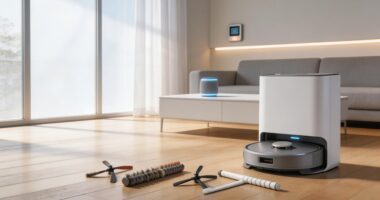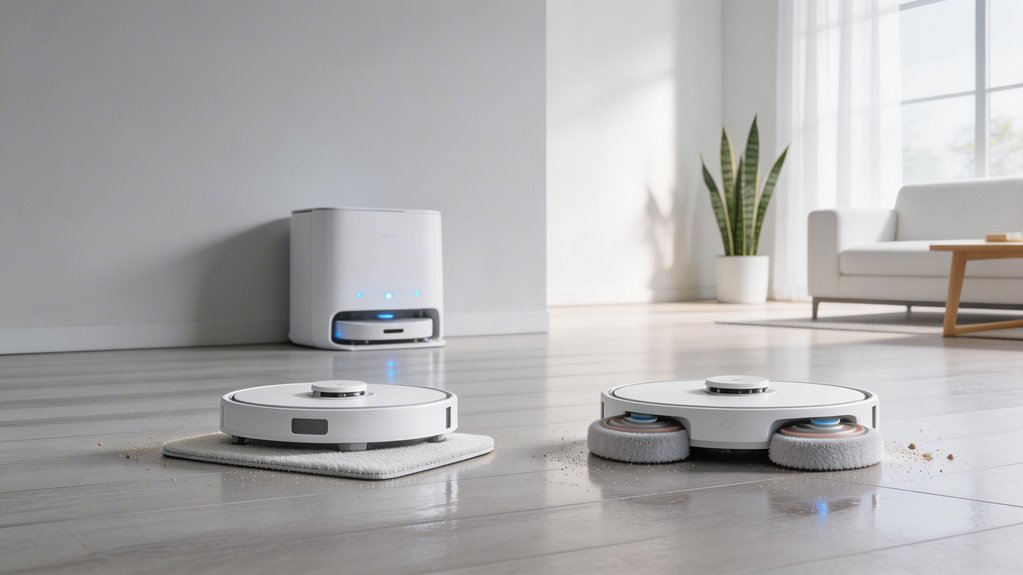
Vibrating pads oscillate 100-200 times per second to loosen dust and light spills quietly, but they struggle with dried-on messes and can redeposit dirt since the same surface stays wet throughout. Rotating discs spin opposite directions up to 260 RPM, generating friction that tackles tougher residue more effectively. Both systems rely on precise water delivery—too much spreads dissolved dirt, too little leaves streaks—and neither reaches corners or stairs, though each excels at different maintenance levels depending on your floor’s actual condition.
Key Points
- Vibrating pads oscillate 100-200 times per second to loosen dust and light spills without spinning brush noise or power consumption.
- Counter-rotating discs spin oppositely at up to 260 RPM, generating friction that scrubs dried-on residue more effectively than vibration alone.
- Vibrating pads excel at daily maintenance on smooth tile but struggle with textured grout and sticky kitchen messes requiring manual intervention.
- Rotating discs combine 6-12N downward pressure with spin to break down soil, while continuous self-cleaning prevents fiber saturation between rooms.
- Electronic water control systems deliver precise water pulses to prevent oversaturation and streaking, adjustable via apps for sealed floor types.
How Vibrating Mop Pads Work in Robot Mops on Hard Floors
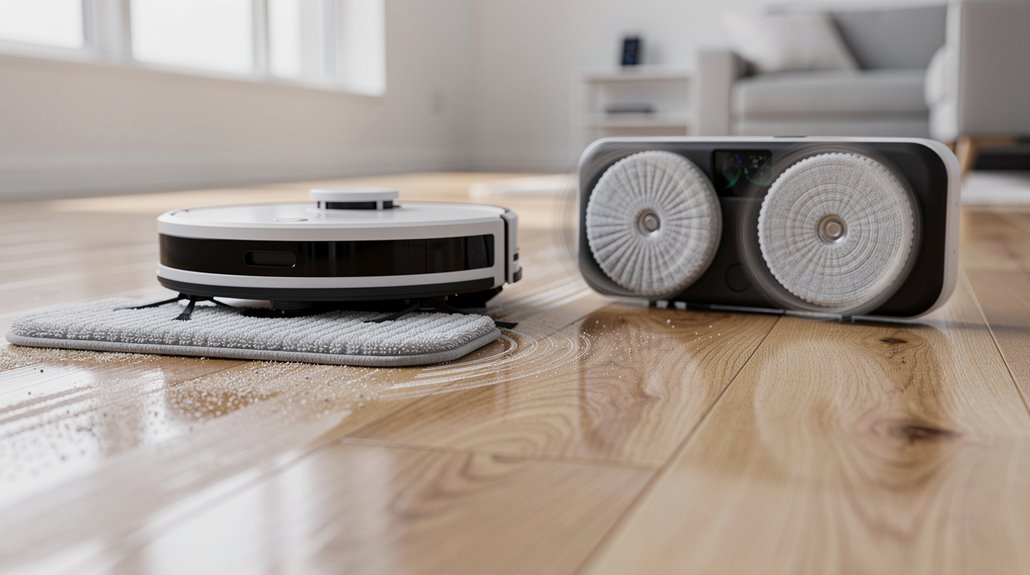
You’re fundamentally watching a mop pad vibrate at a controlled frequency—usually somewhere between 100 and 200 times per second—which creates enough agitation to loosen dust and light spills without the noise and power drain of spinning brushes.
The scrubbing force you’re getting per pass depends on how wet the pad is and how much downward pressure the robot applies, so a damp pad on a smooth tile floor does decent maintenance work, but that same pad struggles on textured grout lines where you’d need more mechanical force. Unlike tracked mop systems, vibrating pads use the same pad surface throughout the entire cleaning cycle, which allows dirt and residue to accumulate over time and potentially get redeposited across your floors. Vibrating systems also leave small uncleaned triangles in corners where rectangular mop heads cannot reach.
Vibrating pads work best on hard, even surfaces like sealed tile and laminate; they’re basically insufficient for kitchen messes or anything dried on, which is why you’ll end up mopping by hand in those spots anyway.
How oscillation frequency translates to scrubbing force per pass
Robot mops generate scrubbing force through vibration frequency rather than downward pressure, which means the speed of oscillation—not how hard the pad pushes down—determines how effectively dirt gets dislodged per pass.
At 4000 vibrations per minute, you’re getting more contact points working the surface. Higher frequency creates cumulative agitation. The microfibre pad material used in most robot vacuums maximizes this agitation effect by increasing surface contact with floor debris. VibraRise® 4.0 technology achieves dual sonic vibrating zones operating simultaneously to intensify the cleaning effect across a larger surface area.
Still, one pass rarely handles sticky residues or ground-in particles effectively.
What surface types vibrating pad mops clean effectively
Vibrating mop pads excel at light daily maintenance on hard floors—tile, laminate, and wood—but they’re not built for the messier corners of your kitchen. Your robot mop handles routine upkeep well. Sticky spills and ground-in grime? They’ll frustrate you. Vibration alone lacks the downward force wet messes demand. The Roborock S7’s oscillating vibration is effective at stain removal on hard surfaces, but picking up stains means those marks remain on the pad and can spread across your home unless you change pads between runs. Many vibrating pad models include automatic detergent dispensers at their base stations, which compensates for the limited mechanical action by increasing the chemical cleaning factor according to Sinner’s Circle principles.
| Floor Type | Best For | Avoid |
|---|---|---|
| Tile | Daily dust, dried splatters | Wet sticky residue |
| Laminate | Light maintenance | Heavy moisture buildup |
| Wood | Routine cleaning | Stubborn stains |
How Rotating Disc Mop Systems Work in Robot Mops
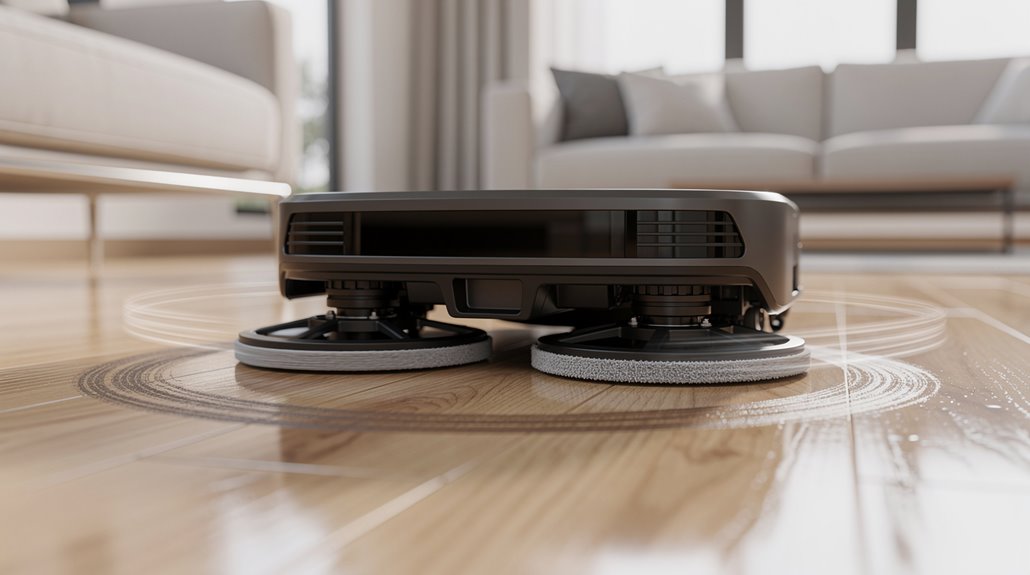
When you’re looking at rotating disc systems, you’re dealing with counter-rotating discs that spin in opposite directions against sealed hard floors, which generates serious friction across the contact area. This dual-motion approach beats vibrating pads when you’ve got dried-on mess because the spinning action actively scrubs rather than just tremoring at the surface. The trade-off is that you get less total mop surface area touching the floor compared to dual spinning pads, so you’re covering ground with more concentrated pressure instead of broader contact. Higher-end rotating disc models include dirty-water extraction systems that prevent the saturation and smearing issues common with static and spinning flat pads.
How counter-rotating discs generate friction on sealed hard floors
Counter-rotating discs work by spinning in opposite directions to generate the scrubbing friction that actually lifts dirt off sealed hard floors.
Your counter-rotating mop discs create this friction through high-speed rotation, typically reaching up to 260 RPM. The opposing spin prevents smearing; instead, dirt suspends in water for extraction.
Downward pressure between 6N and 12N combines with rotation to break down soil effectively. Unlike traditional flat mop pads that become saturated and redistribute grime across floors, rotating disc systems maintain continuous self-cleaning through wringing, which keeps the mop fibers cleaner and prevents performance degradation between rooms.
Why rotating discs outperform vibrating pads on dried-on residue
The counter-rotating discs you read about earlier handle fresh spills well, but they hit a wall with dried-on mess.
Your rotating disc robot mop tackles that problem through sheer mechanical action. The discs’ rotational scrubbing breaks down stubborn residue where vibration falls short. Combined with downward force and continuous agitation, they maintain cleaning power despite limited contact time on tough, baked-on grime.
How Water Delivery Systems Work in Robot Mops
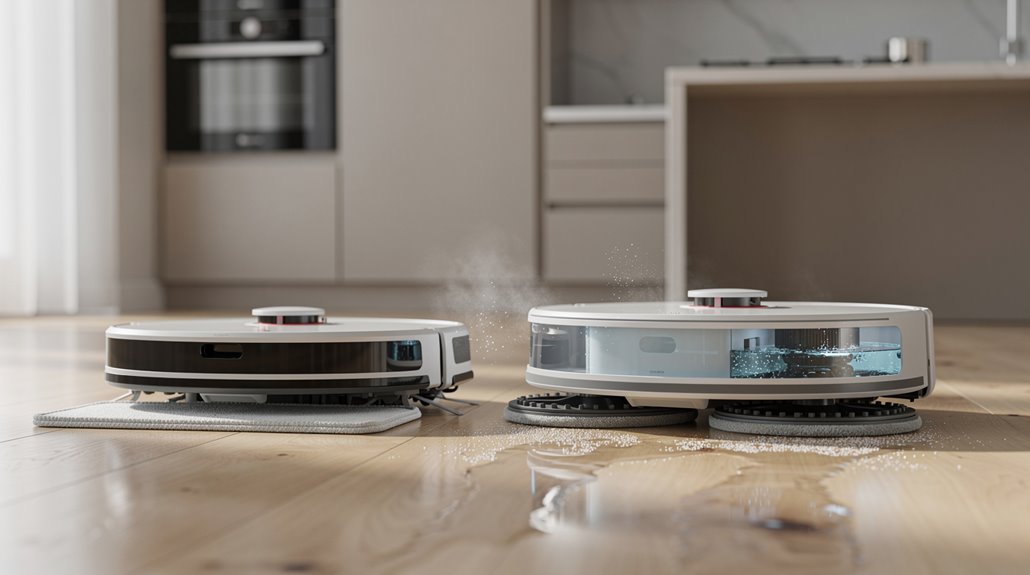
You’ll find robot mops use either gravity-fed systems that drip water continuously onto the mop pad, or electronically controlled valves that release water in precise pulses timed to the mopping motion.
The amount of water you apply per square meter matters more than you’d expect—too little and you get streaky, uneven coverage, but too much and the pad becomes oversaturated, leaving your floors wet and slick.
Getting this balance right depends on your water delivery method, your home’s floor type, and whether the mop’s sensors can actually adjust flow in real time or just run at one fixed rate. Some advanced systems integrate automatic water exchange modules that connect to your home’s water source and drainage, eliminating manual water refilling and dirty water tank emptying during mopping cycles. Next-generation systems like WaterRecycle™ take this further by purifying wastewater through distillation and harvesting water from the air, enabling truly autonomous operation without plumbing connections.
Gravity-fed vs electronically controlled water flow mechanisms
Water’s gotta get from the tank to the mop pad somehow, and robot mop makers’ve settled on two basic approaches: gravity doing the work for free, or electronics handling it with precision.
Gravity-fed systems drip water passively, keeping costs down but offering no control. You get uneven wetting. Electronic systems use pumps and app adjustments for consistent moisture across different floor types. Models equipped with electronic water tanks offer multiple flow levels that can be fine-tuned through companion apps to match specific floor types and cleaning preferences. Flat mop systems typically rely on gravity-fed mechanisms, which is why they struggle with uneven moisture control on larger floor areas.
How water volume per square metre affects streak patterns
Balancing water volume per square meter is where robot mops either clean your floors or just push dirty water around.
Too much water saturates pads, spreading dissolved dirt instead of removing it.
Too little leaves residue streaks behind.
Your robot mop’s sealed floors need precise dosing.
Peristaltic pumps deliver controlled amounts, preventing both oversaturation and dry mopping problems.
How Robot Mop Navigation Differs from Robot Vacuum Cleaning Paths
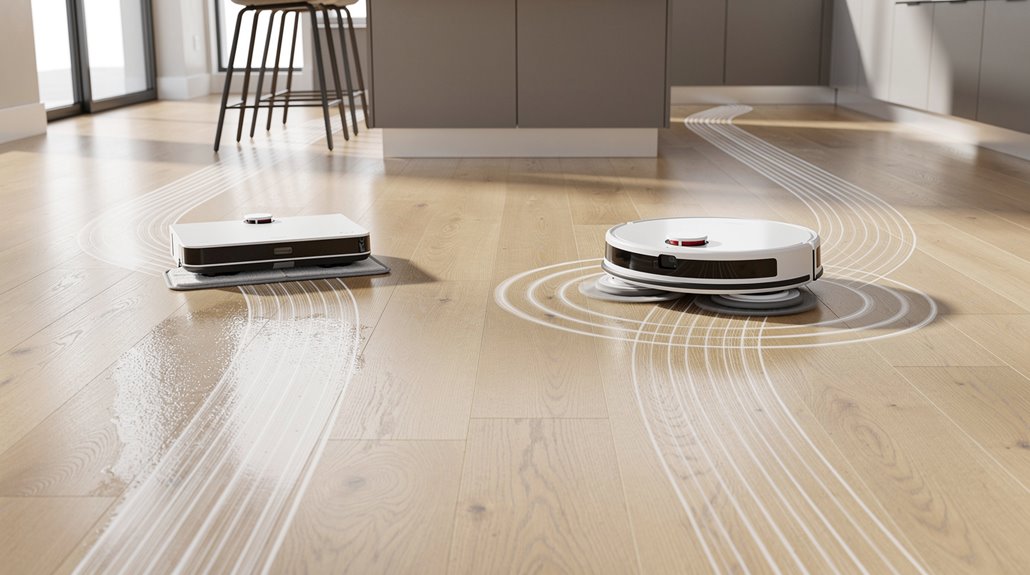
Mapping your home works fundamentally differently for robot mops than it does for vacuums, and that difference shapes how efficiently each machine cleans. Mops need to detect wet floors and adjust water dispensing, while vacuums optimize suction paths. You’ll notice mops incorporate floor-type sensors that vacuums skip entirely. Like mapping vacuums that can achieve nearly 100% floor coverage, robot mops use their advanced sensors to ensure systematic coverage while accounting for moisture and surface type. Mops are also designed to avoid carpets and rugs entirely, since water and wet cleaning solutions can damage these surfaces and create safety hazards.
| Feature | Robot Vacuum | Robot Mop |
|---|---|---|
| Primary mapping tool | LIDAR for obstacles | LIDAR + floor detection |
| Path adjustment | Route optimization | Water volume + carpet avoidance |
| Navigation focus | Complete coverage | Wet-floor sequencing |
What Robot Mops Cannot Clean Regardless of Mop System Type
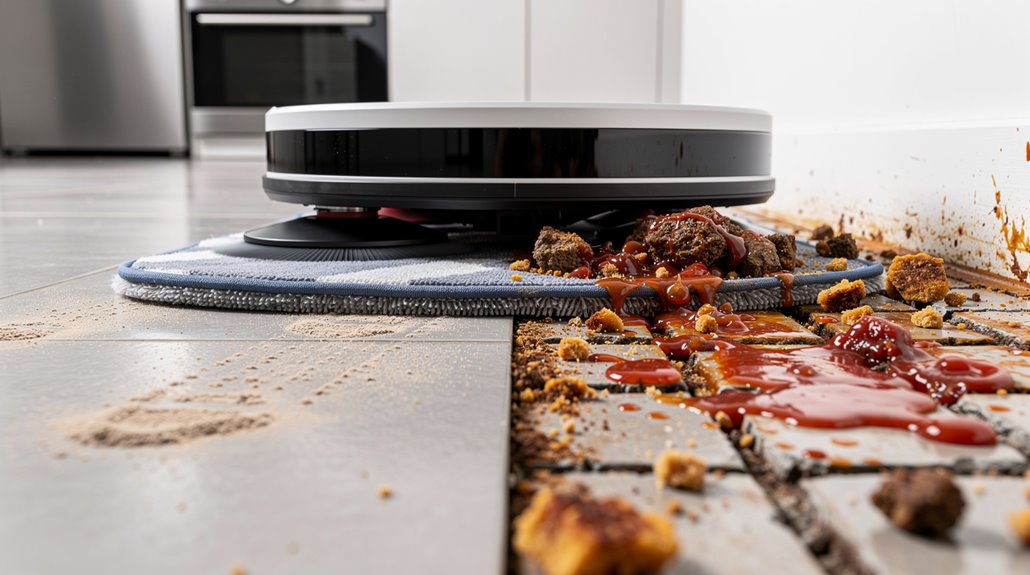
While robot mops handle routine floor cleaning efficiently, they’ve got hard boundaries you’ll run into pretty quickly. Your vibrating mop pad robot can’t climb stairs or squeeze into tight spaces. Wet floors, raised surfaces, and vertical areas stay off-limits. Improper cleaning solutions damage the system. These aren’t design flaws—they’re physical constraints built into how mopping robots operate. Using unapproved cleaning products can cause sensor errors and flow restrictions that compromise performance over time. Robot mops also cannot reach cabinets, bay windows, or desks, leaving those areas requiring manual attention.
Frequently Asked Questions
How Often Should I Replace the Mop Pads or Discs for Optimal Cleaning Performance?
You should replace your mop pads every 2-3 months for standard usage. However, you’ll need more frequent replacements if you’ve got pets or clean often. Check your manufacturer’s app for replacement notifications.
Are Robot Mops Safe to Use on Hardwood Floors and Natural Stone Surfaces?
You’re absolutely safe—robot mops won’t obliterate your hardwood or stone if you’ve got the right model. Choose soft rubber brushes, low water flow, and mop-lifting features to protect your precious surfaces from catastrophic damage.
Can Robot Mops Effectively Clean Grout Lines Between Tiles?
You’ll find robot mops can’t deeply clean grout lines effectively. They remove surface dirt, preventing buildup, but you’ll need manual intervention for stubborn, entrenched grime. Oscillating pads help somewhat, though they won’t match deep cleaning results.
What’s the Average Battery Life and Runtime for Most Robot Mops?
You’d think robot mops run forever, but they don’t. You’ll get 90-250 minutes per charge, though you’ll actually see 60-75% of that advertised time. Battery lifespan? You’re looking at 1.5-5 years typically.
Do Robot Mops Work on Dark Floors Without Getting Stuck or Disoriented?
You’ll find modern robot mops handle dark floors effectively thanks to LiDAR sensors and dToF technology that don’t rely on ambient light. However, older models with basic cliff sensors may struggle, misreading dark surfaces as edges.
Conclusion
You’ve got two mop systems doing the same job differently—one vibrates, one spins—but they’re both playing catch-up to a vacuum’s efficiency. Think of them as the slower, wetter cousin of robot vacuums. They handle basic daily grime on hard floors, but stairs, carpets, and thick messes will stop them cold. Pick one based on your floor layout, not marketing claims.