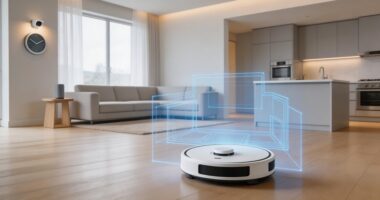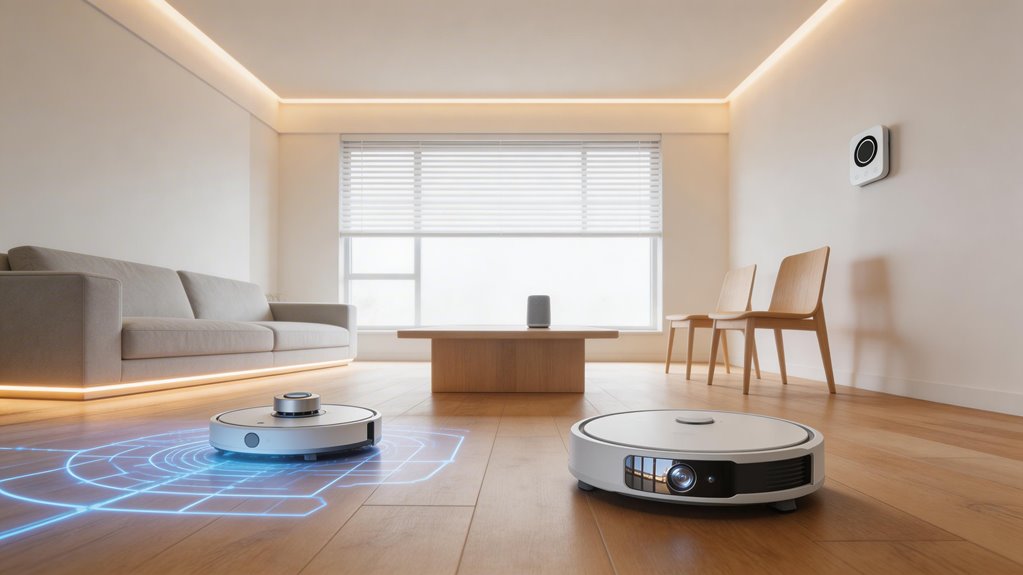

LiDAR-equipped vacuums map your home faster and handle furniture shifts more reliably than camera models, especially in low light and on carpet where pet hair collects. You’ll see straighter cleaning patterns and fewer missed spots. The trade-off: LiDAR struggles with reflective floors and glass, while cameras cost less but need more passes to update maps after rearrangement. Understanding where each system actually falters helps you match the technology to your home’s specific layout.
Key Points
- LiDAR maps homes faster with superior accuracy across all lighting conditions, while cameras struggle in low-light environments.
- LiDAR detects furniture shifts instantly and maintains 85%+ carpet cleaning accuracy; cameras drop to 62–74% on carpet.
- Cameras require longer processing times and multiple passes after rearrangements; LiDAR updates maps instantly upon changes.
- LiDAR fails on reflective and glass surfaces; hybrid LiDAR-camera systems mitigate these limitations effectively.
- LiDAR enables faster cleaning cycles with logical straight-line patterns; camera systems operate slower due to computational demands.
How LiDAR Sensors Map a Room in Robot Vacuums Using Laser Ranging
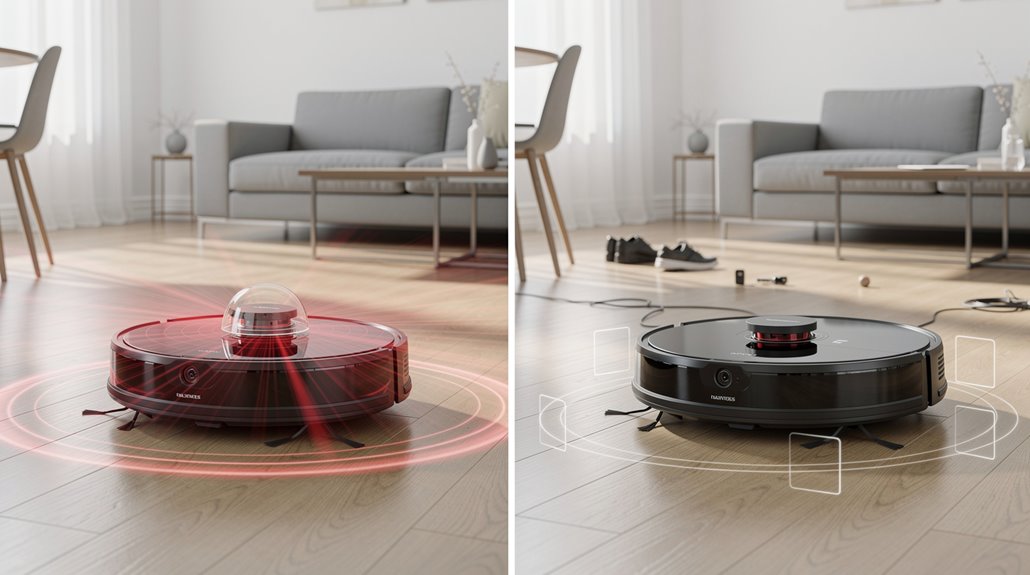
When you’re comparing single-layer and 3D LiDAR, you’re basically choosing between a flat scan versus a stacked map—single-layer gives you the basic floor plan, while 3D captures height data that catches obstacles at different levels.
Here’s where it gets tricky: reflective floors and glass are your LiDAR’s worst enemy because laser pulses pass right through or bounce unpredictably instead of returning clean distance readings. LiDAR systems maintain accurate mapping performance in dark or low-light areas where camera-based navigation would fail.
You’ll notice most robot vacuums handle this by pairing LiDAR with cameras or bumper sensors, since neither tech alone solves the reflective surface problem reliably. The combination of LiDAR and AI object recognition enables systematic paths and object-specific responses that improve overall cleaning performance in complex home environments.
The difference between single-layer and 3D LiDAR in floor robots
Because robot vacuums need to know where they’re going, the type of LiDAR sensor matters more than you’d think.
Single-layer LiDAR handles 2D floor plans fine for flat homes. 3D LiDAR captures height data too, mapping multi-floor layouts and uneven terrain better. This advanced mapping ensures better coverage and more ground covered with an accurate map.
You’ll also find 3D systems use embedded mini-sensors, letting robots slip under furniture more easily than top-mounted single-layer designs. Rapid multi-directional pulses from 3D LiDAR enable faster mapping updates and more precise obstacle detection compared to single-layer alternatives.
How LiDAR handles reflective floors and glass obstacles
Reflective and transparent surfaces don’t play well with laser pulses. Your lidar sensor robot vacuum struggles with high-gloss floors because they scatter light instead of reflecting it back, creating false obstacles or mapping gaps. Glass proves even trickier—it’s basically invisible to lidar. You’ll want a hybrid setup with cameras if your home has lots of shiny tiles or glass furniture. Modern vacuums often include algorithms to mitigate issues with reflective or absorptive surfaces. LiDAR and camera-based systems work best when combined to handle the limitations each technology faces with reflective and transparent obstacles.
How Camera Navigation Processes Visual Data in Robot Vacuums via vSLAM
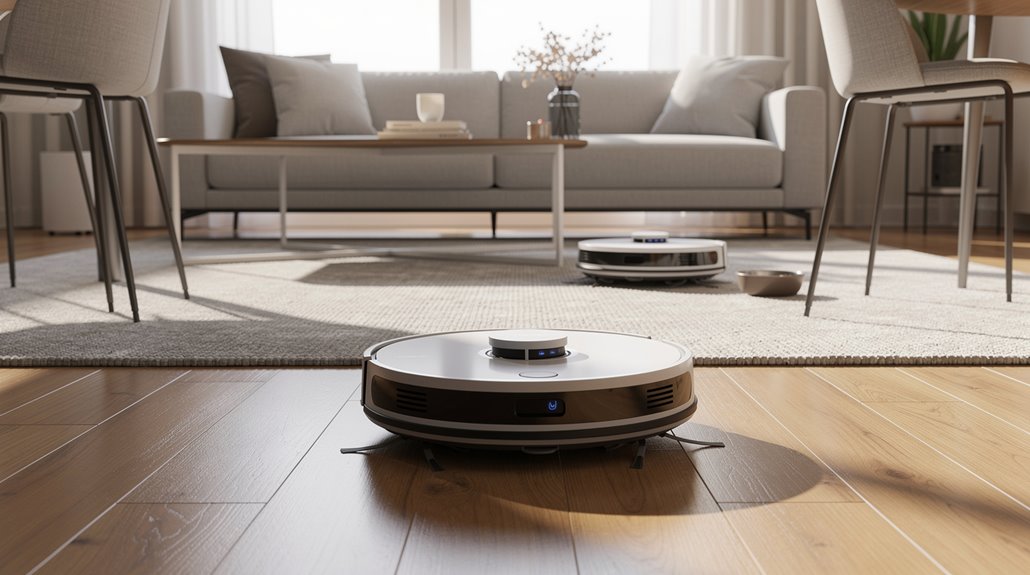
When your robot vacuum uses vSLAM, it spots and remembers specific visual landmarks—corners of furniture, door frames, textured walls—by tracking how these features shift across camera frames as the vacuum moves through your space.
Your vacuum then uses these stored landmarks to figure out where it’s and build a mental map of your home.
The problem is that camera navigation falls apart in rooms with blank walls, low lighting, or minimal contrast, since the system has fewer distinguishable features to lock onto and track. To maintain accuracy, the camera requires optical calibration to minimize geometric distortions that could degrade performance. This computational demand means vSLAM-equipped vacuums operate at slower speeds compared to their LiDAR counterparts.
How vSLAM identifies and stores room landmark features
Your robot vacuum’s camera captures the world upside down, pointing at your ceiling rather than your floor, and this matters because it’s looking for landmarks that don’t move.
Using vSLAM technology, it identifies stable reference points and stores them as a mental map.
- Extracts keypoints from corners and edges
- Filters out transient elements like moving pets
- Compresses feature data for onboard memory
- Updates the map incrementally as it cleans
The algorithms powering these visual systems have improved significantly over time, enabling the robot to add features like virtual boundaries that weren’t possible with earlier camera-based navigation methods.
Why camera navigation degrades without sufficient visual contrast
Now that you know how your vacuum’s camera builds a mental map from ceiling landmarks, there’s a harder truth: that map only works when the camera can actually see what it’s looking at.
Dark carpets, black cables on dark floors, and low-contrast surfaces render your visual navigation robot vacuum nearly blind. The camera can’t detect obstacles it can’t distinguish from their surroundings. Reflective surfaces and patterned rugs can further reduce accuracy by creating visual confusion that disrupts the vSLAM triangulation process. In dim lighting conditions, camera accuracy can decrease by up to 40% in low light, making navigation errors more likely in nighttime or poorly-lit rooms.
How LiDAR and Camera Navigation Compare on First-Run Mapping Efficiency
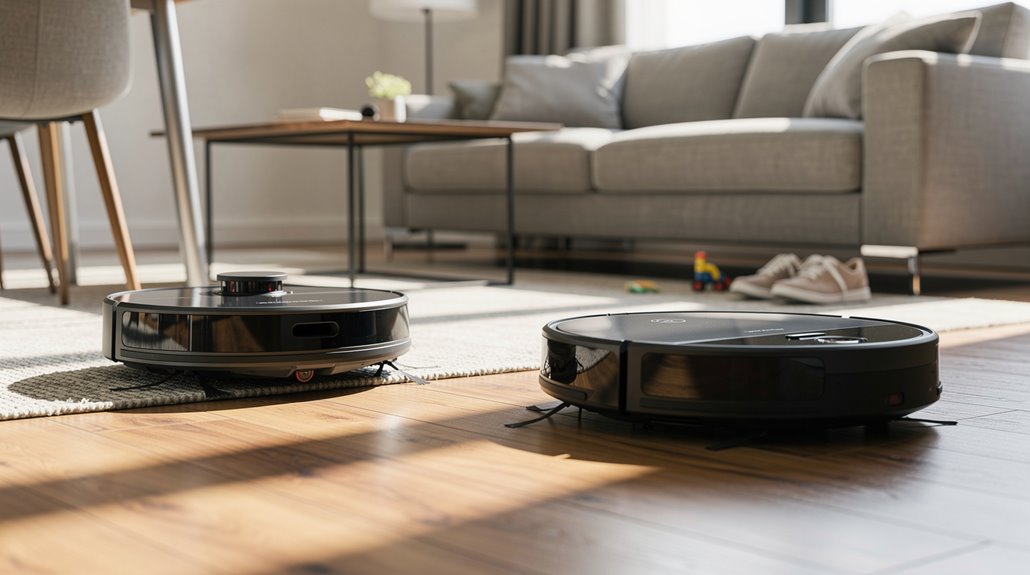
The first time your robot vacuum maps your home matters more than you’d think, because that initial run shapes how efficiently it’ll clean for months to come.
Your robot vacuum’s first mapping run shapes its cleaning efficiency for months to come.
LiDAR finishes mapping in a single pass with precise 3D data. Camera-based systems take longer and generate simpler 2D images. LiDAR‘s laser pulses bounce back to calculate exact distances, enabling faster and more accurate initial mapping compared to visual processing methods.
- LiDAR completes initial mapping after one run
- vSLAM processes visual data more slowly overall
- LiDAR works reliably in darkness; cameras struggle
- vSLAM estimates distances indirectly from visual features
Your first-run mapping efficiency depends heavily on which technology your vacuum uses.
How Each Navigation System Handles Floor Map Updates After Furniture Changes
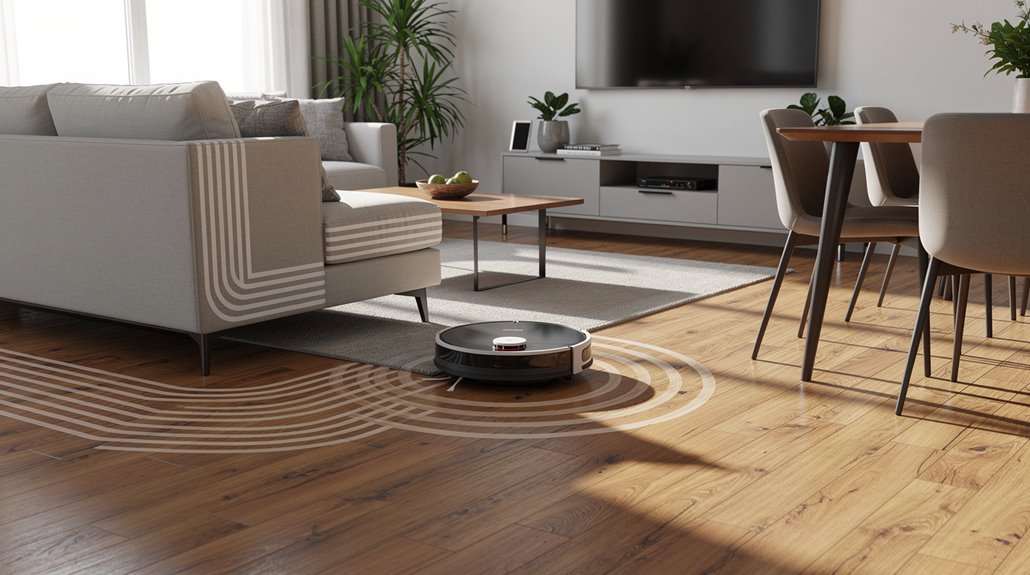
When you move furniture around, your robot vacuum’s navigation system has to figure out what changed and adjust its cleaning path accordingly.
LiDAR rescans your space fast with laser pulses, catching obstacles instantly in any light.
Cameras struggle here—they need good lighting and often require multiple passes. LiDAR continuously generates point-cloud datasets that map your home’s layout in real-time, enabling the vacuum to detect even subtle furniture shifts without waiting for optimal lighting conditions.
In the lidar vs camera robot vacuum debate, LiDAR wins at handling rearrangements efficiently.
Which Navigation Type Performs Better for Pet Hair Coverage on Carpet
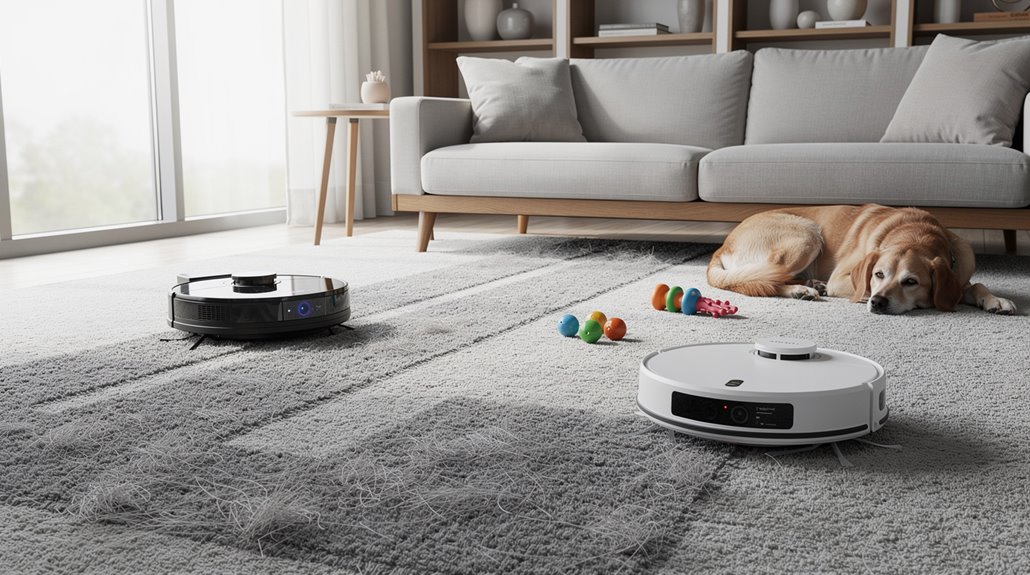
Pet hair on carpet reveals the biggest gap between LiDAR and camera navigation—one system sees the mess coming, the other doesn’t. Your robot vacuum navigation comparison matters here. LiDAR maps carpet-level obstacles with precision, while cameras struggle with depth perception and low light. You’ll notice faster cleaning cycles and fewer missed hotspots with laser-based systems.
- LiDAR completes initial mapping in one cycle versus two or three for cameras
- Laser systems maintain detection accuracy in dark rooms where pet hair accumulates
- Camera-based robots misjudge distances on carpet, dropping to 62-74% accuracy
- LiDAR enables logical straight-line patterns targeting pet hair concentrations
LiDAR vs Camera Robot Vacuum Price Difference and What Drives It
Because LiDAR and camera navigation rely on fundamentally different hardware, you’re looking at a real price gap between the two—and that gap traces back to what’s actually inside your robot vacuum.
LiDAR’s laser technology costs more to manufacture than mass-produced camera sensors. You’ll pay a premium for that superior robot vacuum mapping accuracy and reliability across all lighting conditions, though camera models remain the affordable alternative. Models equipped with advanced dual-sensor navigation systems can store multiple floor maps and provide detailed 3D representations of your home, which contributes to their higher price point.
Frequently Asked Questions
Do Lidar Robot Vacuums Work in Complete Darkness Without Any Light?
Yes, your LiDAR robot vacuum works flawlessly in complete darkness. It generates its own laser pulses to map rooms and detect obstacles, so you don’t need any ambient light for reliable navigation and cleaning performance.
Can Camera-Based Vacuums Navigate Safely Around Stairs and Drop-Offs?
You’re watching your vacuum glide confidently across your floor when it approaches a staircase’s edge. Yes, your camera-based vacuum navigates safely around stairs using cliff sensors that detect drop-offs, stopping instantly before danger.
Which Navigation System Uses More Battery Power During Operation?
You’ll find that LiDAR systems consume more battery power during operation due to their continuous laser emissions and rotating mechanical parts. However, you’ll recover that power through faster, more efficient cleaning cycles that reduce redundant paths by approximately 50%.
How Do Lidar Vacuums Perform in Homes With Reflective or Mirror Surfaces?
You’ll face significant challenges with LDS LiDAR in mirror-filled homes—your vacuum misinterprets reflective surfaces as empty spaces, causing navigation errors and collision risks. dToF models handle reflectivity better, though you may need adjustments.
Are Camera-Based Vacuums Affected by Changing Lighting Conditions Throughout the Day?
Like Heraclitus observing that you can’t step in the same river twice, your camera vacuum struggles when daylight shifts. You’ll experience tracking loss as ambient light changes, while LiDAR operates unaffected by your home’s evolving brightness.
Conclusion
You’re looking at two solid approaches that each win in different spots. LiDAR maps faster on the first run and handles dark rooms without breaking a sweat. Cameras cost less upfront but need better lighting. Here’s the thing: 73% of robot vacuum owners never adjust their maps after the initial setup, so that mapping speed advantage matters more than you’d think. Pick LiDAR if you’ve got a complicated layout or low light. Camera works fine if your home’s straightforward and well-lit.