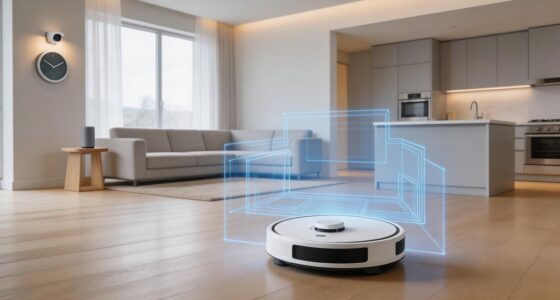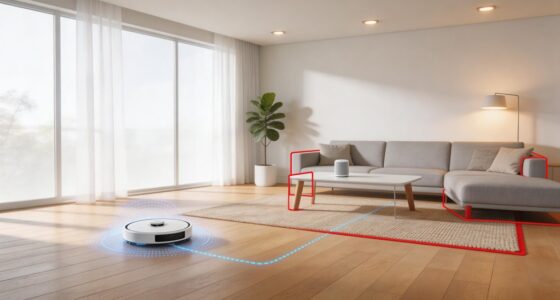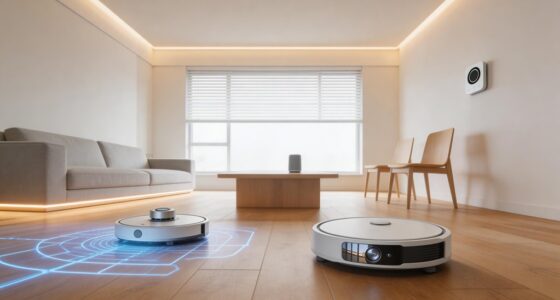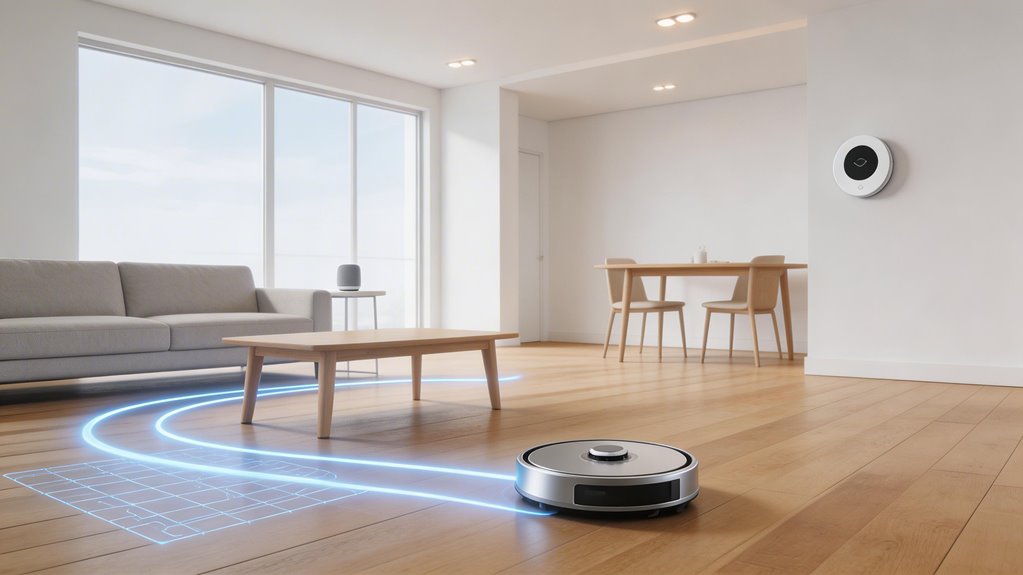

vSLAM lets your vacuum map your floor and figure out where it is using only a camera—no laser needed. It spots furniture edges, corners, and wall textures, then tracks those visual landmarks frame-to-frame to build a layout. The catch: it struggles in dim hallways, blank walls, and rooms with mirrors because it needs distinct features to latch onto. LiDAR-based vacuums handle poor lighting better and tend to plot straighter paths, though vSLAM costs less upfront. Understanding where each tech breaks down helps explain why some models nail certain homes while others stumble in yours.
Key Points
- vSLAM uses camera imagery to simultaneously map surroundings and pinpoint exact robot location from visual landmarks like furniture edges and corners.
- The system triangulates matched features across sequential frames to reconstruct 3D space, enabling navigation without active laser technology like LiDAR.
- vSLAM struggles in low-light conditions, featureless spaces, and reflective surfaces where distinctive visual landmarks are unavailable or unreliable.
- Hybrid systems combining vSLAM with LiDAR or other sensors overcome visual-only limitations and improve obstacle avoidance across varied environments.
- vSLAM adoption remains narrower than LiDAR-focused designs, though it’s becoming standard in premium robot vacuum lineups like iRobot Roomba.
What vSLAM Navigation Actually Does Inside a Robot Vacuum
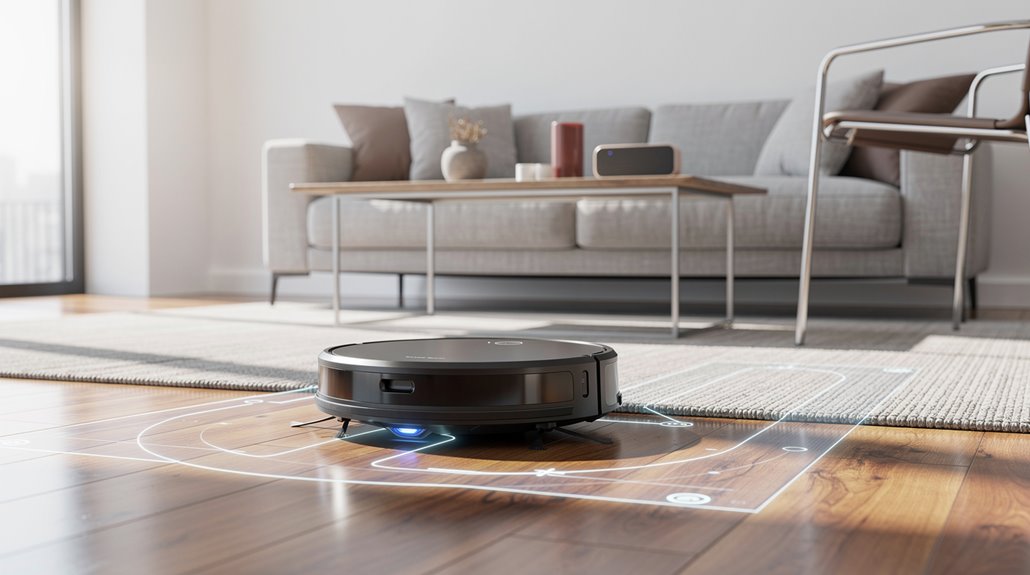
When your robot vacuum navigates a room without a human steering it, it’s not following a preset path or bouncing randomly off walls.
Your vSLAM robot vacuum simultaneously maps its surroundings and pinpoints its exact location. It captures images, detects furniture edges and corners, then calculates position through optical flow and feature matching.
This real-time processing lets it chart efficient routes and avoid obstacles autonomously. By identifying areas already cleaned through map creation, your robot minimizes redundant passes over the same spots and maximizes coverage efficiency. However, vSLAM performance can degrade significantly in poorly lit rooms, which is why some models include LED headlights to maintain navigation accuracy.
How vSLAM Builds a Floor Map Without a Laser Sensor
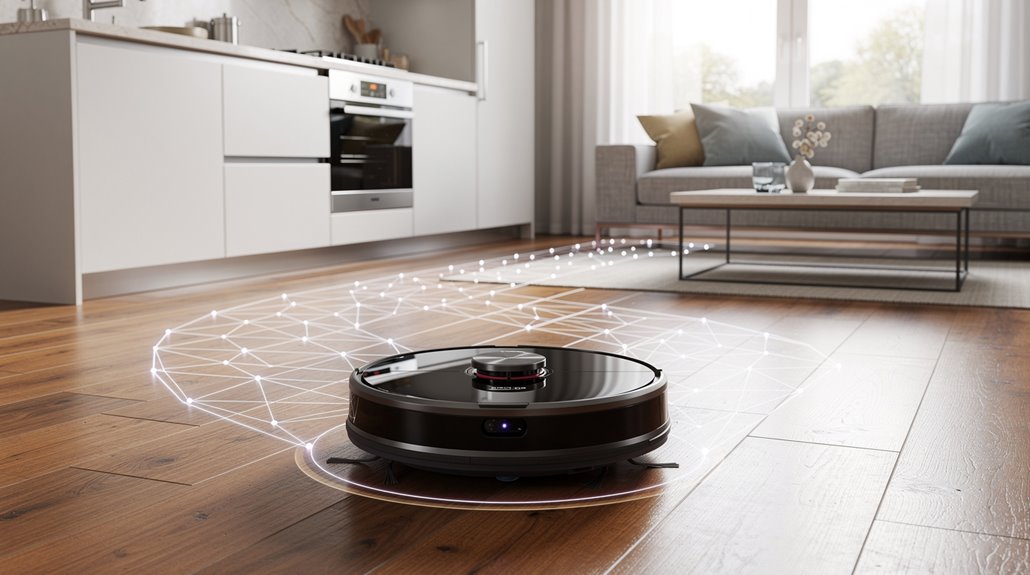
Without a laser to bounce off surfaces, your vacuum’s camera has to spot visual landmarks—corners of furniture, edges where walls meet floors, textured patterns on carpet—and lock onto those keypoints frame after frame.
As the camera moves, it watches how those same landmarks shift position between sequential images, then uses the pattern of that shift to figure out both where the camera moved and how far away each landmark actually is.
It’s basically reconstructing 3D space from 2D snapshots, which works fine in a well-lit living room but stumbles in hallways with blank white walls where there’s nothing distinctive to track. Advanced hybrid approaches that combine direct and indirect methods can maintain tracking even in texture-deprived environments by processing both pixel intensity values and detected features simultaneously. Since vSLAM maps update continuously as the device moves, the system enables real-time navigation adjustments and can adapt when furniture is repositioned or room layouts change.
What visual landmarks vSLAM uses to determine position
Your robot vacuum’s camera needs something to look at, and that’s where visual landmarks come in.
Corners, edges, and shapes give the system distinct reference points for visual landmark navigation.
Your vacuum triangulates these features across multiple frames to pinpoint its position. Feature-point triangulation across sequential camera frames allows the system to establish accurate 3D coordinates of environmental markers.
Furniture edges and ceiling angles work best because they create high contrast. This camera-based visual SLAM approach builds persistent maps of your home layout over time.
Blank walls, though, leave your robot fundamentally blind and confused.
How feature matching works between sequential camera frames
Feature matching is where your vacuum’s vSLAM system actually builds continuity between what it saw a moment ago and what it’s seeing now.
Your vacuum’s feature matching navigation works by:
- Matching keypoints from the current frame against your previous keyframe
- Using radius-based searches around projected map points for correspondences
- Applying outlier rejection to discard wrongly matched features
- Tracking features frame-to-frame for incremental motion estimation
This process keeps your vacuum oriented as it moves. The vacuum refines its pose estimate through motion-only bundle adjustment, which jointly optimizes the camera position and orientation by minimizing reprojection errors between observed 3-D map points and their corresponding 2-D image projections. These matched correspondences are then used in subsequent mapping stages to create local 3-D reconstructions through triangulation of matched features.
Where vSLAM Navigation Performs Well in Residential Environments
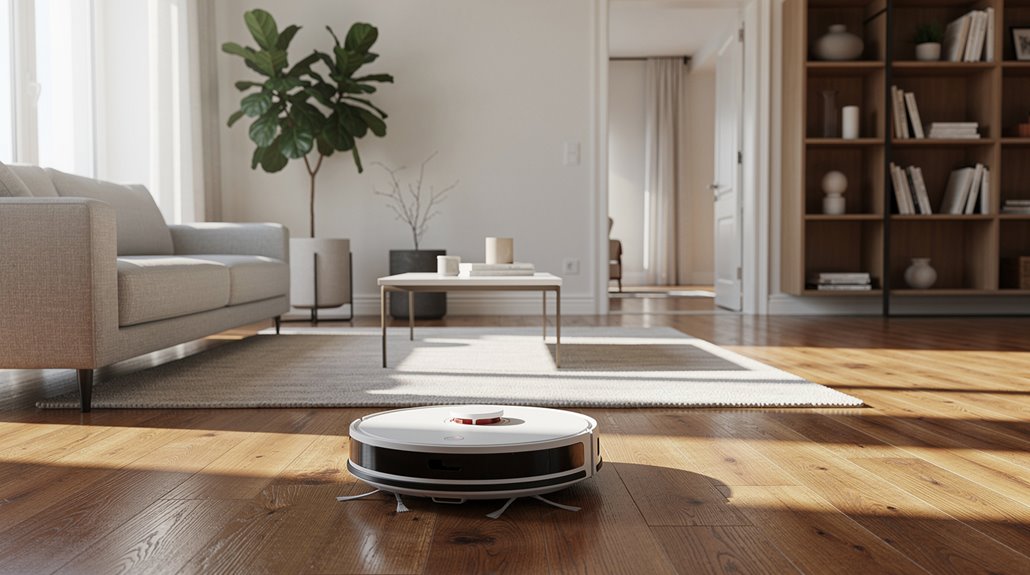
vSLAM navigation consistently performs well in homes where lighting is decent and the layout includes plenty of visual landmarks.
Your camera-based robot vacuum navigation thrives in furnished rooms where it identifies edges and corners for mapping.
It handles varied floors and layout changes smoothly.
Smaller spaces work particularly well since the lower profile lets it reach under furniture where taller robots can’t go. This design advantage enables access to areas that raised LiDAR pucks cannot reach, making vSLAM especially valuable in homes with low-clearance furniture. The iterative learning process allows vSLAM systems to update maps after each cleaning session, continuously improving navigation accuracy and efficiency over time.
Where vSLAM Navigation Loses Accuracy and What Causes It
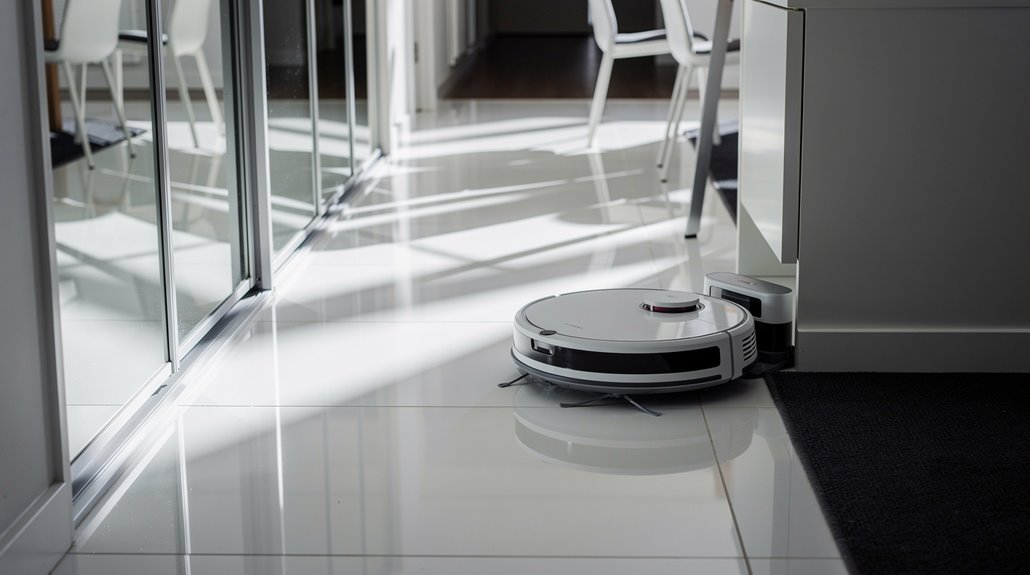
You’ll notice your robot’s accuracy drops fast in dim hallways and poorly lit corners because cameras need enough light to pick out visual landmarks—without them, the system can’t build a reliable map.
Reflective surfaces like mirrors and glass throw another wrench in things, since they either confuse the camera into seeing false features or disappear entirely from its view, leaving navigation gaps.
Featureless rooms with blank walls create the same problem: when there’s nothing distinctive for the camera to lock onto, your vacuum loses its sense of where it’s and starts wandering in illogical patterns. Even when vSLAM robots encounter moving people or drapes, they struggle to maintain accurate mapping because these inconsistent or occluded objects shift the visual landmarks the system depends on for localization. Hybrid mapping systems that combine multiple sensor types can reduce these errors by cross-referencing data sources when visual information alone proves unreliable.
How low-light conditions degrade camera-based positioning
Cameras lose their grip on the world when light disappears, and that’s where most robot vacuums’ visual positioning systems start to fail.
You’re dealing with visual slam navigation that relies entirely on what sensors can see.
Here’s what happens in the dark:
- Feature detectors like SIFT and SURF extract fewer identifiable points
- Keypoint algorithms struggle to create reliable map references
- Localization accuracy drops sharply even with image improvement
- Poor contrast makes descriptor matching between frames unreliable
Sensor fusion with auxiliary systems like LiDAR, ultrasonic, and infrared can compensate for these visual navigation failures and restore positioning accuracy when cameras alone cannot perform.
How reflective or featureless surfaces disrupt landmark detection
While low-light conditions throw a wrench into visual positioning by starving the system of detectable features, reflective and featureless surfaces create a different kind of problem—they either overwhelm the camera with false information or starve it of any useful information at all.
Mirrors bounce light unpredictably, creating phantom obstacles. Blank walls offer nothing to track. Both scenarios tank your vSLAM mapping accuracy because the robot can’t find stable landmarks to triangulate its position. Unlike LiDAR’s active laser measurements, vSLAM depends entirely on passive camera imagery to recognize and relocalize against environmental features, making it particularly vulnerable when those features are either obscured or absent.
How vSLAM Compares to LiDAR Navigation on Real-World Mapping Tasks
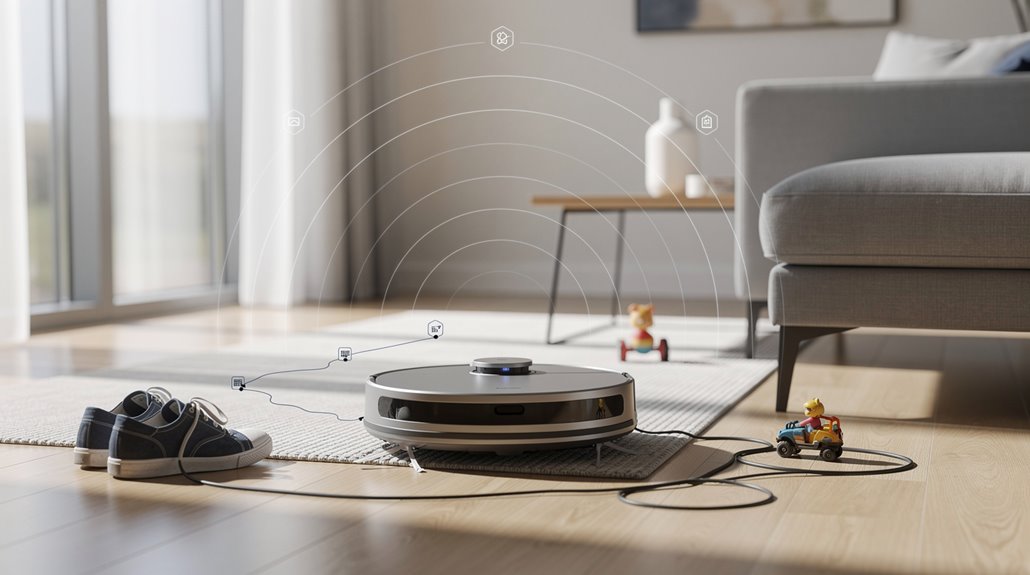
When you’re comparing how these two navigation systems actually perform on real floors, the differences become pretty clear pretty fast.
- LiDAR maps in straight lines; vSLAM often bounces around inefficiently
- LiDAR stays accurate in dim light; vSLAM needs brightness
- vSLAM struggles with plain walls; LiDAR handles featureless spaces. LiDAR’s insensitivity to lighting conditions makes it particularly valuable in homes with varying illumination throughout different rooms. Visual SLAM’s reliance on feature detection means it cannot effectively navigate through areas lacking distinctive visual landmarks.
- LiDAR finishes faster overall despite theoretical camera speed advantages
Which Robot Vacuum Models Use vSLAM Technology
If you’re shopping for a robot vacuum and wondering which brands actually use vSLAM, you’ll notice the field’s a lot narrower than you might expect. iRobot Roomba has basically locked in vSLAM as its navigation standard across its lineup, relying on an onboard camera to build maps from visual landmarks in your home rather than spinning a LiDAR puck on top.
| Brand | Technology | Strength | Limitation |
|---|---|---|---|
| iRobot Roomba | Camera-based vSLAM | Sleek profile design | Needs good lighting |
| Ecovacs | vSLAM + sensors | Real-time 3D mapping | Less common in budget models |
| Advanced models | LiDAR + vSLAM | Handles varied lighting | Higher price point |
Ecovacs incorporates vSLAM technology explained through camera-based mapping that identifies edges and furniture. Some advanced vacuums combine both systems for better performance. Premium models that integrate LiDAR, cameras, sensors, and AI achieve optimized coverage and obstacle avoidance beyond what single-technology systems can deliver. You’ll find vSLAM most common in iRobot’s range, though it’s spreading.
Frequently Asked Questions
Does vSLAM Navigation Work in Complete Darkness Without Any Light Source?
No, you can’t rely on vSLAM navigation in complete darkness. Your camera-based system won’t function without adequate light since it depends on visual information to map and triangulate your position accurately.
How Much Processing Power and Battery Does vSLAM Consume Compared to Other Navigation Systems?
You’ll find vSLAM consumes less processing power than LiDAR but demands more algorithmic computation than random navigation. It drains battery faster in low-light conditions while using cheaper, simpler components overall.
Can vSLAM Robot Vacuums Navigate Multiple Floor Levels or Just Single Floors?
You’re climbing a mountain one peak at a time—your vSLAM vacuum navigates multiple floors, but you’ll manually reposition it between levels. Advanced models store separate maps for each space, recognizing different floors through visual landmarks.
How Often Does a vSLAM Vacuum Need to Recalibrate or Update Its Floor Map?
You don’t need recalibration on a fixed schedule. Instead, you’ll want to update your map whenever you rearrange furniture significantly or add new obstacles. Regular sensor maintenance every few days prevents most recalibration needs.
Will vSLAM Navigation Improve Over Time as the Robot Vacuums Repeatedly Clean the Same Area?
Yes, your vSLAM vacuum’ll improve significantly over time. With each cleaning run, it’ll refine its map, optimize routes, distinguish permanent obstacles from temporary ones, and adapt to your home’s layout and habits for increasingly efficient performance.
Conclusion
You’re looking at a technology that works like a person finding their way through a dark room by memory and touch rather than a flashlight. vSLAM gets you solid performance on typical floors, but it stumbles in low-light spaces and reflective surfaces where LiDAR excels. If your home’s well-lit and clutter-free, you’ll save money without sacrificing much. Just know you’re trading some mapping precision for a lower price tag.