
Matter protocol changes how you control your robot vacuum and which smart home ecosystems can talk to it—not how it actually cleans. You’ll get faster local commands through Wi-Fi or Thread instead of cloud delays, plus the ability to start, stop, or pause from Apple Home, Google Home, or Alexa. The catch: advanced features like mapping, scheduling, and firmware updates still live in the manufacturer’s app. If you want to understand which vacuums support it and whether yours qualifies for an update, the specifics get more granular.
Key Points
- Matter enables cross-brand vacuum control via Apple Home, Google Home, and Alexa without proprietary hubs or apps.
- Local command processing delivers near-instant start, stop, and pause responses without internet latency or cloud dependencies.
- Matter doesn’t change mapping, scheduling, firmware updates, or cleaning history—these remain in manufacturer apps.
- Current Matter support limited to basic controls; advanced modes and features require protocol expansion for future hardware.
- Approximately 25 robot vacuums from Roborock, Eufy, Ecovacs, and others now support Matter through firmware updates or new models.
What Matter Protocol Is and Why It Was Created for Smart Home Devices
If you’ve ever stood in the electronics aisle wondering why your Amazon speaker won’t talk to your Google camera without downloading three separate apps, Matter Protocol exists to fix that problem.
This matter smart home standard lets devices from different brands communicate directly over Wi-Fi and Thread without proprietary hubs cluttering your setup. The protocol is backed by major tech companies like Apple, Google, and Amazon, ensuring broad device compatibility across the market. Matter was developed by the Connectivity Standards Alliance and originated as Project CHIP in December 2019 to simplify development for manufacturers and increase compatibility for consumers.
How Matter Changes Robot Vacuum Connectivity and Local Control
When you send a command like “start cleaning” through your voice assistant, Matter lets that instruction process directly on your home network instead of bouncing to the cloud first—which means you’re looking at near-instant response times even if your internet hiccups.
That said, some features still lean on cloud connections: advanced scheduling, remote access when you’re away from home, and integration with third-party automation services all typically require that cloud bridge. You’ll get the speed and reliability gains for everyday commands, but you’re not completely untethered from the internet for everything your vacuum can do. Matter’s local-first design also means your vacuum can continue responding to basic commands from supported voice platforms even during internet outages, keeping your essential cleaning operations independent of external servers. This universal smart home standard developed by the Connectivity Standards Alliance eliminates compatibility barriers between devices from different brands, allowing your Roborock vacuum to work seamlessly with Apple Home, voice assistants, and other Matter-enabled smart devices in your ecosystem.
What local processing means for robot vacuum command response speed
By processing commands directly on your robot vacuum through your local home network instead of routing them through cloud servers, Matter local control cuts out the delays that used to plague smart home control.
Your start, stop, and pause commands now execute in under a second. No internet round-trips. No waiting. Just immediate response. This local control architecture also improves privacy by keeping your cleaning schedules and movement patterns within your home network rather than transmitting them to external servers. Matter uses cryptographic verification to ensure only authenticated devices can connect to your network, preventing unauthorized access to your robot vacuum’s controls and sensor data.
Which robot vacuum features still require a cloud connection under Matter
Matter’s local control doesn’t mean your robot vacuum cuts the cord entirely—several important features still need cloud servers to work.
Firmware updates, cleaning history reports, and remote access from outside your home all require cloud connections. Thread and Wi-Fi networks enable local communication that reduces latency for routine commands, but cloud infrastructure remains necessary for data storage and cross-platform synchronization. Your Matter controller and vacuum must operate on the same local network to maintain reliable local communication.
Multi-device synchronization across ecosystems and advanced analytics likewise depend on manufacturer servers, even with Matter protocol’s local command capabilities.
How Matter Affects Robot Vacuum Compatibility Across Smart Home Platforms
You’re probably wondering if your Matter-compatible vacuum will actually work across all your smart home platforms—Apple HomeKit, Google Home, Amazon Alexa, Samsung SmartThings—and the honest answer is it’s still patchy.
Apple delayed official robot vacuum support until 2025, while Google and Amazon lack full Matter integration as of early 2025, so you might set up local control through one platform but not get the same voice command options everywhere.
Thread networks can speed up your vacuum’s response time by keeping it connected locally instead of bouncing commands through the cloud, though that only matters if you’ve already built out a Thread mesh in your home.
Matter 1.2 defines a common robotic vacuum device type (0x0074) in CSA documents to standardize control across brands, but platform adoption remains uneven as vendors continue rolling out support.
Matter support across Google Home, Amazon Alexa, and Apple HomeKit
What’s the point of Matter if your robot vacuum only works with one voice assistant anyway. A matter compatible robot vacuum changes that entirely.
You get:
- Siri, Alexa, and Google Assistant commands work interchangeably
- Single certification replaces separate app setups
- Multiple platforms control the same vacuum simultaneously
- No reconfiguration needed between voice assistants
You’re no longer locked into one ecosystem.
What Thread network support means for robot vacuum response latency
Thread network support fundamentally changes how your robot vacuum responds to commands by enabling local communication instead of routing everything through the cloud. Your vacuum gets faster response times through mesh networking. However, as device counts scale to 60+ Thread devices, simultaneous commands can cause network congestion and missed responses that degrade performance for several minutes until the mesh recovers. Here’s what shifts with Matter over Thread:
| Feature | Without Thread | With Thread |
|---|---|---|
| Command speed | Cloud-dependent delays | Sub-second local response |
| Internet outage | Vacuum stops working | Full local control remains |
| Network reliability | Single failure point | Self-healing mesh reroutes |
What Matter Protocol Does Not Change in Robot Vacuum Operation
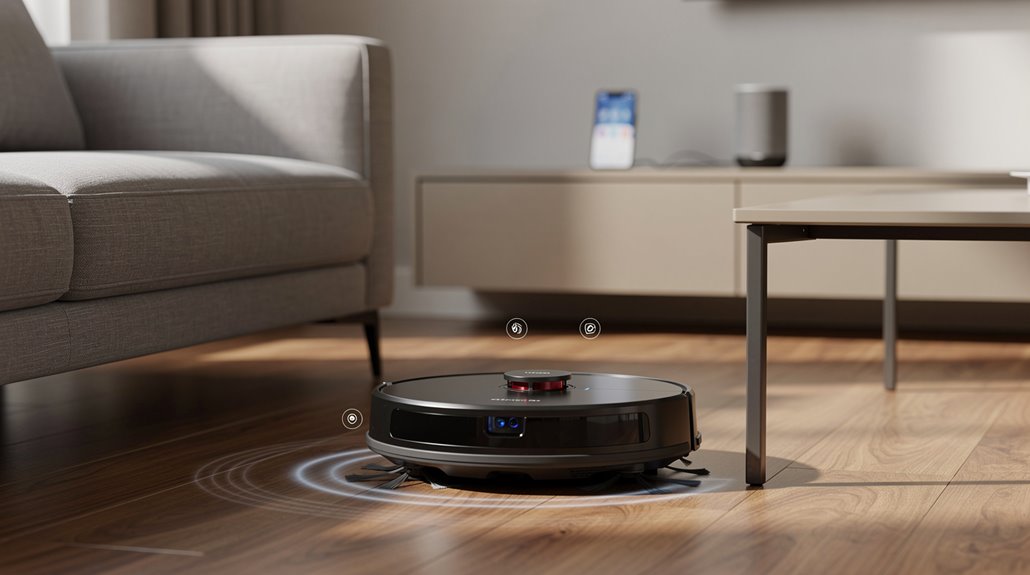
Although Matter promises to simplify how you control your robot vacuum, it doesn’t actually change what the vacuum can do or how you’ll need to manage it day-to-day.
Matter simplifies vacuum control but doesn’t fundamentally change what your robot can do or how you manage it daily.
You’re still dependent on manufacturer apps for:
- Home mapping and room selection
- Automated self-cleaning routines
- Advanced cleaning task scheduling
- Security patches and firmware updates
Robot vacuum Matter support handles remote commands only. Everything else stays locked behind brand-specific software. Current Matter implementations across platforms like Homey show limited Flow card functionality, restricting users to basic start, stop, and pause operations rather than advanced mode selection. As robot vacuums advance with hardware like robotic arms, the protocol will need expansion to support capabilities beyond basic cleaning mode changes and status monitoring.
Which Robot Vacuum Brands Have Confirmed Matter Protocol Support
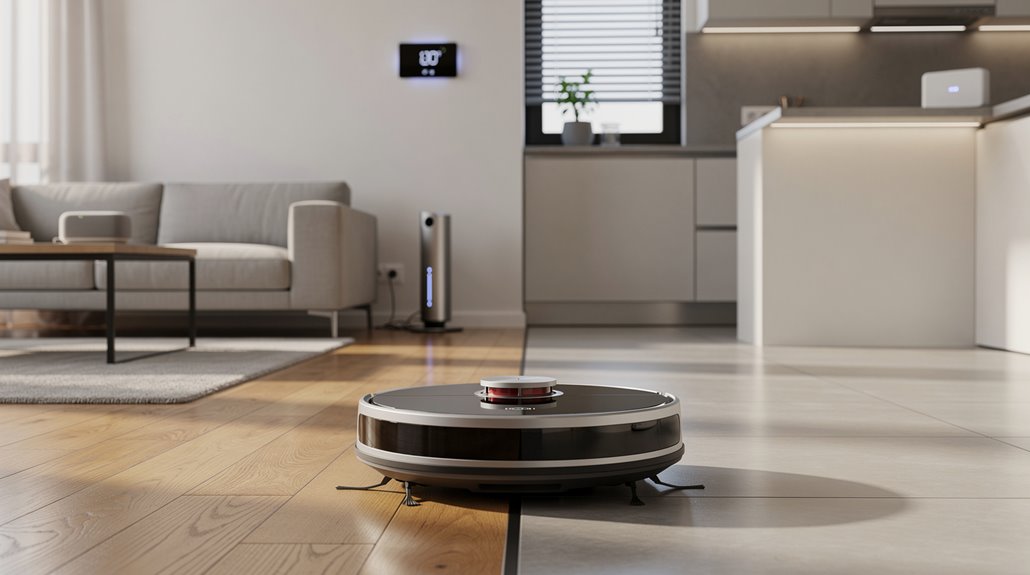
Several major robot vacuum manufacturers have already certified their models for Matter support, with more rolling out compatibility over the coming months.
Roborock leads with S8 MaxV Ultra and Saros series certified. Eufy offers Robot Vacuum S2 and Omni models. Ecovacs, Dreame, Tapo, and Eureka have confirmed robot vacuum matter support too. Approximately 25 robot vacuums have been announced or made available with Matter support across these brands and others. Narwal’s Flow model will join this roster, though the company delayed Matter support to 2026 to allow for firmware finalization and certification.
Coverage expands as firmware updates roll out through 2025.
Whether Existing Robot Vacuums Can Receive Matter Compatibility via Update
If you own a robot vacuum that’s a year or two old, you might be wondering whether a firmware update could enable Matter support without forcing you to buy a new one.
Here’s the reality: your matter upgrade robot vacuum prospects depend entirely on hardware:
Your Matter upgrade robot vacuum prospects depend entirely on hardware capabilities.
- High-end models receive Matter updates through firmware
- Budget and older models lack necessary hardware capabilities
- Manufacturers decide which devices qualify for upgrades
- New Matter-labeled models guarantee support without risk
Only premium vacuums get this treatment. Roborock’s April 2025 firmware rollout demonstrates that early adopter manufacturers are prioritizing Matter implementation across their latest premium models to enhance interoperability with Apple Home, Google Home, Amazon Alexa, and other smart home ecosystems. Matter connectivity works seamlessly across Apple Home, Google Home, and Amazon Alexa, enabling hands-free voice control through Siri and other virtual assistants on compatible devices.
Frequently Asked Questions
Will Matter Protocol Reduce My Robot Vacuum’s Battery Life or Performance Capabilities?
Matter protocol won’t reduce your vacuum’s battery life or performance. It adds minimal background processing similar to Wi-Fi overhead. You’ll maintain your normal runtime and cleaning power with Matter-compatible models.
How Much Will Matter-Compatible Robot Vacuums Cost Compared to Non-Matter Models?
You’ll find Matter-compatible vacuums cost more since manufacturers restrict the feature to premium newer models. Specific price premiums aren’t listed, but you’re paying for advanced flagships rather than budget options.
Can I Use Matter Protocol With Older Smart Home Hubs and Controllers?
You can’t teach an old dog new tricks—your older hubs won’t natively support Matter, but you’ll need upgraded controllers like Aqara Hub M3 or Homey Pro that bridge your existing devices into Matter networks.
What Happens if My Internet Connection Drops With Matter-Enabled Vacuums?
Your Matter-enabled vacuum continues operating locally through Thread or Wi-Fi without internet. You’ll maintain control over essential commands like start, stop, and pause. Cloud-dependent features temporarily pause until connectivity restores.
Does Matter Protocol Improve Robot Vacuum Mapping and Obstacle Detection Features?
No, Matter doesn’t improve your vacuum’s mapping or obstacle detection. It standardizes control commands and enables local operation, but your device’s sensor hardware—LiDAR, cameras, or hybrid systems—determines mapping quality and obstacle avoidance capabilities.
Conclusion
You’re basically watching your vacuum learn a common language. Matter’s the translator that lets your robot talk to different platforms without friction—think of it as moving from shouting across rooms to using a phone. Your existing vacuum probably won’t get this upgrade. New models will handle it better. The actual cleaning stays the same. You’re paying for smoother integration, not a better vacuum.