HEPA filters do capture microscopic particles like dust mites and pet dander at 99.97% efficiency, but that only works if your vacuum’s sealed system stays intact and you replace the filter every 1–3 months—most people don’t. A clogged filter cuts suction by 30–50%, which defeats the point. You’ll see real benefits if you have allergies or pets and commit to maintenance. Whether that justifies the cost depends on what you’re actually cleaning.
Key Points
- True HEPA filters capture 99.97% of particles as small as 0.3 microns, substantially outperforming foam and mesh alternatives.
- HEPA filtration significantly benefits allergy sufferers, pet owners, and those with respiratory concerns by removing fine dust and dander.
- Regular maintenance every 1–3 months is essential; clogged HEPA filters reduce suction by 30–50% and compromise cleaning performance.
- “HEPA-style” labels are misleading; only certified HEPA with ISO 29463 verification and sealed-system design guarantee genuine performance.
- Mid-range robot vacuums ($300–$600) with HEPA offer practical allergy relief, though H13 grade suffices for most households.
What HEPA Filtration Actually Captures in Robot Vacuum Exhaust Air
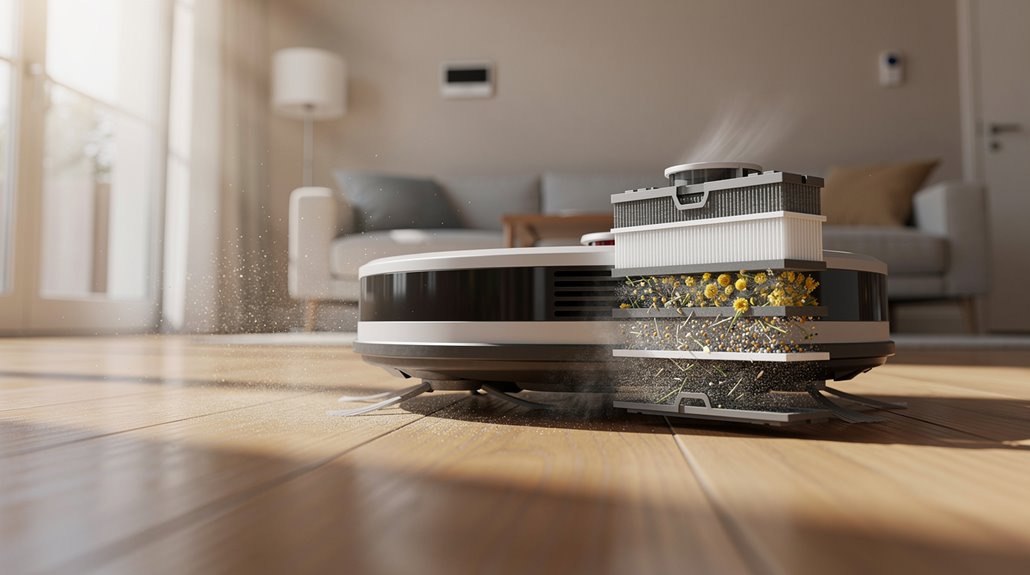
When you run a true HEPA filter through a robot vacuum, you’re capturing particles as small as 0.3 microns—that’s the size where HEPA filters hit their certified 99.97% efficiency threshold, trapping everything from fine dust and pollen to pet dander, mold spores, and bacteria.
Standard foam and mesh filters you’ll find in cheaper models catch larger debris fine, but they let microscopic stuff slip right through your exhaust air, which matters if you’ve got allergies or asthma. Some advanced robot vacuum models also integrate activated carbon filters that reduce odors and certain volatile organic compounds beyond what standard mechanical filtration alone can achieve.
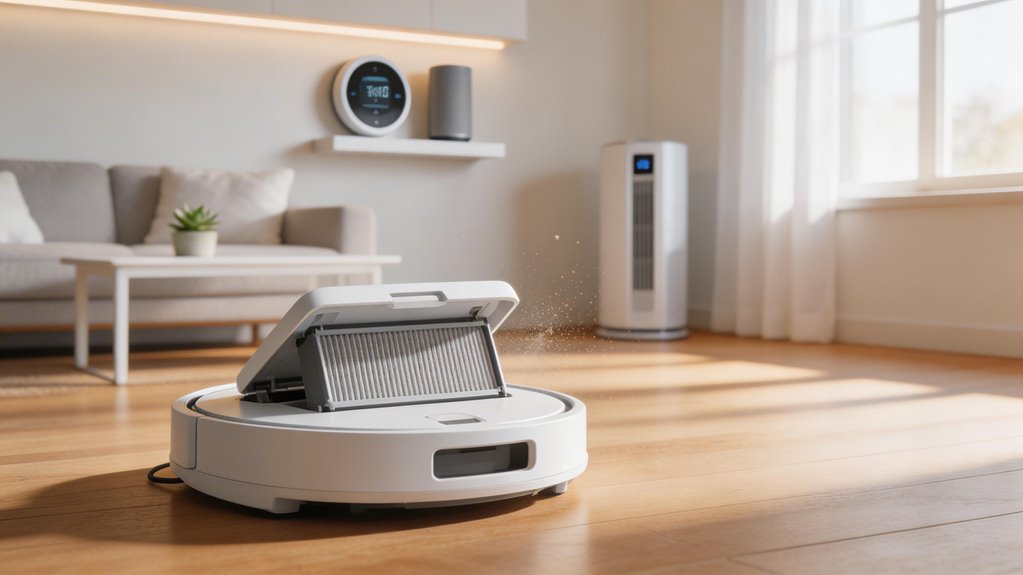
The difference comes down to filter material: HEPA uses dense media with electrostatic charge to grab those tiny particles, while foam just can’t match that level of capture no matter how thick you make it. When HEPA filters become clogged with dust and debris, resistance increases and airflow weakens, reducing the vacuum’s suction power and the effectiveness of that premium filtration you’re paying for.
The particle size range a true HEPA filter traps at 99.97 percent efficiency
True HEPA filters capture 99.97% of particles at a very specific size: 0.3 microns. That’s the most penetrating particle size—the hardest one for filters to catch.
Your true HEPA robot vacuum won’t perform equally well at every particle size. Smaller particles get trapped through diffusion. Larger ones fall to inertial impact. But at that exact 0.3-micron sweet spot, you’re getting certified performance. This counterintuitive efficiency pattern means that particles smaller than 0.3 microns are often captured at even higher rates due to the overlapping filtration mechanisms working throughout the filter media. The tortuous paths in glass microfiber media enable these multiple capture mechanisms to work simultaneously across different particle sizes.
How HEPA filtration differs from standard foam and mesh filters
While foam and mesh filters handle visible dust effectively, they let smaller allergens escape. An H13 HEPA filter traps what they miss—99% of microscopic particles. The trade-off: HEPA reduces airflow slightly, requiring more powerful motors to maintain suction. HEPA filtration is particularly recommended for households with allergies, pets, or respiratory concerns where removing fine particles like dust mites, pet dander, and mold spores significantly improves indoor air quality. Regular filter maintenance, including cleaning after every use or at least once a week, ensures the HEPA filter maintains capture efficiency for allergens and particles.
How to Verify a Robot Vacuum Filter Is Genuinely HEPA Rated
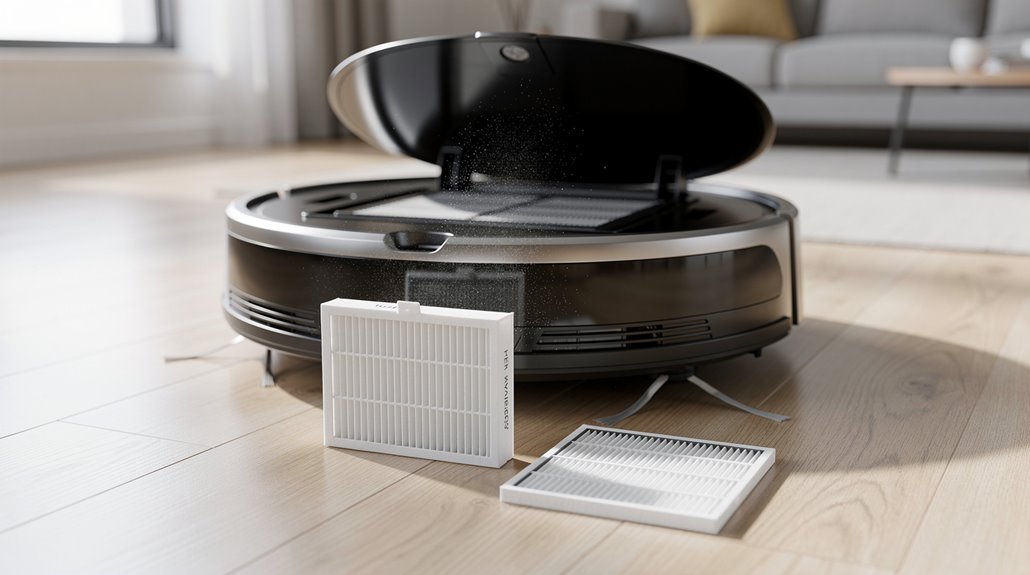
When you’re shopping, you’ll run into labels like “HEPA-style” or “HEPA-type,” which manufacturers use to skirt actual certification—these don’t meet the DOE standard of 99.97% capture at 0.3 microns and legally shouldn’t claim real HEPA performance.
The certified grades you should know are H13 (99.95% efficiency) and H14 (99.995% efficiency), both legitimate ratings that beat the baseline true HEPA spec, though robot vacuum makers rarely pursue these higher tiers.
Check the spec sheet for the exact percentage claim at 0.3 microns rather than vague marketing language; if it says 99% or uses hedging words without a micron size, you’re looking at marketing spin, not a genuine HEPA filter. Manufacturer proof of sealed system design prevents dust and allergens from escaping before reaching the filter, which is just as critical as the filter rating itself.
What H13 and H14 HEPA certification grades mean in consumer products
Most robot vacuum makers slap “HEPA” on their filters and call it a day, but the certification actually comes in two distinct grades—H13 and H14—and they’re not interchangeable.
H13 captures 99.95% of tiny particles; H14 catches 99.995%. That 0.045% difference matters in cleanrooms. Even this small rated efficiency gap can yield significant annual particle capture in high-volume systems, demonstrating that minor efficiency differences compound over time. However, H14’s increased filter media density reduces airflow through the filter, lowering the volume of purified air your vacuum can deliver.
For your home, H13 handles allergens fine. H14 costs more, uses extra fan energy, and requires strict sealing.
Why HEPA-style marketing terms do not meet the standard
Beyond those H13 and H14 grades you’ve just learned about sits a murkier space where filter makers use terms like “HEPA-style,” “HEPA-type,” or “HEPA-like” without actually earning a real HEPA rating.
These unverified labels capture as low as 90% of particles. EN1822:2019 establishes the European standard for filter classification and performance testing methods that distinguish genuine HEPA filters from imitations.
Your robot vacuum allergy filter might claim HEPA performance, but without ISO 29463 certification, you’re looking at marketing language, not tested results. The FDA and EPA recommend True HEPA filtration specifically for removing allergens, mold spores, pet dander, and PM2.5 from your home environment.
How HEPA Filters Affect Robot Vacuum Suction Performance Over Time
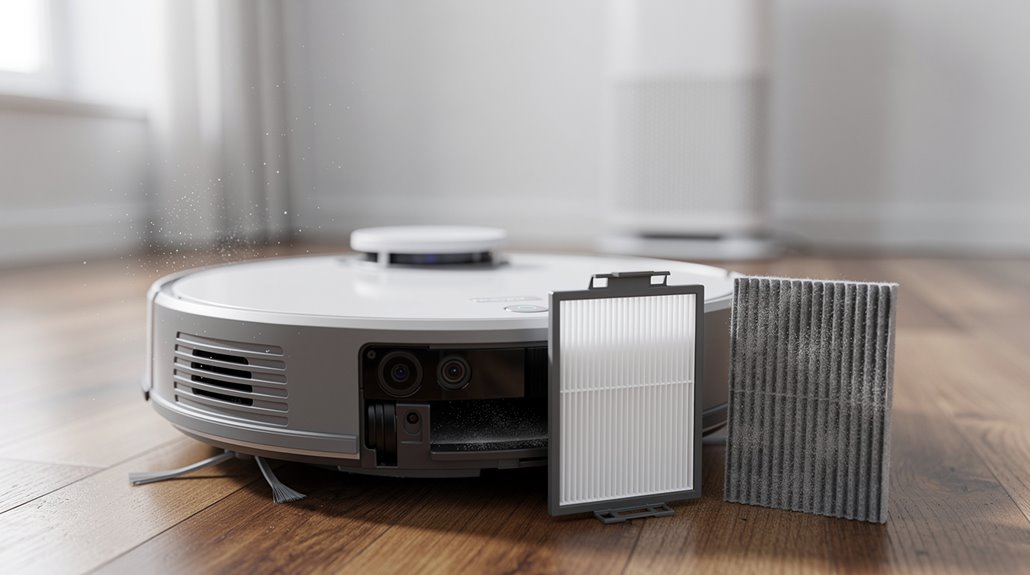
When your robot vacuum’s HEPA filter loads with fine dust and pet hair, the air resistance climbs and your effective suction drops—even though the motor’s still running at full strength.
You’ll notice this happens faster than with standard filters because HEPA systems trap 99.97% of 0.3-micron particles, meaning the filter itself becomes the bottleneck pretty quickly. Modern robot vacuums with adaptive suction sensors automatically adjust motor power in real-time to compensate for airflow resistance and maintain consistent cleaning performance across different bag fill states.
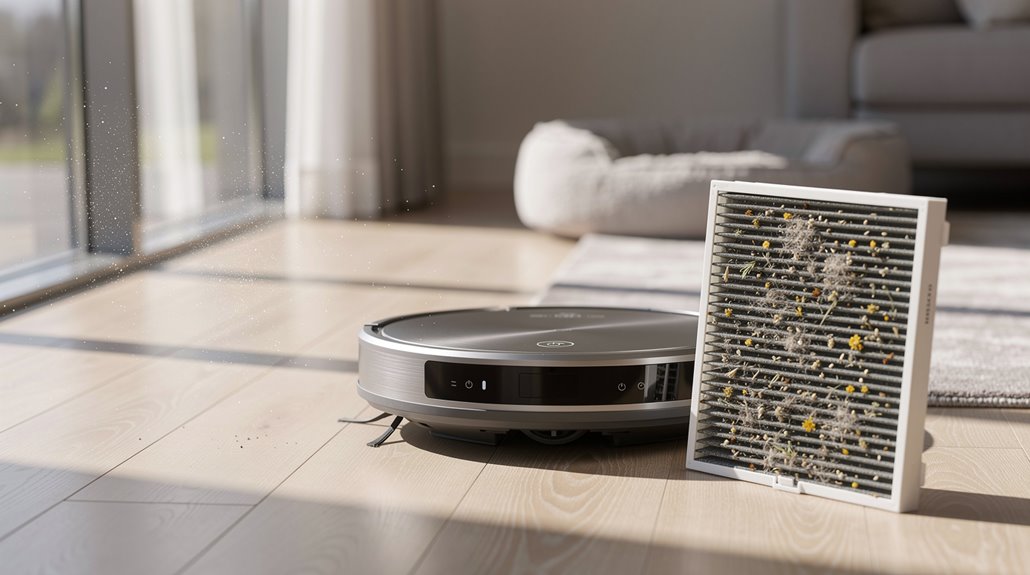
Most HEPA filters need cleaning or replacing every 1-3 months depending on your home’s dust level, while standard filters can stretch to 6 months, so the maintenance schedule’s tighter and the cost adds up over time. A clogged filter significantly reduces airflow through the vacuum’s ducting system, which can drop your suction performance by 30-50% until maintenance restores the seal.
How filter loading reduces effective airflow and Pa output
As your robot vacuum runs through cleaning cycles, its HEPA filter gradually fills with the very particles it’s designed to trap—and that’s where things get tricky.
Your suction pressure drops from 1900 Pa as debris accumulates. Airflow decreases measurably. Most manufacturers recommend inspecting your HEPA filter monthly to prevent excessive buildup that compromises performance.
That reduced hepa filtration efficiency means weaker cleaning performance, though you mightn’t notice it happening gradually until your vacuum struggles on pet hair or fine dust. Advanced vacuum systems like the CS 1445 H feature Electromagnetic Pulse Cleaning Systems that automatically shake filters when airflow decreases, maintaining maximum suction during operation.
How frequently HEPA filters need replacing vs standard filters
HEPA filters typically last 2-6 months with regular maintenance, while standard filters need replacing every 1-3 months.
Heavy pet use compresses both timelines significantly.
Weekly tapping extends HEPA life; standard filters demand monthly rinsing just to stay functional. As filters clog, suction and airflow drop, reducing pickup of fine dust and pet dander that these premium filters are designed to capture. Non-washable robot vacuum filters should not be cleaned with water or soap, as this can damage filtration performance and reduce their effectiveness despite appearing undamaged.
Which Buyers Actually Need HEPA Filtration in a Robot Vacuum
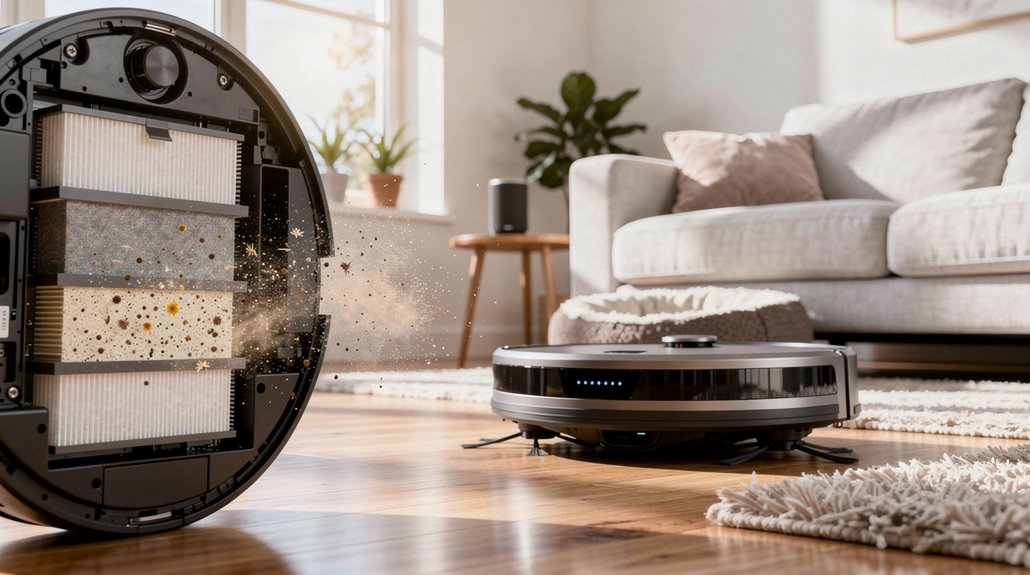
Not everyone needs a robot vacuum with HEPA filtration, but certain households get real benefits from one.
You’ll want HEPA if you fit these categories:
- Robot vacuum allergy sufferers dealing with dust triggers
- Pet owners managing dander and hair accumulation
- Residents in high pollution areas needing comprehensive filtration
- People sensitive to microscopic indoor particulates
- Households prioritizing long-term air quality maintenance
Regular vacuuming with HEPA filtration helps maintain cleaner indoor air, benefiting allergy and asthma sufferers while ensuring that HEPA-equipped vacuums do not significantly increase PM emissions during operation.
How HEPA Robot Vacuums Compare on Price vs Allergy Performance
When you’re hunting for a robot vacuum that handles allergens without draining your bank account, you’ll find the mid-range market ($300–$600) delivers real cleaning performance that rivals pricier models.
A hepa vs standard filter robot vacuum comes down to your needs. DreameTech D10 Plus at $279 clears 62.5% carpet debris cheaply. Yeedi M14+ excels at pet hair but lacks explicit HEPA mention. You’re paying more for filtration you mightn’t need. Models in this price band often include LiDAR or camera-based mapping, which helps them navigate consistently and avoid allergen-spreading obstacles like pet hair tangles. Bagless auto-empty systems can significantly increase particle counts during emptying cycles, offsetting any HEPA filter benefits in certain models.
Frequently Asked Questions
How Often Should HEPA Filters in Robot Vacuums Be Replaced for Optimal Performance?
You should replace your robot vacuum’s HEPA filter every 1-2 months for typical homes. If you’ve got pets or carpets, you’ll need replacement every 3-6 weeks. Weekly cleaning extends intervals significantly.
Can HEPA Filters in Robot Vacuums Help Reduce Odors From Pet Waste or Accidents?
Your robot vacuum’s HEPA filter acts as a guardian against pet odors, trapping odor-causing bacteria and dander. You’ll notice fresher rooms when you combine HEPA with carbon filters, though you shouldn’t vacuum liquid waste directly.
Are Washable HEPA Filters as Effective as Disposable Ones in Robot Vacuums?
You’ll find washable HEPA filters don’t match disposable ones’ performance. They can’t maintain the 99.97% efficiency at 0.3 microns that true HEPA standards require after repeated washing, letting more fine particles escape.
Do HEPA Filters Work Effectively on All Floor Types, Including Carpets and Hardwood?
You’ll find HEPA filters work effectively on both carpets and hardwood. They capture 99.97% of fine particles on carpets while preventing allergen recirculation on hardwood. You’ll maintain superior air quality across all floor types.
How Do HEPA Filters in Robot Vacuums Compare to Central Home Filtration Systems?
You’ve got two complementary systems: a robot HEPA traps 99.97% of allergens during floor cleaning, while central systems filter your entire home’s air supply continuously. Combined, they’re superior to either alone.
Conclusion
You’re paying more for HEPA filtration, but here’s the thing—it genuinely traps particles your standard filter misses. If you’ve got allergies or asthma, that difference matters. Otherwise, you’re mostly buying peace of mind. The catch: HEPA filters clog faster, tanking suction within months unless you clean them weekly. Weigh that maintenance against your actual symptoms before upgrading.