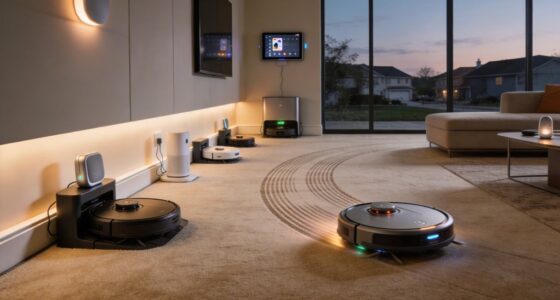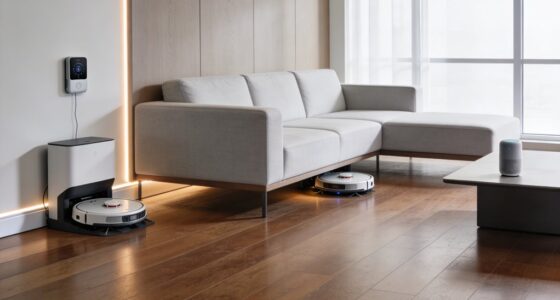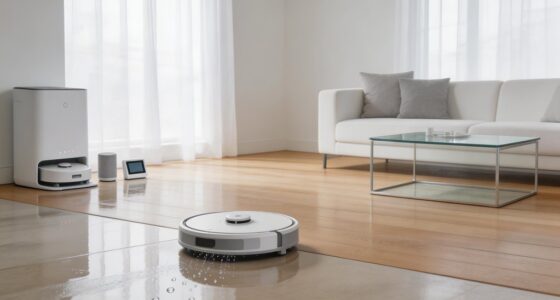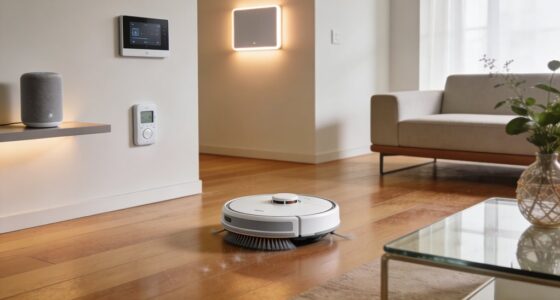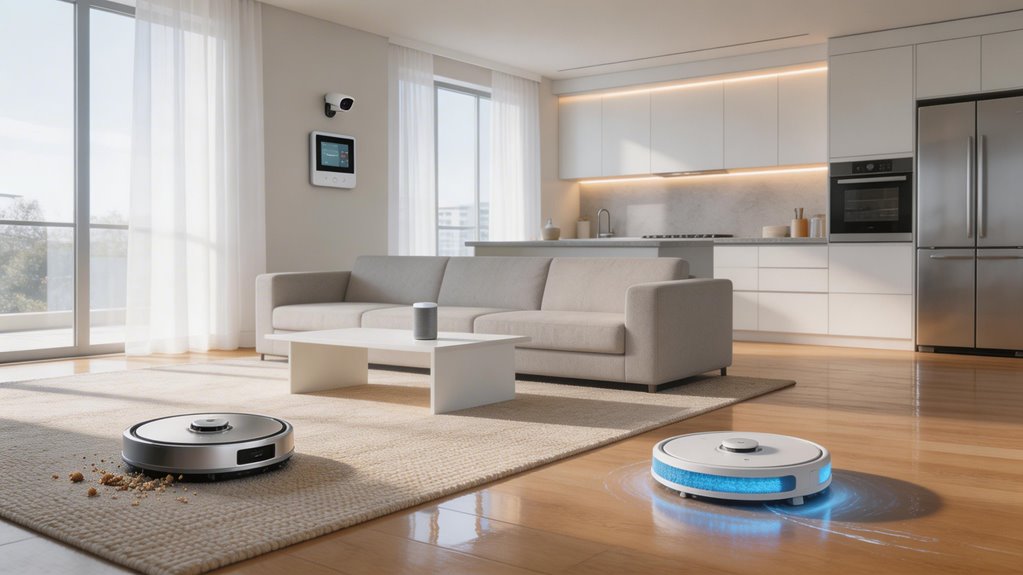
Robot vacuums use high-speed motors (17,300+ RPM) and powerful fans to suction debris, while mops rely on slower rotating pads (180–220 RPM) and peristaltic pumps for water distribution. You can’t vacuum with a mop—it’ll just push dust around. Vacuums can’t dissolve dried-on grime the way moisture and friction do. Combos offer convenience in mixed-floor homes but sacrifice the specialized suction power of dedicated vacuums and the scrubbing precision of dedicated mops. The right choice depends on your floor type and what you’re willing to trade.
Key Points
- Vacuums use high-speed motors and suction (17,300–35,000 RPM) to lift loose dirt, dust, and pet hair that mops cannot remove.
- Mops use slower rotating pads (180–220 RPM) with peristaltic pumps and water to dissolve and scrub dried-on residue through friction.
- Vacuums excel at carpet cleaning (~98% debris pickup) while mops specialize in hard floors; combos compromise on both.
- Pre-vacuuming prevents slurry and streaking during wet-cleaning; vacuum-first modes in combos address this interaction automatically.
- Auto-lift mop technology raises wet pads over carpets to prevent water damage, enabling seamless transitions between floor types.
How Robot Vacuum Hardware Differs from Robot Mop Hardware at a Component Level
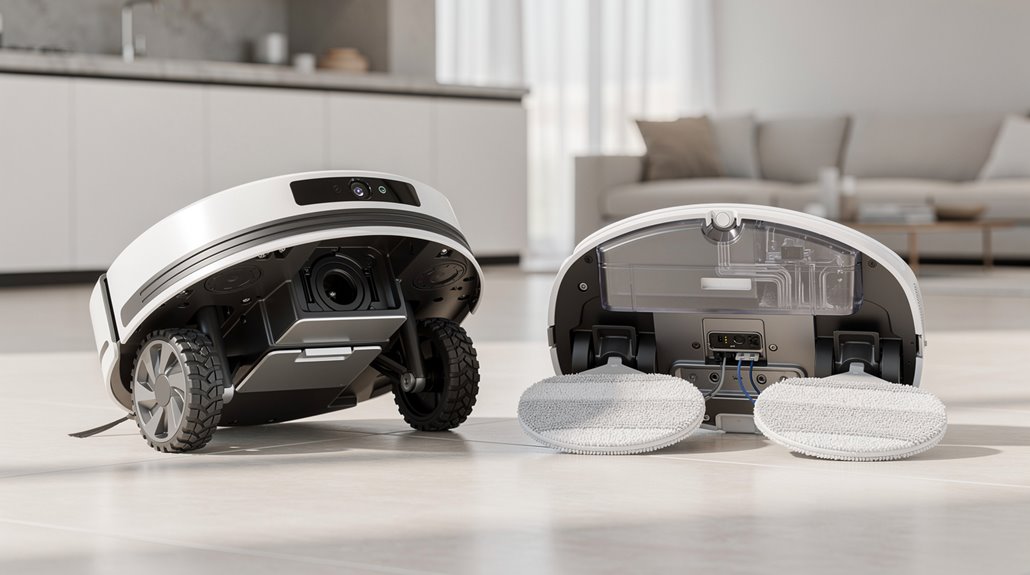
When you’re deciding between a robot vacuum and a robot mop, the hardware differences start at the component level and cascade through how each machine actually works.
Vacuums pack high-speed motors (17,300 RPM brushes) and powerful fans (20,000–35,000 RPM). Robot mop technology ditches those entirely, swapping them for slower rotating pads (180 RPM) and peristaltic pumps instead. One trades suction for moisture control. The sealed airflow pathway in vacuums transports debris through internal ducts into a dustbin, while mops rely on water distribution systems to dampen and lift dirt from hard floors. Both systems depend on BLDC motors for precise speed regulation and efficient power delivery to their respective mechanical components.
What Robot Mops Do That Robot Vacuums Cannot Replicate
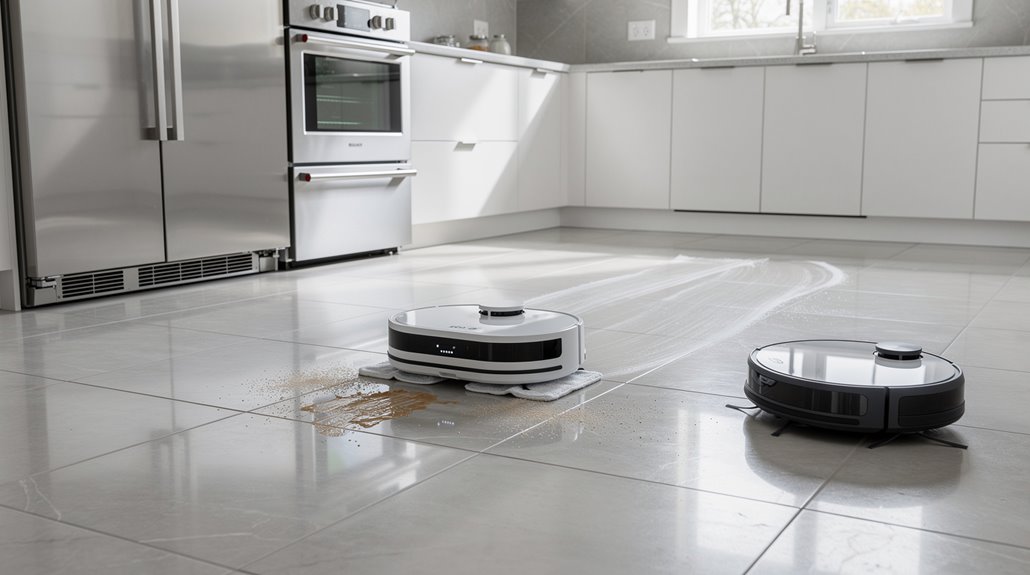
You’ll find that a robot vacuum‘s dry pad can trap loose dust, but it won’t budge sticky juice residue or dried-on grime that’s bonded to your floor—that’s where the robot mop‘s water and scrubbing action actually work.
When you run a robot mop with its OZMO ROLLER technology spinning at 220 rpm, you’re applying downward pressure and moisture that dissolve stuck-on messes; a vacuum pad just slides over them. Premium models like the DEEBOT X9 PRO OMNI also feature auto-lift mop technology that raises the pad over carpets to prevent water damage during transitions.
The trade-off is that mops need frequent water tank refills on larger homes, while vacuums handle bigger square footage before needing attention. Robot mops are also limited to sealed hard floors and require pre-vacuuming to prevent streaking, making them less versatile than vacuums for mixed flooring types.
How wet mopping removes dried-on residue that suction cannot lift
Dissolving dried-on gunk requires something a vacuum simply can’t do: liquid and friction working together. Your wet mopping robot applies water and cleaning solution that actually breaks down stuck residue.
Microfiber pads scrub while the solution penetrates grout lines your vacuum misses entirely. This combination lifts particles vacuums leave behind, sanitizing surfaces simultaneously through dissolution and agitation. Advanced models like the Dreame X50 Ultra feature auto-lifting mop pads to prevent moisture from saturating nearby carpeted areas while still delivering superior wet-cleaning performance on hard floors. Roller-style mops clean big messes more effectively than spinning pads, though they require monthly reservoir brushing to maintain optimal performance.
Why a vacuum dry pad attachment is not functionally equivalent to mopping
Some vacuum makers have tried adding a dry microfiber pad attachment to their robots, hoping it’d handle what their suction misses. Here’s the problem: a robot vacuum mopping attachment without water just pushes dust around. You need actual moisture to dissolve sticky residue and sanitize surfaces. Dry pads can’t reach what wet cleaning does. Consistent, regular maintenance cleaning with a true robot mop ensures floors stay cleaner longer compared to sporadic deep cleaning attempts with dry attachments.
| Feature | Dry Pad Attachment | Robot Mop |
|---|---|---|
| Moisture application | None | Consistent water dispensing |
| Sticky residue removal | Ineffective | Scrubbing at 220 rpm |
| Sanitization capability | Limited | Water-based sanitization |
What Robot Vacuums Do That Robot Mops Cannot Replace
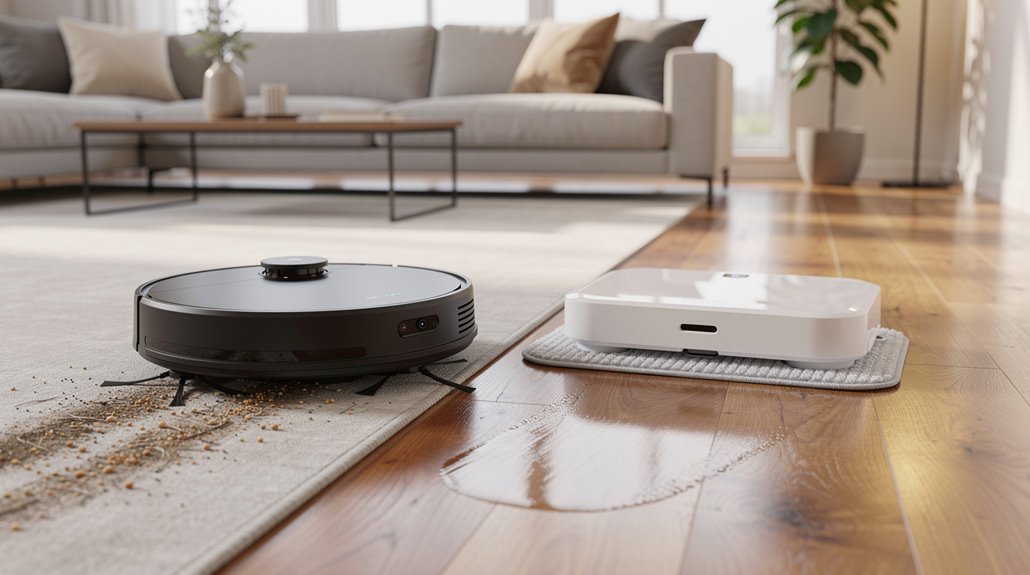
You need suction to handle what mops can’t: lifting loose dirt, dust, and pet hair off your floors before they get spread around.
If you mop over unvacuumed debris, you’re basically pushing that stuff across your surfaces instead of removing it, which defeats the purpose.
A robot vacuum’s dual brush system and strong suction do the heavy lifting first, leaving you with actually clean floors rather than just wet ones. Suction measured in Pascals indicates the vacuum’s ability to collect dirt and debris effectively, which is crucial for tackling pet hair and deeply embedded carpet dirt that mopping alone cannot address. Models equipped with HEPA filtration also reduce dust, pet hair, and allergens, maintaining cleaner indoor air during the cleaning process.
How suction removes loose debris before mopping is effective
Robot vacuums handle something robot mops simply can’t: they pull loose debris off the floor before any wet cleaning happens.
This debris removal before mopping matters because suction targets particles mops can’t capture. High suction power—like the 5000 Pa in DEEBOT X8 PRO OMNI—clears dust and small debris first, preventing them from turning into mud when water hits. Larger dustbins paired with auto-empty stations also mean the debris collection capacity supports continuous cleaning cycles without frequent manual interruptions, allowing the vacuum to handle bigger homes and higher foot traffic effectively. According to research on cleaning effectiveness in homes, robot vacuums remain helpful but cannot fully replace traditional cleaning habits, particularly for deep cleaning tasks that require human intervention.
Why mopping over unvacuumed debris spreads dirt across floor surfaces
When you run a mop over debris-covered floors, you’re fundamentally creating a problem instead of solving one.
Wet pads dissolve dry particles into slurry that spreads across your floor.
The robot mop vs robot vacuum comparison matters here: vacuums remove grit entirely, while mops redistribute it, grinding particles deeper into surfaces and scratching finishes.
You’ll get streaks, not clean floors. Robot vacuums with dual spinning pad systems can handle light maintenance and dried-on stains after initial vacuuming, but they lack the dry-particle removal capability that vacuums provide.
How Robot Vacuum Mop Combos Attempt to Solve Both Functions
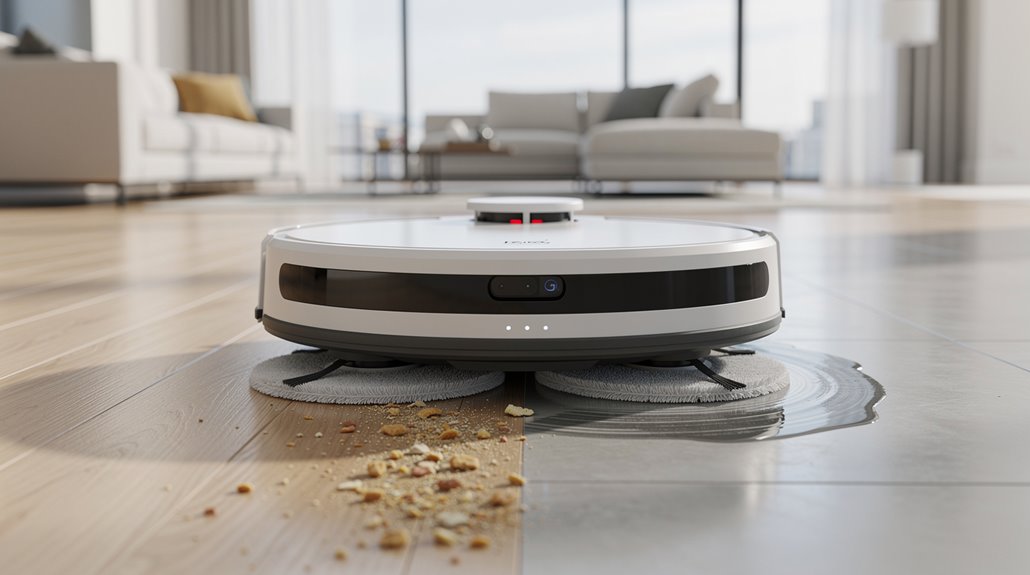
Combo units handle the hard floor-to-carpet transition with auto-lift mop technology, which retracts the wet roller when you’re vacuuming carpet so you don’t end up with soggy fibers. You’re getting convenience here, but the tradeoff is real: these machines sacrifice the specialized suction power of dedicated vacuums and the deep mopping precision of standalone mops to do both jobs in one pass. The Roomba Max 705 Combo addresses this limitation with four cleaning modes—vacuum only, mop only, both simultaneously, or vacuum first then mop—giving you more control over how the machine tackles your specific floor types. The Shark Matrix Plus 2-in-1, by comparison, uses Sonic Mopping technology that scrubs hard floors 100 times per minute while simultaneously vacuuming, eliminating the need to choose between separate cleaning passes.
If your home’s mostly one surface type, a dedicated machine will outclean a combo; if you’ve got mixed flooring throughout, the combo’s speed and hands-off approach might matter more to you than that performance gap.
What auto-lift mop technology does at carpet-to-hard floor transitions
At carpet-to-hard floor transitions, auto-lift mop technology does one straightforward job: it gets the wet mop pad off your carpet before it can soak in. Your auto-lift mop robot uses ultrasonic sensors to detect when you’re moving from hard floors onto carpet. Within milliseconds, it raises the mop pad 20mm. The vacuum keeps running.
Water stays off the fibers. Top performers like the MOVA S10 and Dreame L50 Ultra apply downward pressure while mopping hard floors to enhance cleaning performance, then lift automatically when carpet is detected. The Noesis Florio uses Mop Lift technology to raise its brush roll by 7 mm and mop pad by 20 mm over cleaned areas, preventing the spread of dirty water.
Where combo units make trade-offs vs dedicated machines
Because you’re asking one machine to do two jobs well, combo units can’t match what dedicated machines pull off in either category.
Your combo robot vacuum mop handles light spills on hard floors, but vacuuming performance on carpet stays middling.
Dedicated vacuums crush deep carpet cleaning. Robot vacuums typically achieve around 75% debris pickup on carpets compared to uprights that remove approximately 98% of embedded dirt. Models with spinning mop heads tend to clean stains more effectively than those with stationary designs.
Dedicated mops don’t exist.
Pick combos for mixed homes, dedicated units for carpet-heavy spaces.
When to Buy a Robot Mop vs a Robot Vacuum vs a Combo Unit
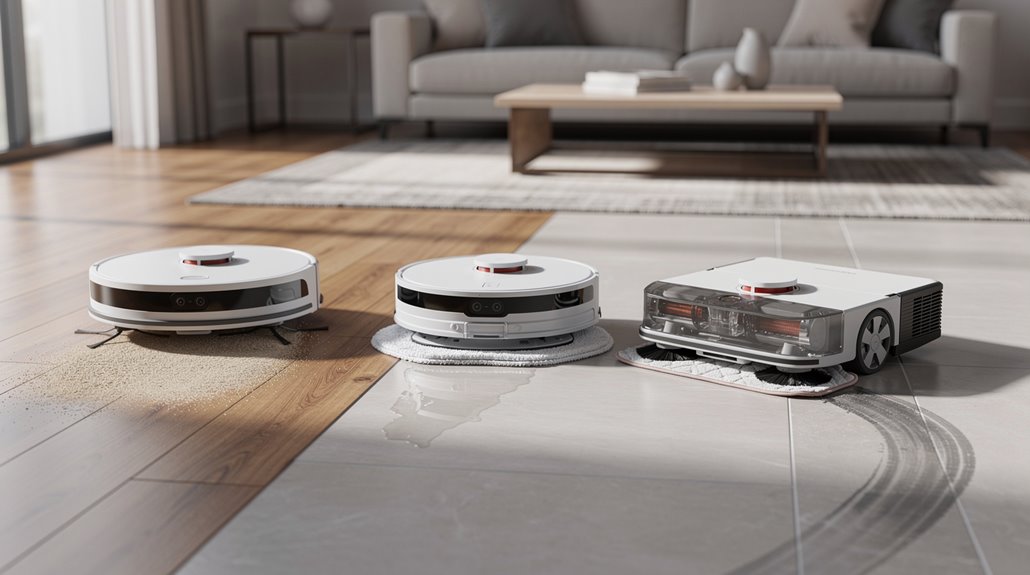
When you’re staring at your floor type and daily mess, the right robot comes down to matching the machine to what actually lives in your home.
Pick a vacuum for carpet and pet hair. Choose a mop for hard floors needing robot vacuum wet cleaning. Get a combo if you’ve got both but accept it’ll sacrifice depth in each task. Vacuum Wars’ rigorous testing shows that combo units like the MOVA Mobius 60 deliver practical low-maintenance benefits by combining self-emptying, mop washing, and obstacle avoidance in a single dock system, though dedicated single-function robots still outperform them in their respective specialties.
Frequently Asked Questions
How Much Does a Robot Mop Cost Compared to a Robot Vacuum?
You’ll spend $200-$300 on basic robot vacuums, but you’re looking at $600-$1,300+ for mopping-equipped combos. The mopping feature costs more because you’re getting self-emptying docks, stain scrubbing, and advanced automation.
Can Robot Mops Damage Certain Types of Flooring Like Wood?
Yes, robot mops can be a double-edged sword for wood floors. You’re risking water damage, scratches, and finish degradation if you don’t use precise water control, soft brushes, and sealed hardwood surfaces.
Do Robot Vacuums Work on Carpeted Surfaces Better Than Mops?
You’ll find robot vacuums outperform mops on carpet. They’re designed with twin brushrolls, 12,000Pa suction, and AI dirt detection that automatically boosts performance on carpeted surfaces, achieving 94.1% embedded sand removal on Berber carpet.
How Long Do Robot Mop and Vacuum Batteries Typically Last?
You’d think robot batteries last forever, but they don’t. Your vacuum battery typically lasts 1–2 years before declining, while your mop’s drains faster due to heating water. Both reach 2–5 years with proper maintenance and care.
Are Robot Mops and Vacuums Compatible With Smart Home Systems?
You’ll find that most robot mops and vacuums integrate with Amazon Echo, Google Home, and Home Assistant. However, compatibility varies by model—some offer room-specific commands while others support only basic on/off functions.
Conclusion
You’re looking at three separate tools wearing different hats. Your choice hinges on your floor type and what actually needs cleaning. Vacuum-only handles pet hair and dust; mop-only tackles sticky spots. Combos are like trying to be a Swiss Army knife—they do both reasonably well but neither brilliantly. Your floors will tell you which one deserves the charging dock.