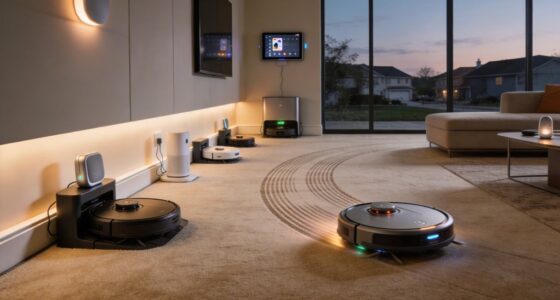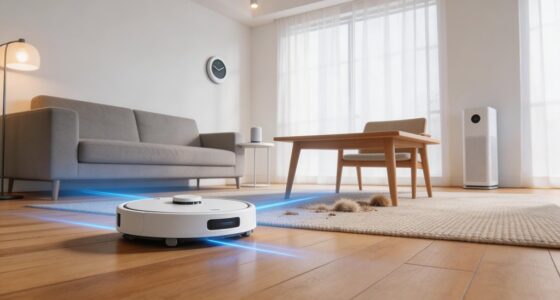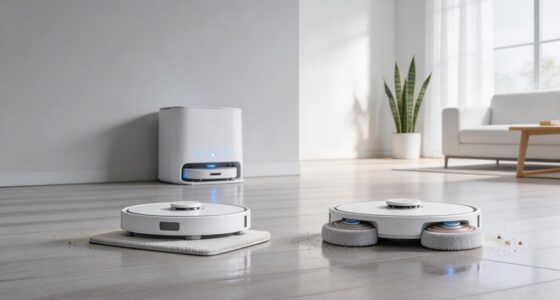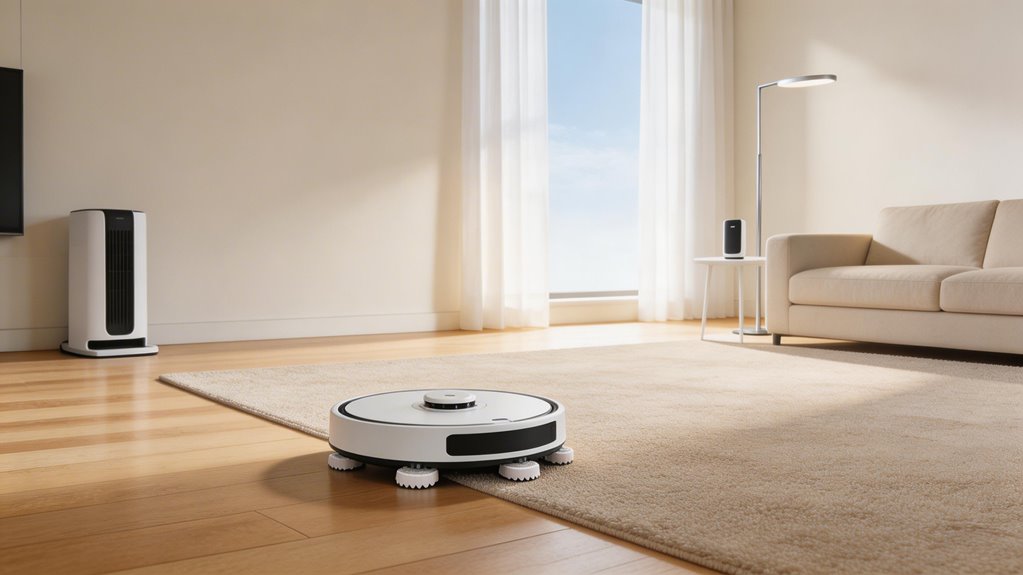

You can run a robot mop on carpet if it has auto lift technology—servo motors raise the pad 10 to 20 millimeters when sensors detect pile. Without it, moisture saturates fibers and weakens adhesives, potentially voiding your warranty. RGB cameras and pressure sensors trigger the lift in milliseconds before contact happens. That said, auto lift isn’t foolproof, especially on high-pile rugs. No-mop zones drawn in your app provide extra protection where you need it most, and some models combine both strategies for reliability across mixed floors.
Key Points
- Robot mops can go on carpet using auto-lift technology that raises the mop pad 10.5–20 mm when carpet is detected via sensors.
- Servo motors receive carpet detection signals and rotate mechanical linkages to lift the mop pad before pile contact occurs within milliseconds.
- RGB cameras and pressure sensors detect carpet type and pile height in real-time to optimize lift positioning automatically during cleaning cycles.
- No-mop zones provide additional protection since auto-lift is not foolproof, especially recommended for high-pile carpets over 0.75 inches tall.
- Auto-lift works best on low-pile surfaces under 0.5 inches; medium-pile and high-pile carpets benefit from combining no-mop zones with automatic lifting.
What Happens When a Robot Mop Contacts Carpet Without Auto Lift Technology
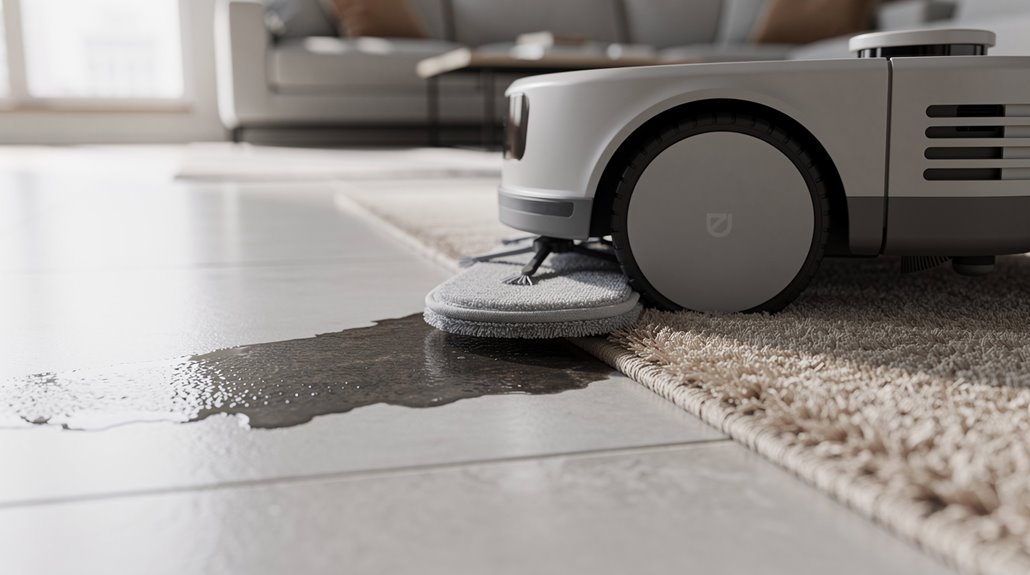
When your robot mop rolls onto carpet without auto lift technology, it doesn’t just wet the surface—it saturates the fibers themselves.
The mopping function keeps dispensing water while the device travels across the carpet, forcing moisture deep into the backing and padding beneath.
Your fibers swell, the adhesive weakens, and mold starts growing in the dampness. Carpet construction vulnerability means older or cheaper carpets are particularly susceptible to this kind of damage from prolonged moisture exposure.
You’re looking at structural damage that’s expensive to fix. Excessive moisture from mopping can also void manufacturer warranties if the carpet care guidelines are violated through improper cleaning methods.
How Auto Mop Lift Mechanisms Work in Robot Vacuum Mop Combos
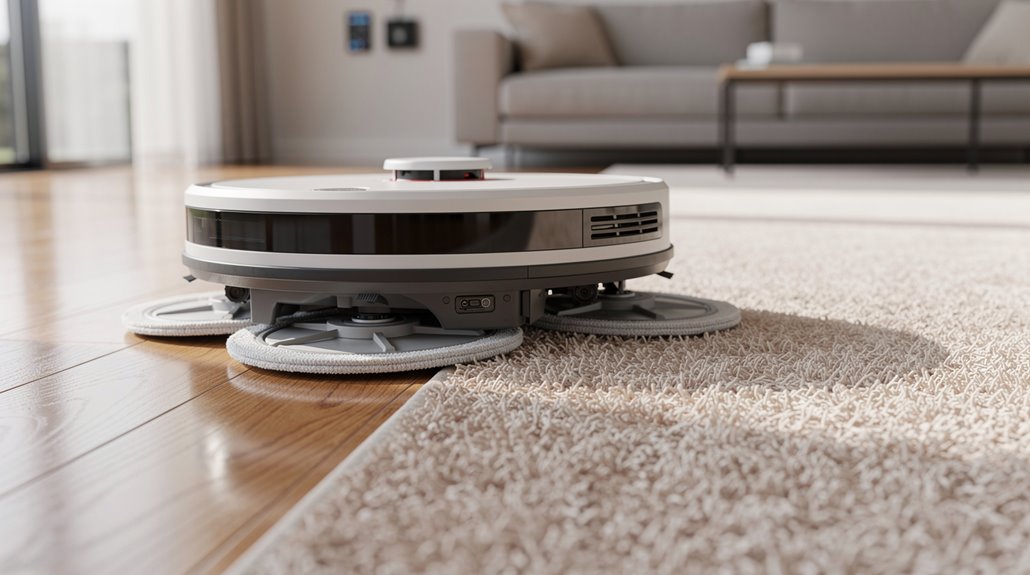
When your robot mop encounters carpet, servo motors engage to raise the mop pad—typically between 10.5mm and 20mm depending on the model—so the wet pad clears the carpet pile without manual intervention.
You’ll find that this lift height matters because too shallow and low-pile rugs still get damp, but models like the MOVA S10 and Dreame L50 Ultra hit that sweet spot where the pad rises far enough to keep carpets dry while staying compact enough for everyday cleaning. Many robot combos also feature auto-pad lift technology that automatically detects carpet transitions for seamless operation.
The whole process happens in real time during your single-run vacuum-mop cycles, meaning you don’t have to babysit the robot or swap out pads when it hits a rug. Premium models like the Yeedi M14+ also feature mop-lift on carpet via app, giving you additional control over when the mop engages or disengages across different room types.
How servo motors raise the mop pad clear of carpet pile
Servo motors handle the actual lifting work in robot mop combos, and they’re surprisingly straightforward once you see what’s happening. Your servo motor mop lift receives carpet detection signals, then rotates to raise the mop pad vertically through mechanical linkages.
These motors adjust positioning in real time, lifting pads between 0.39 and 0.55 inches depending on carpet pile density. Spring mechanisms help lower the mop back down, reducing motor strain during descent cycles. The CarpetFocus technology enhances this process by automatically lowering the brush cover when carpets are detected, ensuring optimal contact on carpet surfaces while maintaining mop lift efficiency on hard floors. Models with advanced sensors can also distinguish between different carpet types and pile heights to optimize lift positioning accordingly.
What minimum lift height prevents carpet wetting on low-pile rugs
The gap between your mop pad and a low-pile rug is where the real distinction happens—too close and you’re dragging moisture across fibers, too high and you’re not actually cleaning when you need to. Your robot mop carpet detection needs clearance:
- 0.8 inches minimum handles standard low-pile transitions without contact
- 12mm lift (Narwal models) prevents moisture pooling on fibers
- Real-time sensors trigger mop raise before pile contact occurs
That margin keeps rugs dry while cleaning hard floors nearby. Models with Carpet First feature or mop-lift functions automatically prevent wetting carpets during transitions between rooms, ensuring your robot maintains optimal cleaning performance across multiple floor types. The physical design trade-off between low-profile clearance and under-furniture cleaning capability means that active lift mechanisms are particularly valuable for homes with mixed flooring types.
How Zone-Based Carpet Avoidance Works as an Alternative to Auto Lift
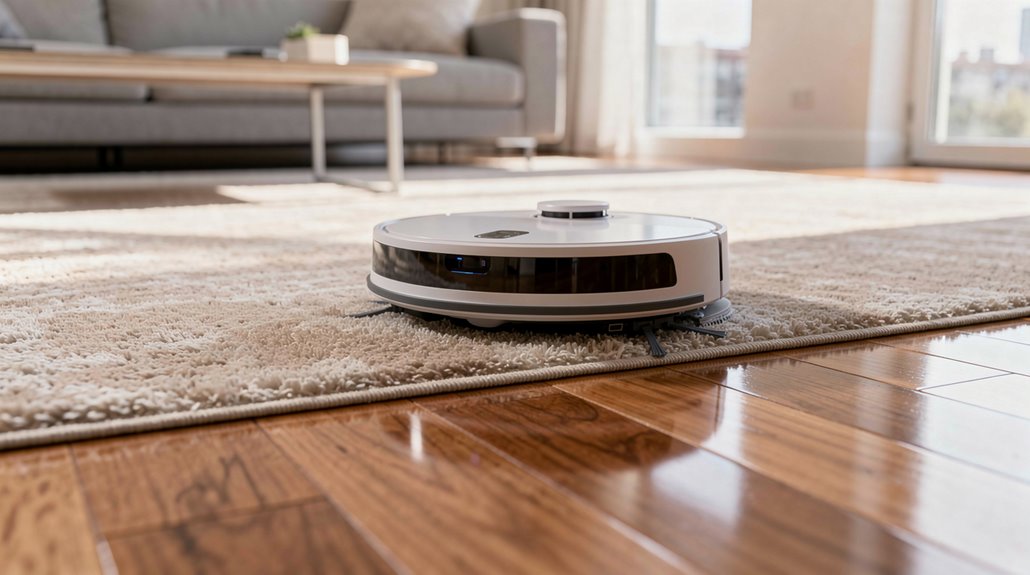
You set up no-mop zones by drawing boundaries around carpets directly in your robot’s app after it completes its initial LiDAR or camera scan—essentially telling the mop “don’t go here” rather than relying on it to lift itself when it detects carpet.
The trade-off is that these zones only work on maps you’ve already created, so if you move a rug or add new carpet, you’ll need to redraw those boundaries and re-run the map.
At zone edges, you’ll typically see a margin of error between 4 to 8 inches where the robot might still wet-mop right up to the boundary line, meaning you’ll want to give yourself a little extra cushion when drawing zones around valuable rugs. The Roborock App provides real-time customization of these zones for seamless map management. Models with FloorDetect technology can optimize this process by automatically recognizing carpet types and adjusting mop behavior accordingly.
How no-mop zones are mapped and enforced from the app
Zone-based carpet avoidance works by letting you draw digital boundaries on your phone instead of relying on the robot to physically lift its mop when it encounters carpet.
You’re creating virtual no-mop zones directly on your app’s map:
- Draw rectangular barriers around carpets or areas you want to skip
- The robot uses SLAM to track its position and switches to vacuum-only mode when entering zones
- Pre-set zones save automatically and stay editable anytime
This approach handles mixed floors without hardware lifts. Advanced models combine LiDAR navigation with app-based zone controls to achieve seamless carpet avoidance across multiple floor types. The Localization & Mapping Layer ensures the robot maintains precise awareness of its location within stored maps, allowing it to recognize when it has crossed into a no-mop zone and execute the appropriate mode switch seamlessly.
What margin of error exists at zone boundary edges
When your robot mop approaches a no-mop zone boundary, it’s not guessing where the line is—it’s using multiple sensors working together to stay on the right side of it. Premium models keep deviation under 2 cm through LiDAR and AI camera fusion. Budget robots might drift 3-5 cm, especially in low light.
That precision beats auto mop lift technology’s fixed mechanical limits, which can’t adapt to irregular carpet edges. Some advanced systems even use cloud-based directories of obstacle types to classify carpet textures and refine their boundary detection in real time. This multi-sensor fusion approach enables robot mops to distinguish between carpet boundaries and hard flooring through real-time depth sensing rather than relying solely on mechanical height adjustments.
How Robot Mops Detect Carpet Transitions in Real Time
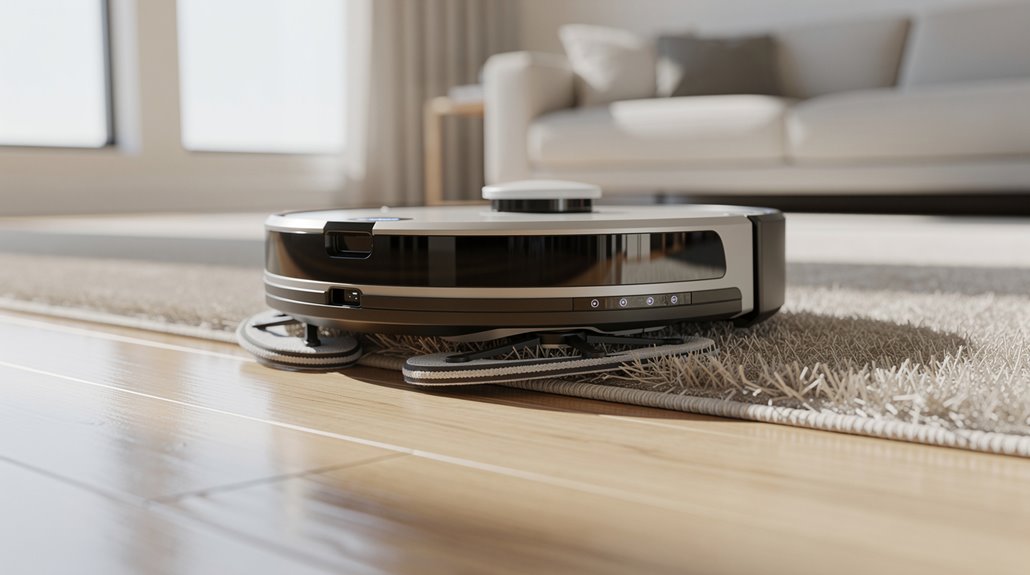
Robot mops figure out where carpet starts and hard flooring ends by layering multiple detection methods that work together in real time.
Your auto lift robot vacuum mop combo uses:
- RGB cameras capturing floor images for instant surface recognition
- Onboard AI analyzing sensor data to trigger immediate responses
- Pressure sensors measuring texture changes across transitions
Detection triggers mop lift within milliseconds, stopping water release completely. These detection technologies form the foundation of modern robot-vacuum design, enabling devices to learn from passes and deliver personalized results as AI mapping evolves. The Shark PowerDetect™ UV Reveal™ 2-in-1 combines UV light detection with an RGB color camera to seek out hidden messes while maintaining intelligent navigation capabilities.
Which Robot Mops Handle Mixed Hard Floor and Carpet Homes Most Reliably
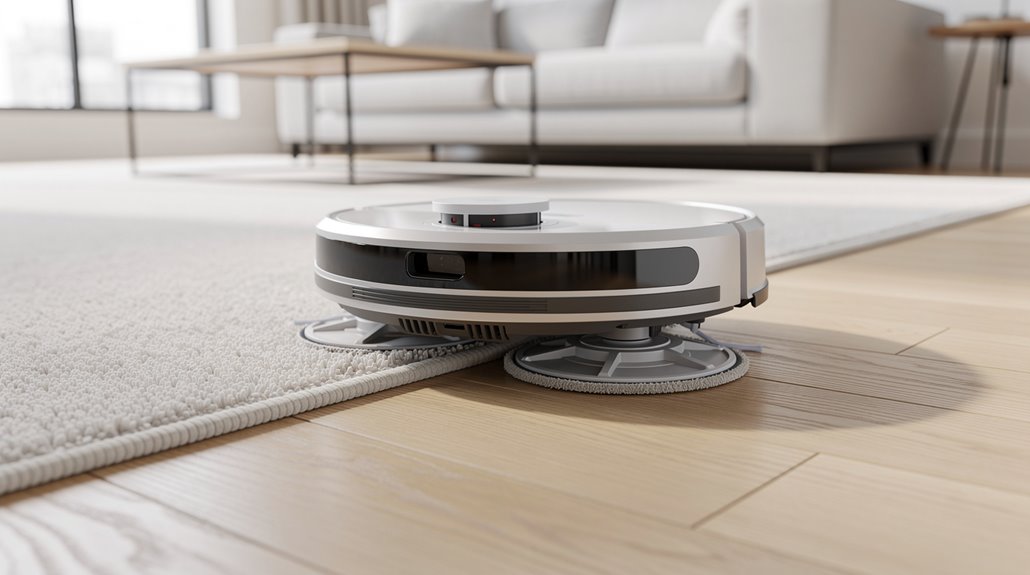
Most robot mops struggle with mixed-floor homes because they’re built to do one job well, not two jobs at once.
Ecovacs models handle carpet transitions best—they lift or scrape moisture before reaching carpet without detaching pads. Dreame L40S Ultra detaches pads at the station for vacuum-first runs, keeping high-pile completely dry. Narwal Freo wets carpet despite lift capability, making it unreliable for combined runs. Models with full-featured docks can automatically manage emptying, mop washing, and water refilling, supporting more frequent cleaning cycles on mixed surfaces. Programming no-mop zones for valuable rugs or carpets provides an additional safeguard, since automatic mop-lifting features are not foolproof across all models and conditions.
When to Use No-Mop Zones vs Relying on Auto Lift
The Ecovacs and Dreame models we talked about handle carpet transitions differently, but neither approach works everywhere—that’s where you’ve got to make a choice.
Ecovacs and Dreame robots handle carpet transitions differently—neither works everywhere, so choosing the right approach matters.
You’ll want a no-mop zone robot if you’ve got high-pile carpets or delicate rugs. Auto lift works fine for low-pile surfaces under 0.5 inches. Consider these:
- High-pile carpets over 0.75 inches need no-mop zones
- Low-pile under 0.5 inches handles auto lift reliably
- Medium-pile benefits from combining both methods
Models with extendable mop pads like the Roborock Saros 10R provide additional edge coverage when transitioning between carpet and hard flooring, offering flexibility beyond standard auto lift alone. Robot mops equipped with infrared sensors can detect carpet presence and automatically adjust their cleaning approach to prevent water damage and maintain effectiveness across different surface types.
Frequently Asked Questions
How Much Does Auto Lift Technology Typically Add to a Robot Mop’s Cost?
You’ll typically spend $200–$400 more for auto lift technology on combo robots. However, you’re finding it’s increasingly standard across mid-to-premium models rather than an exclusive luxury feature that drastically inflates prices.
Can Auto Lift Mechanisms Fail, and What Happens if They Malfunction?
Yes, auto lift mechanisms can fail. You’ll experience issues like your mop dragging on carpets, getting stuck on transitions, or leaving wet streaks. You may hear unusual noises and need manual intervention to free your robot.
Are Robot Mops With Auto Lift Safe for Pets and Children?
You’ll appreciate that anti-tangle brushes handle pet hair without snagging—a key safety feature. Set virtual boundaries around your pet areas, remove toys beforehand, and you’ll create a secure environment for both children and pets.
How Long Do Auto Lift Motors Usually Last Before Needing Replacement?
You’ll find that auto lift motors don’t have a specific lifespan documented, but they’ll typically last as long as your main motors—beyond four years with proper maintenance. You can extend their life by keeping components clean and replacing worn parts regularly.
Do All Robot Mop Brands Use the Same Auto Lift Technology Standards?
You’ll find that only ECOVACS specifies a standard 0.39-inch lift height, while other brands like eufy and Roborock don’t publish exact measurements. You’re working with fragmented standards across the industry, so you’ll need to compare individual models rather than relying on universal benchmarks.
Conclusion
You’re basically choosing between two paths: teaching your robot where not to mop, or letting it learn carpet on the fly. Auto lift tech handles mixed floors without your input, like a friend who knows your house better each visit. Zone mapping puts you in control but demands setup work. Neither’s perfect. Your choice depends on whether you’d rather fiddle upfront or trust the machine to figure it out.