
You’re picking between three main navigation systems. LiDAR spins a laser 360 degrees to build precise real-time floor maps, handling dark rooms and complex layouts. Camera-based systems track visual landmarks but struggle without good lighting or distinct features. Gyroscopes and accelerometers estimate movement using motion sensors—cheap and simple, but less accurate for larger spaces. Each approach trades accuracy for cost and works better in different homes. The layout of your space and lighting conditions determine which tech actually serves you best.
Key Points
- LiDAR uses rotating lasers firing thousands of pulses per second to create 360-degree real-time floor maps for navigation.
- Camera-based vSLAM tracks visual features like corners and textures to build maps, but struggles in low-light or featureless spaces.
- Gyroscope and accelerometer sensors enable budget navigation through motion tracking without detailed mapping, suitable for simple homes.
- S-path algorithms create systematic straight-line coverage with reduced overlap, improving efficiency over random-bounce patterns.
- LiDAR maintains consistent mapping in darkness and complex layouts where camera systems degrade due to poor lighting conditions.
How LiDAR Sensors Build a Real-Time Floor Map in Robot Vacuums
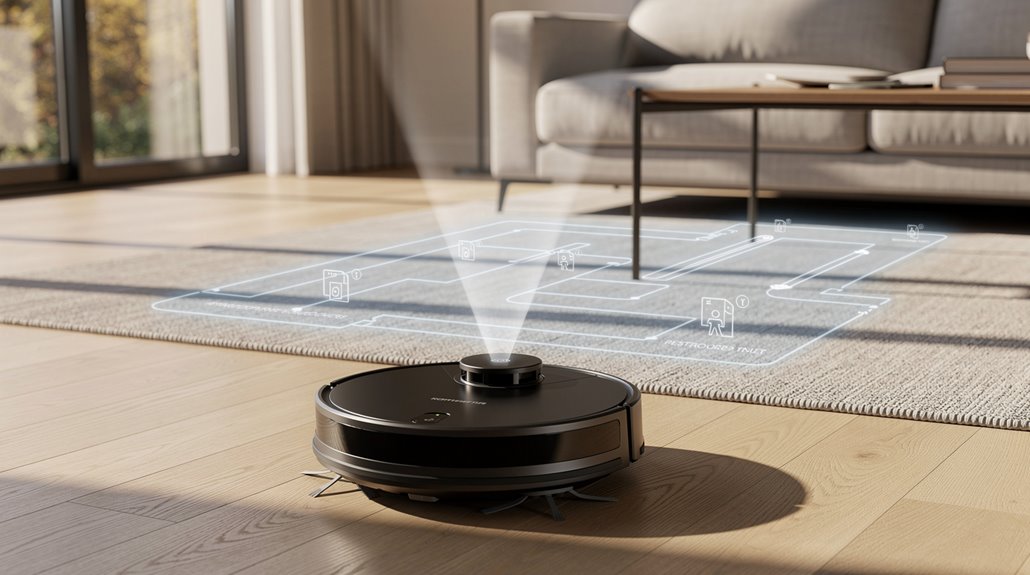
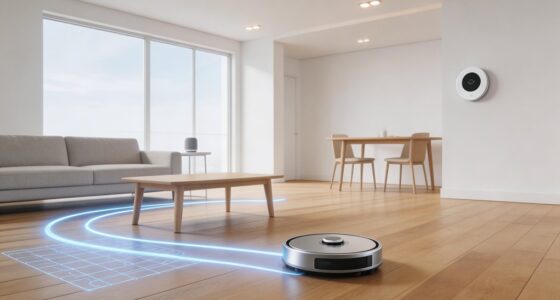
When your robot vacuum’s laser spins 360 degrees across the room, each beam that bounces back tells it exactly how far away a wall or chair leg sits, and those individual distance readings stack up into a point cloud that forms your floor plan in real time.
You get accurate mapping even when your lights are off or dimmed, since LiDAR creates its own light source rather than relying on ambient brightness the way cameras do. That active illumination is why LiDAR vacuums maintain consistent map quality in dark hallways or nighttime cleaning runs where camera-only systems start guessing. Unlike camera-based systems that struggle with transparent or reflective surfaces, LiDAR’s laser technology can penetrate through glass and shiny floors without the confusion that impacts hybrid or vision-only approaches. SLAM fuses inputs from multiple sensors to produce accurate, efficient navigation and reduce collisions during the mapping process.
How a rotating laser creates a point-cloud 2D floor plan
To map your home, a robot vacuum needs to know where walls and furniture are, which is where LiDAR comes in. Your lidar robot vacuum spins a laser thousands of times per second, converting distance measurements into precise coordinates:
- Rotating laser fires pulses in all directions
- Distance data converts to x-y coordinates
- Each scan creates a 2D point cloud slice
- Successive scans merge into a complete floor map
This generates the real-time map your vacuum navigates by. The 360-degree mapping capability enables the vacuum to build a comprehensive environmental model that supports thorough and precise cleaning results across your entire space. These distance measurements are processed by SLAM technology to simultaneously localize the vacuum’s position while mapping its surroundings.
Why LiDAR robot vacuums maintain accuracy in low-light rooms
Now that you know how LiDAR creates those detailed floor maps by spinning a laser thousands of times per second, here’s something that matters in real homes: that same laser works just as well whether your lights are on or off. Your LiDAR sensor emits its own light, so it doesn’t depend on ambient brightness. Dark hallways and nighttime cleaning don’t slow it down. This rapid multi-directional pulse capability allows LiDAR to build an extremely accurate map regardless of environmental lighting conditions, making it ideal for homes with varying light throughout the day. Unlike vSLAM systems that struggle with poor lighting, LiDAR’s light-independent design ensures consistent performance in any room brightness level.
| Condition | Camera Systems | LiDAR Sensor |
|---|---|---|
| Bright room | Works well | Works well |
| Dim lighting | Struggles | Maintains accuracy |
| Complete darkness | Fails | Maintains accuracy |
How Camera Navigation Uses vSLAM to Map a Home Without a Laser
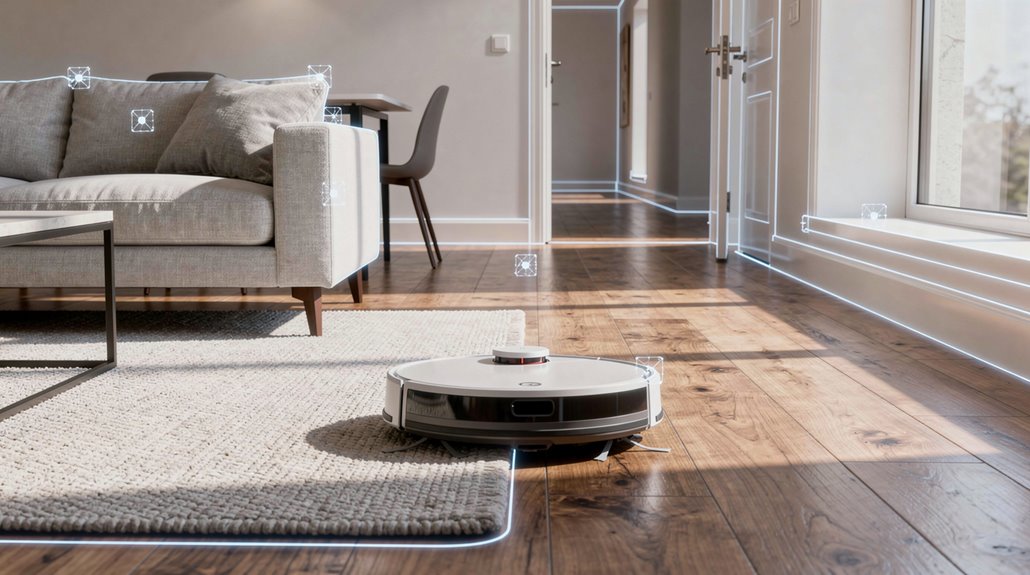
While camera-based systems track visual features like corners and texture instead of bouncing lasers, you’re relying on those landmarks to stay oriented—which works fine in a furnished living room but falls apart in a sparse bedroom or hallway where there’s nothing distinctive to lock onto.
Your vacuum effectively loses its bearings in featureless spaces because vSLAM needs enough visual detail to build and match a map, so a blank white wall or empty tile floor gives the system almost nothing to work with. Some manufacturers mitigate this limitation by adding LED ring lights to improve visibility in darker areas.
That’s why these robots often struggle with initial mapping in minimalist homes or poorly lit rooms, whereas a LiDAR unit would map the same space without hesitation. However, many camera-based systems improve their performance through iterative learning by updating their maps after each cleaning session to refine their understanding of the space.
How visual landmarks replace laser data in camera-guided models
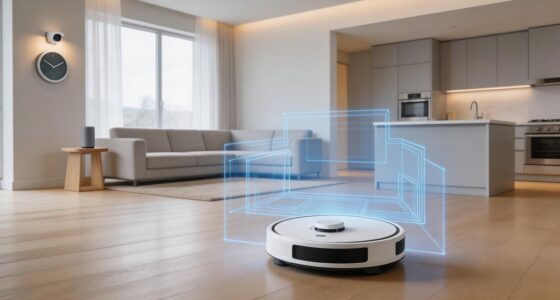
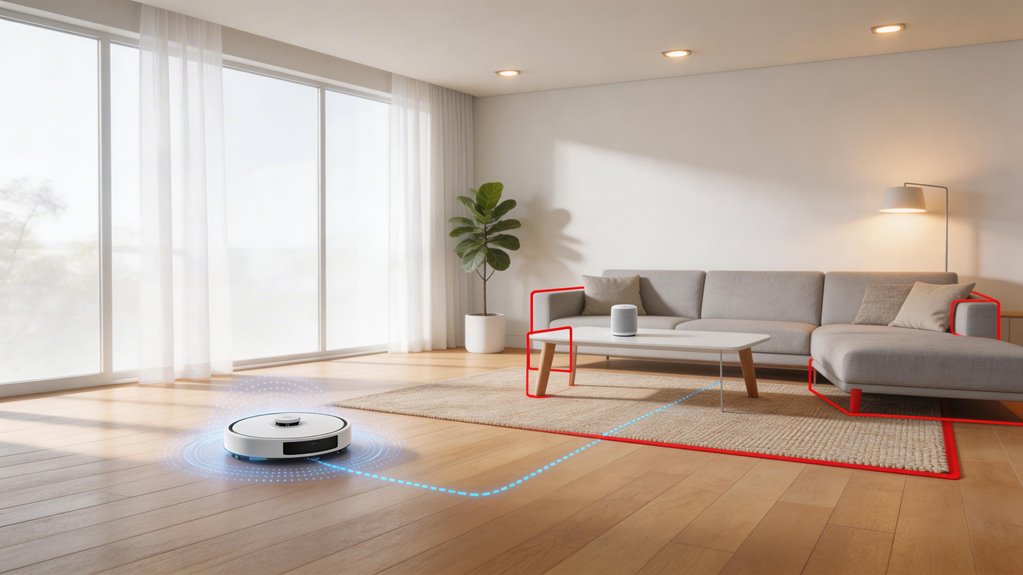
Camera-guided robot vacuums skip the laser entirely and swap in visual landmarks instead—corners, texture patches, and object edges that the robot’s onboard camera detects and tracks as it moves through your home.
A vSLAM robot vacuum builds its map this way:
- Detects keypoints using algorithms like FAST or ORB
- Matches features between consecutive frames
- Triangulates 3D positions from camera motion
- Refines landmark positions through bundle adjustment
Pairing the camera with an IMU improves robustness when the robot navigates past featureless areas or transitions between rooms with varying lighting conditions. However, camera-based systems face limited functionality in low light environments, which can degrade navigation accuracy and mapping performance.
Where camera navigation loses accuracy in sparse or featureless rooms
The camera-guided approach works well in a furnished living room or kitchen, but it hits real limits the moment you move into sparse or visually plain spaces.
Your camera navigation robot vacuum needs distinct features—corners, edges, furniture—to build an accurate map. Empty rooms or uniform walls starve the vSLAM system of reference points, forcing your vacuum to navigate with incomplete spatial data and miss coverage areas entirely. In contrast, LiDAR maintains obstacle detection through laser distance measurements that function independently of visual landmarks, allowing consistent navigation where camera systems fail. Combining both technologies—camera plus LiDAR—enables systematic cleaning paths that work reliably across all room types and lighting conditions.
How Gyroscope Navigation Works in Robot Vacuums and Which Models Use It
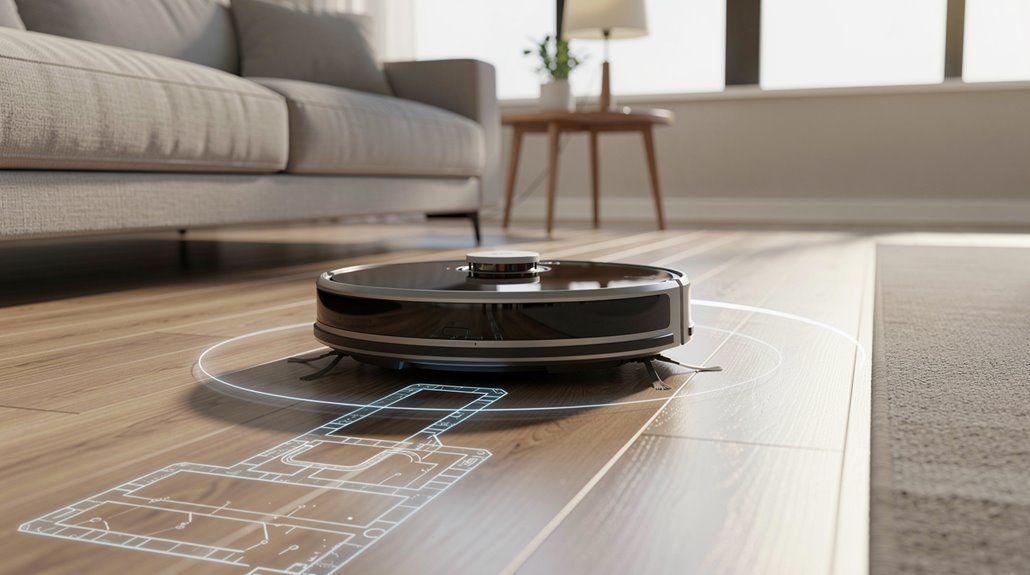
If you’ve shopped for robot vacuums on a budget, you’ve probably encountered models relying on gyroscope navigation—and you might’ve wondered what that actually means.
Budget robot vacuum shoppers often wonder what gyroscope navigation actually means and how it works.
Gyroscope robot vacuums track motion and angles through built-in sensors:
- Motion sensors monitor directional changes like smartphone technology
- Accelerometers calculate distance and direction of surrounding objects
- Rotation sensors determine robot position relative to obstacles
- Semi-structured cleaning patterns follow without detailed visual maps
Models like the Tesvor X500 and Dirt Devil EV3320 deliver affordable cleaning for simple, single-level homes. Gyroscope and accelerometer mapping sensors are commonly found in these lower-cost models because they provide less precise maps compared to LiDAR or camera-based alternatives. These motion-based systems represent an upgrade from random movement for budget-conscious consumers seeking better efficiency than purely random navigation.
You get moderate accuracy and basic obstacle avoidance—practical for clutter-free spaces under $200.
How Robot Vacuum Navigation Technology Affects Cleaning Path Coverage
When your robot vacuum bounces randomly around your living room, it’s burning battery life covering the same spots twice while missing corners—especially tough in larger floor plans where random patterns just can’t scale efficiently.
Systematic S-path algorithms, by contrast, break your rooms into ordered lines that the robot follows methodically, so you get consistent edge-to-edge coverage and less wasted energy on overlap. EdgeSwing technology enables close baseboard and furniture-edge cleaning without missing spots along the perimeter.
The trade-off is that these structured paths demand accurate mapping tech (LiDAR or camera-based SLAM), which costs more upfront but typically cuts your cleaning time per run and leaves fewer skipped zones. When a robot is lifted and relocated, it must re-localize by detecting objects and tracing walls to reestablish its position on the map before resuming systematic coverage.
Why random-bounce patterns waste battery on large floor plans
Because random-bounce robots lack mapping intelligence, they’re forced to clean the same spots over and over—which absolutely tanks battery life on anything bigger than a small apartment.
You’ll notice:
- Repeated passes waste energy on covered ground
- Frequent direction changes drain the battery faster
- Extended run times needed for partial coverage
- Open spaces create haphazard, inefficient paths
The robot simply bounces until it hits something, then changes direction randomly. Without wall and stair sensors, the robot cannot effectively detect obstacles and prevent falls, compounding navigation inefficiencies. Dust bin sensors and idle power monitoring can also significantly increase standby battery consumption, causing drain rates of 10–13% per hour even when the robot is not actively cleaning.
On large floor plans, this redundancy means you’re replacing the battery long before the robot finishes the job.
How systematic S-path algorithms improve per-run coverage rate
While random-bounce robots waste energy covering the same floor over and over, S-path algorithms take a different approach—they move your vacuum in straight lines until it hits something, then execute two 90-degree turns in the same direction before switching directions for the next pass.
This creates an S-shaped pattern that systematically covers floor spaces. Robot vacuum floor mapping builds incrementally during exploration, so each run covers more ground without redundant passes.
Which Robot Vacuum Navigation Technology to Choose for Your Home Layout
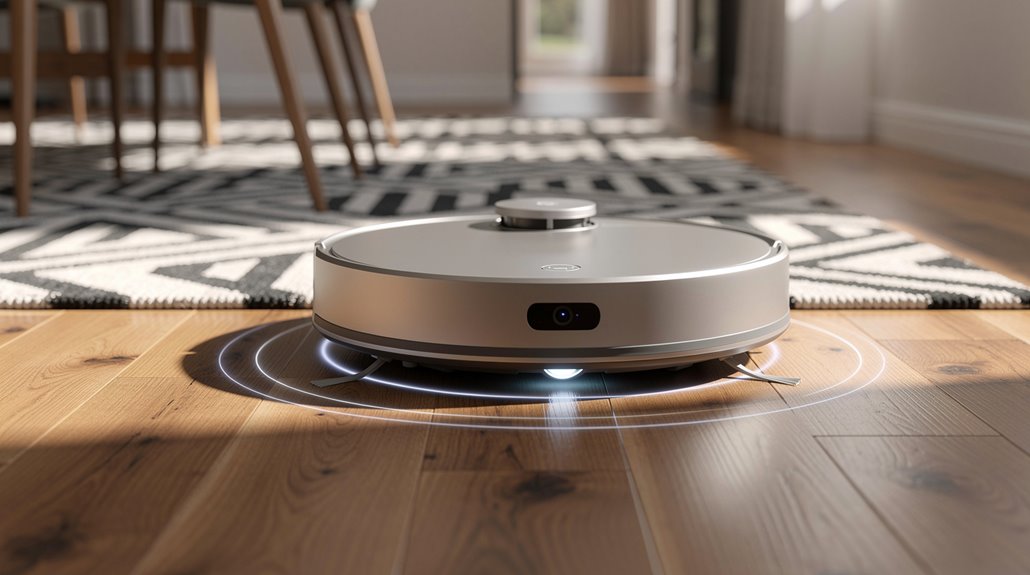
Picking the right navigation tech for your robot vacuum comes down to understanding your home’s layout and lighting, not chasing the fanciest option.
Your choices matter more than marketing buzz:
- LiDAR handles dark rooms and complex layouts with 2D floor plan mapping
- vSLAM works best in bright spaces with clear visual landmarks
- Hybrid systems balance mixed lighting and complicated floor plans
- Ultrasonic sensors add millimeter-accurate obstacle detection regardless of conditions
Match the tech to your actual space. RobotVacs.com’s comprehensive database lets you filter robot vacuums by navigation technology specifications to find models that align with your home’s unique conditions and layout requirements.
Frequently Asked Questions
How Often Do Robot Vacuums Update Their Navigation Maps During Cleaning Cycles?
Your robot vacuum’s practically a map-making machine, updating its navigation pathways fifty times per second during cleaning cycles. You’re getting constantly recalibrated routes as it encounters every tiny furniture shift and obstacle change.
Can Robot Vacuums Navigate in Complete Darkness Without Any Light Sources?
You can absolutely navigate your robot vacuum in complete darkness. Modern models use LiDAR, infrared sensors, and AI technology to map environments and avoid obstacles without relying on any ambient light sources whatsoever.
What Happens to a Robot Vacuum’s Map if Wifi Connection Is Lost?
Your map doesn’t vanish—it stays put. While your app goes dark and you’ve lost remote control, your vacuum’s onboard memory retains the stored map. You’ll keep cleaning autonomously until WiFi reconnects and syncs your session data back.
How Do Robot Vacuums Handle Obstacles That Appear After Initial Mapping?
Your vacuum continuously scans during cleaning with LiDAR or cameras, detecting new obstacles in real-time. When it finds one, it automatically recalculates your cleaning path and reroutes around the obstruction to resume coverage.
Do Multiple Robot Vacuums Interfere With Each Other’s Navigation Sensors?
Yes, you’re barking up the right tree with that concern. Your vacuums’ LiDAR beams scatter off each other’s surfaces, cameras create visual confusion, and ultrasonic sensors pick up false echoes, disrupting navigation accuracy significantly.
Conclusion
You’ve got genuinely good options now. LiDAR lets you lay out no-go zones with precision. Cameras work well in lit rooms but struggle in dim spaces. Gyroscopes alone won’t cut it. Pick based on your home’s layout and lighting. Budget matters too—LiDAR costs more but cleans smarter. Neither tech is perfect, and that’s fine. You’ll get a cleaner floor either way.