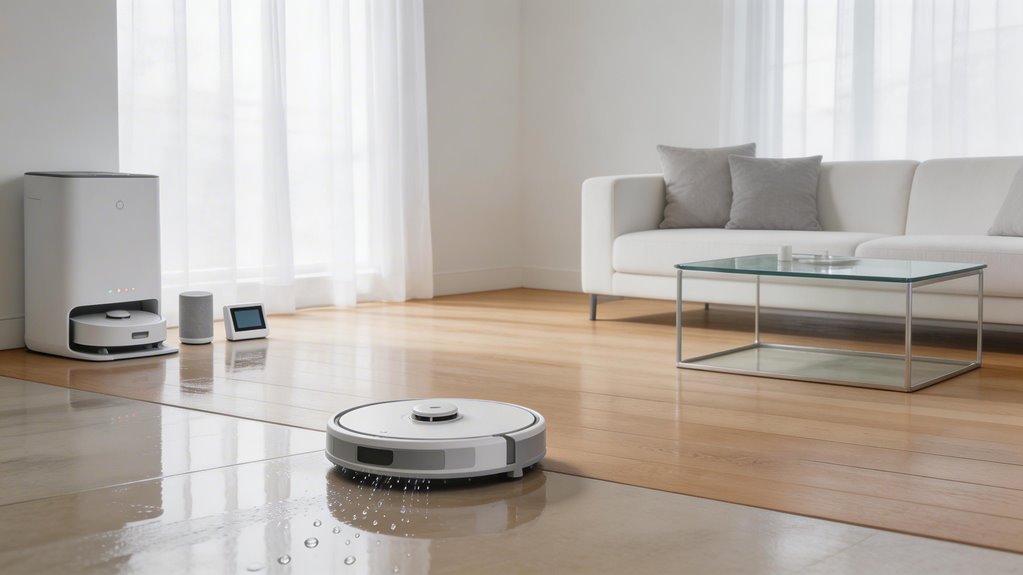

Auto water control in robot mops adjusts water flow in real time based on dirt and floor type, using sensors and microcontrollers to meter precise volumes—typically 10–20 ml per square metre. Pump-fed systems maintain consistent pressure regardless of tank level, whereas gravity tanks lose effectiveness as they empty, causing streaks and uneven coverage. You’ll get longer runtime, better battery efficiency, and fewer second passes when your mop adapts water output to what your floors actually need rather than dumping constant moisture. Understanding how these systems fail—clogged nozzles, mineral buildup, degraded check valves—helps you pick models built to handle hard water and regular maintenance demands.
Key Points
- Microcontrollers adjust water flow in real time using floor-type and dirt sensors for optimal moisture levels.
- Peristaltic pumps meter precise volumes (10–20 ml per sq metre) via PWM signals for consistent pressure.
- Auto water control extends runtime by adapting pump intensity to cleaning demands and surface types.
- Low-flow protects sealed hardwood from warping; high-flow effectively cleans tile and grout without streaking risks.
- Electronic systems maintain consistent pressure regardless of tank level, unlike gravity tanks that lose effectiveness.
What Auto Water Control Actually Does in a Robot Mop System
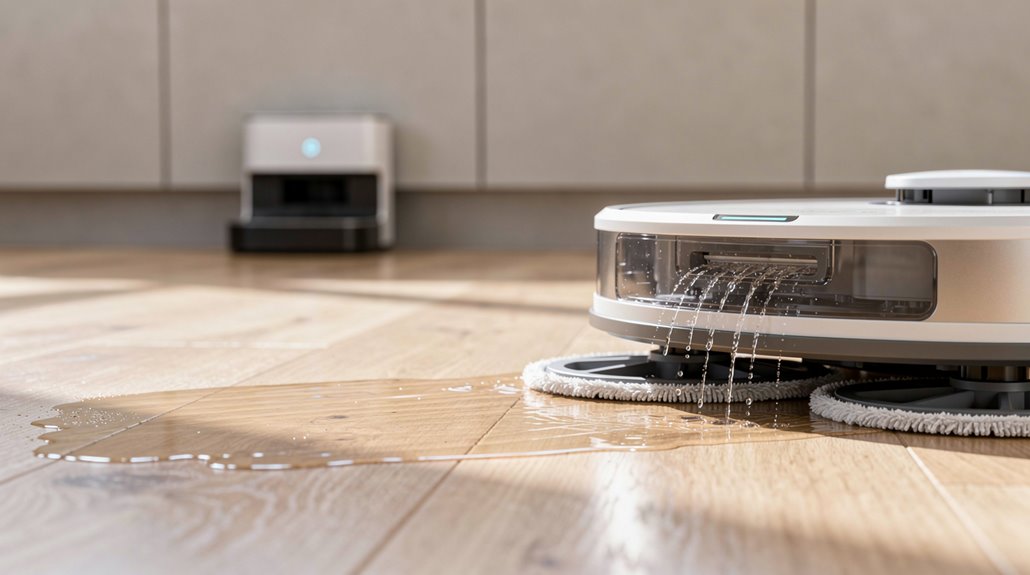
Auto water control in robot mops does something pretty straightforward: it handles the water sourcing and drainage that’d otherwise be your job.
Your robot mop water flow regulation works through a control box that signals when to pull clean water and when to dump dirty water into your home’s drainage system. The control box connects directly to your home’s cold water source and household drainage, operating similarly to how a laundry machine manages its embedded water tanks. Advanced docking stations with self-emptying dustbin technology also handle wastewater management automatically, similar to how traditional dustbins are disposed of every 30 to 60 days.
You get continuous mopping without manual refilling or emptying tanks.
How Electronically Controlled Water Flow Differs from Gravity Tank Delivery
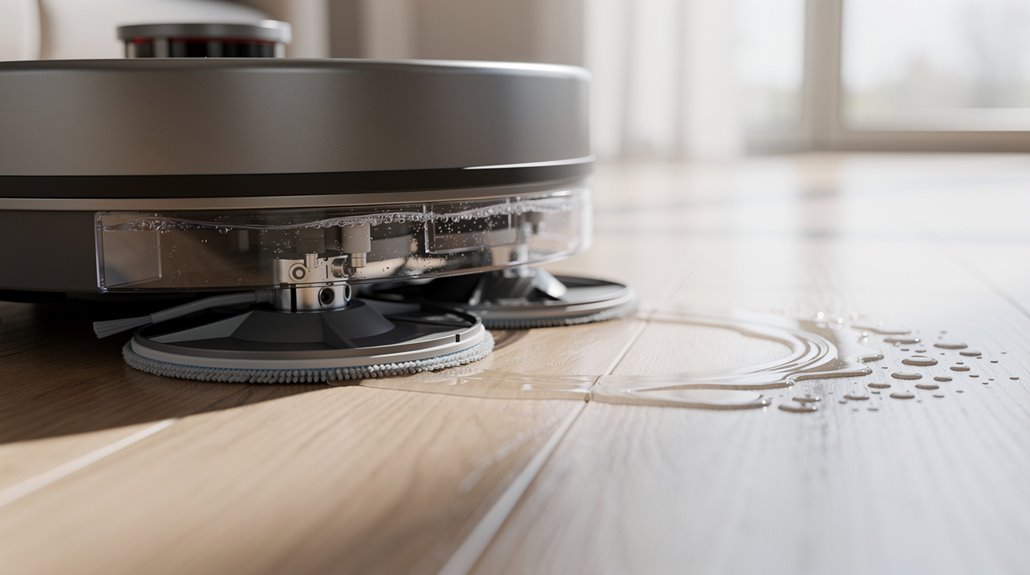
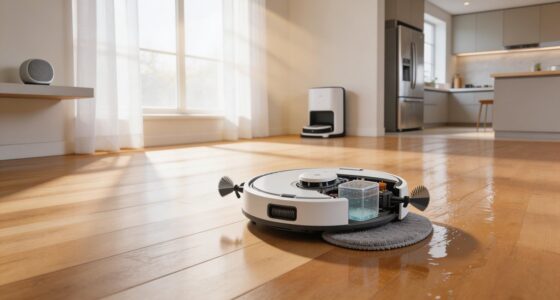
When you use a pump-fed system, the robot adjusts water flow in real time based on how dirty the floor is, so you’re not wasting water on already-clean areas.
A gravity tank, on the other hand, drips the same amount of water whether you’re on your first pass or your fifth, which means you either start with oversaturated floors or finish with a dry mop.
This inconsistency is why pump-based robots can handle 1500 square feet on one tank while gravity systems peter out halfway through with uneven cleaning. By continuously removing dirty water through peristaltic pump technology and vacuum suction, pump-fed systems maintain optimal moisture levels throughout the entire cleaning cycle. The FlowWash Mopping System uses warm water and scrubbing pressure to break down stains effectively while regulating water distribution through its 16 nozzles.
How a pump-fed system regulates flow rate per square metre of floor
Pump-fed systems in robot mops work differently than the gravity tanks you might expect, and that difference matters for how much water actually hits your floor. Your pump-fed robot mop delivers water through active control:
- Microcontrollers adjust flow based on floor type and dirt sensors
- Peristaltic pumps meter precise volumes, typically 10-20ml per square meter
- PWM signals modulate pressure in real-time across your entire cleaning path
- Auto-calibration during docking optimizes water output for each session. Proper metal contact alignment ensures the electrical connection required for consistent water release throughout your cleaning cycle. The automatic fill and drain kits that connect to household plumbing eliminate the need for manual water container maintenance while supporting these electronically controlled systems.
Why gravity tanks deliver inconsistent water volume across a full run
Gravity tanks sound simple—water sits in a reservoir, gravity pulls it down through the mop pad, done.
Except your gravity tank robot mop delivers different water volumes as it cleans. Pressure drops as the tank empties, so early passes oversaturate while later ones underwet. You get streaks, incomplete stain removal, and floors that need a second pass. That’s the trade-off with unpressurized systems. Premium robot mops like the Yeedi M14+ and Dreame L50 Ultra address this with auto detergent filling and electronically controlled water flow, which maintains consistent pressure throughout the entire cleaning cycle regardless of tank level. In testing, robots with electronically controlled systems like the Dreame L40S Ultra used only 97.5% of water per 100 sq ft compared to gravity-fed competitors, demonstrating superior water efficiency while maintaining mopping performance.
How Water Volume Settings Affect Mopping Results on Different Hard Floors
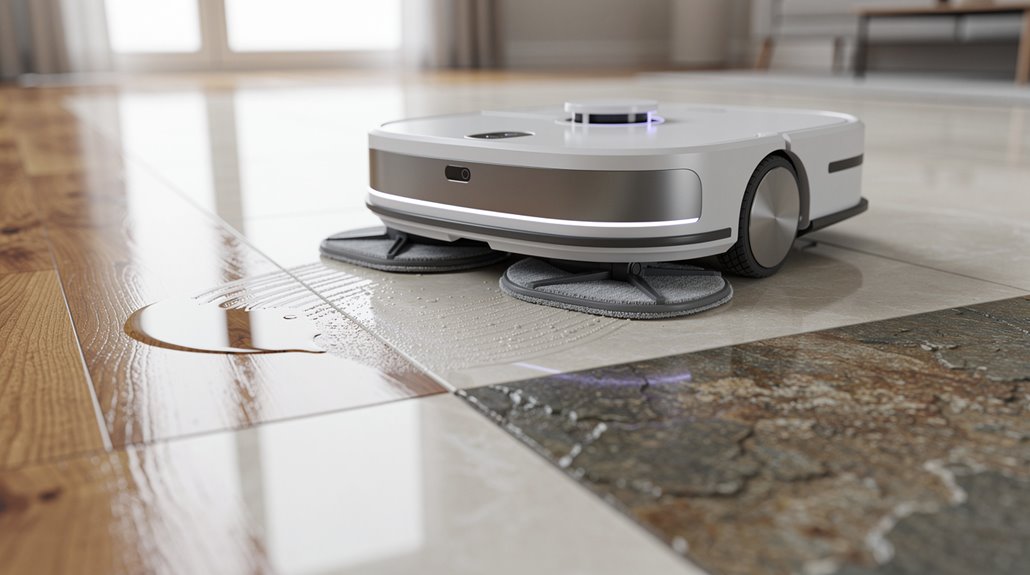
When you set your robot mop to low-flow on sealed hardwood, you’re protecting that finish from moisture seeping into the wood and causing warping, while the same low setting on unsealed tile won’t give you the grout cleaning power you actually need.
High-flow settings flip the script—they work well for tile because the material shrugs off extra water and lets you tackle stubborn grime in grout lines, but that same volume on hardwood risks dulling the surface and leaving streaks.
The real move is matching your water volume to what each floor type can handle, which the app lets you dial in separately for different rooms. Models like the DEEBOT X8 PRO OMNI feature OZMO ROLLER Instant Self-Washing mopping technology that automatically adjusts water delivery based on surface type, ensuring optimal cleaning without compromising floor integrity. Saving separate water settings per floor in your robot’s app prevents accidental damage when the system switches between different room types during a cleaning session.
What low-flow settings do on sealed hardwood vs unsealed tile
Low-flow settings handle sealed hardwood and unsealed tile differently because the two surfaces have opposite vulnerabilities to moisture. Your robot mop water volume settings matter here:
- Sealed hardwood risks warping and finish damage from pooling water between planks
- Unsealed tile tolerates slightly more moisture without structural harm
- Low flow prevents grout line over-saturation on textured surfaces
- Real-time dirt detection adjusts flow, protecting sensitive wood better than tile
- Adjustable water flow via companion app allows minimal water use on wood, reducing excess liquid exposure that could cause long-term damage. Dry mopping mode provides an additional option for stubborn spots on hardwood without applying excessive moisture.
This distinction shapes which floors benefit most from flow control.
How high-flow settings interact with grout line cleaning
Because grout lines trap dirt and debris the way sealed hardwood can’t, you’ll notice high-flow settings handle them differently than low-flow does. Your robot mop grout cleaning improves significantly when you increase water volume. The higher saturation penetrates joint buildup effectively. Electronic pumps prevent oversaturation despite increased flow. You’ll reduce manual scrubbing frequency considerably. Electronic control pumps deliver precise water distribution, ensuring that excess moisture doesn’t damage grout or create pooling on tile surfaces.
| Flow Setting | Water Volume | Grout Penetration | Frequency Needed |
|---|---|---|---|
| Low-Flow | Minimal | Surface only | Weekly |
| Medium-Flow | Moderate | Partial depth | Every 5 days |
| High-Flow | Maximum | Full saturation | Every 7-10 days |
| High-Flow + Detergent | Maximum | Deep cleaning | Every 10-14 days |
| High-Flow + Textured Pad | Maximum | Optimal agitation | Every 10-14 days |
How Auto Water Control Affects Robot Mop Battery Run Time
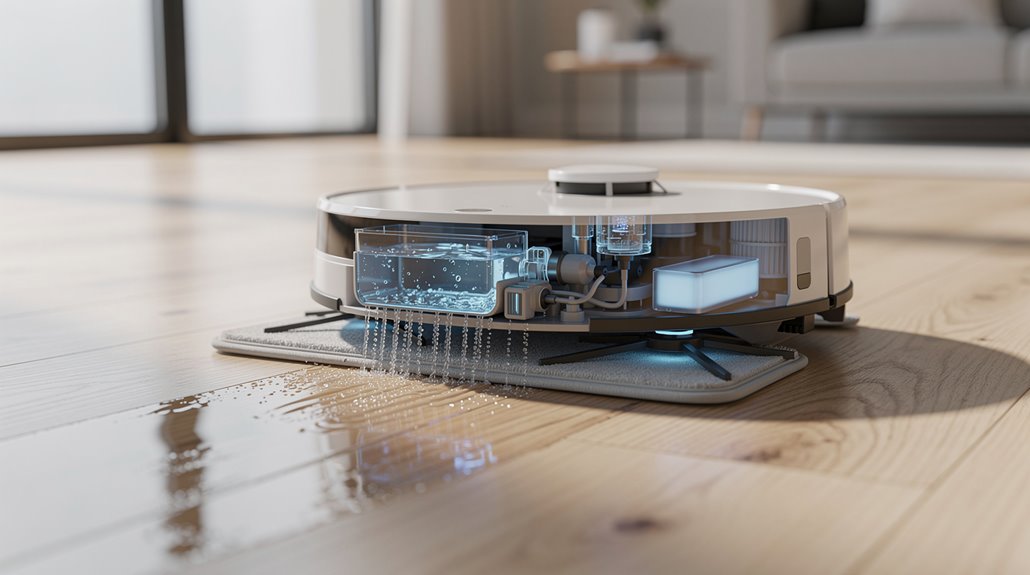
Balancing water flow with battery drain is where auto water control actually earns its place in robot mops. Your robot mop battery water consumption drops significantly when the system adapts to surface type instead of running full-blast everywhere. Similar to how intelligent power management preserves runtime in advanced robot vacuums, adaptive water control systems optimize energy use by adjusting pump intensity based on cleaning demands. Mopping systems add load from motors and pumps, so adaptive water control directly reduces the power draw that would otherwise shorten runtime significantly.
- Medium settings extend runtime to 94 minutes per charge
- Edge mopping uses smart flow without excessive pump strain
- Carpet detection lifts mops, skipping unnecessary water activation
- Path planning avoids high-water zones, preserving battery capacity
What Happens When Auto Water Control Components Fail
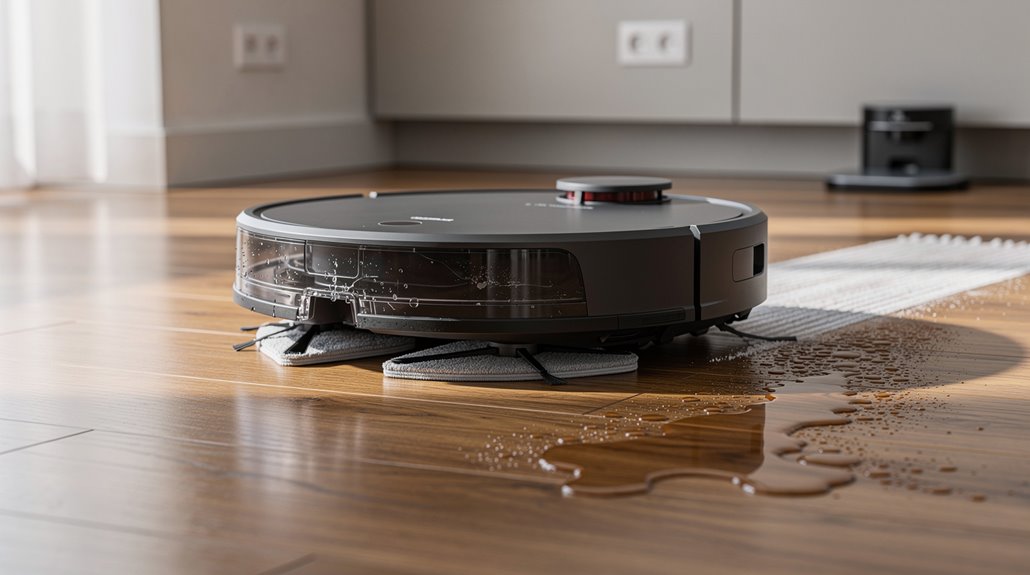
When your robot mop’s water system stops working the way it should, you’re not just looking at a convenience issue—you’re watching a chain reaction that can damage the whole machine. Clogged nozzles restrict flow. Failed solenoid valves trap water. Degraded seals leak internally. Your robot mop water tank design breaks down under mineral buildup and stagnation, forcing costly repairs or replacement. Hard water use for mopping accelerates mineral scaling of valves and pumps within 30–60 cycles, compounding these failures and shortening your machine’s service life significantly.
| Component | Failure Mode | Result |
|---|---|---|
| Spray nozzles | Mineral blockage | Uneven or no water flow |
| Solenoid valve | Electrical failure | Water retention and overflow |
| Check valve | Rubber degradation | Continuous leaking into pads |
| Tank seals | Mineral corrosion | Internal fluid leaks damaging electronics |
Which Robot Mops Have the Most Precise Electronic Water Control Systems
If you’ve been frustrated by robot mops that either flood your floors or leave them barely damp, you’re bumping into the limits of basic water control. Here’s where precision actually matters:
Robot mops struggle with water control—either flooding or leaving floors barely damp. Precision features finally solve this problem.
- Roborock Saros Z70 uses local Matter integration for dock-based adjustments without internet dependency
- Ecovacs X11 pairs heated drying with RGB camera manual targeting for controlled application
- Eufy RoboVac L70 offers app-customizable maps preventing excess water in specific zones
- Dreame L40S balances dual spinning pads with side brush restraint during obstacles
The electronic water pump robot mop that fits you depends on whether you prioritize offline control, mapping precision, or simple adjustability. Most dual spinning pad systems rely on electronic water control to optimize moisture levels across different floor types and soil conditions. Combo units with spinning mop heads that agitate tend to distribute water more effectively during mopping cycles, particularly when tackling dried stains on tile floors.
Frequently Asked Questions
Can I Manually Adjust Water Flow Settings, or Is Auto Control Completely Automatic?
You can manually adjust water flow settings on most models through their mobile apps. You’re not locked into automatic control—you’ll customize water dispensing levels, though some robots like the S10 rely primarily on automatic systems during operation.
How Often Do Water Sensors Need Cleaning or Replacement for Optimal Performance?
Haven’t you noticed your mop’s performance drifting like dust through neglected corners? You’ll clean water sensors monthly with a soft cloth, replacing them only if damaged—they’re remarkably durable when properly maintained.
Are Robot Mops With Auto Water Control Compatible With Vinegar or Cleaning Solutions?
You shouldn’t use vinegar in robot mops with auto water control because it corrodes internal components and voids your warranty. Stick to manufacturer-approved solutions like iRobot’s Braava Jet Fresh Liquid or water alone for safe operation.
What’s the Learning Curve for Understanding My Robot Mop’s Water Control Settings?
You’ll master basic settings quickly—adjusting water output modes takes minutes—yet optimizing customization for your specific floors demands patience. Start with Daily Mop, then experiment with Deep and manual settings as you learn your home’s needs.
Does Auto Water Control Work Effectively on Textured or Uneven Tile Surfaces?
You’ll find auto water control works well on textured tiles through adaptive pressure adjustment and sensor detection. However, you’ll occasionally need manual intervention for stubborn grout buildup, and battery performance may decrease by 10-15%.
Conclusion
You might think auto water control is just a convenience feature, but it’s actually what separates clean floors from streaky ones. When you’ve got the right water volume matched to your floor type, you’re not fighting moisture damage or dry spots. Yes, it drains your battery faster than gravity-fed systems, but you’re getting actual cleaning results instead of just pushing dust around. That trade-off matters.