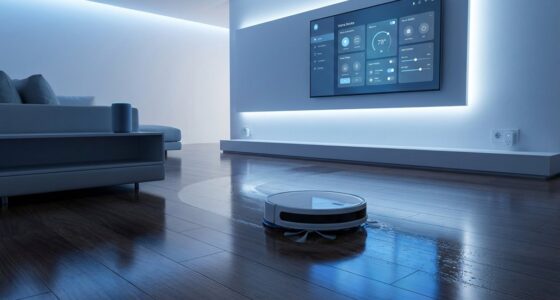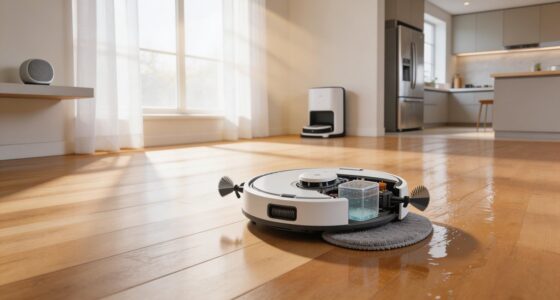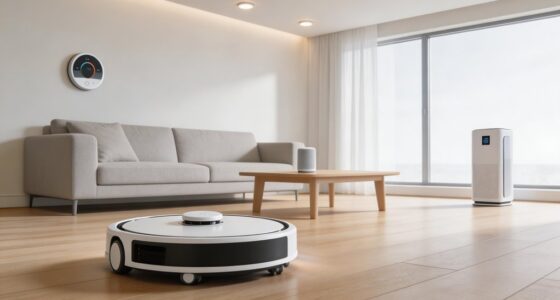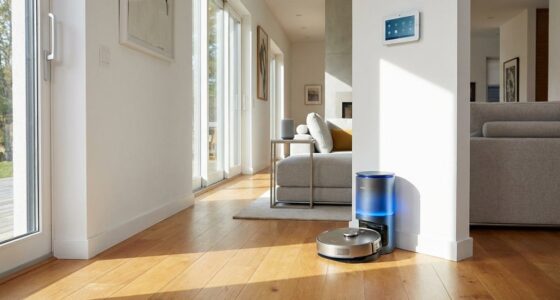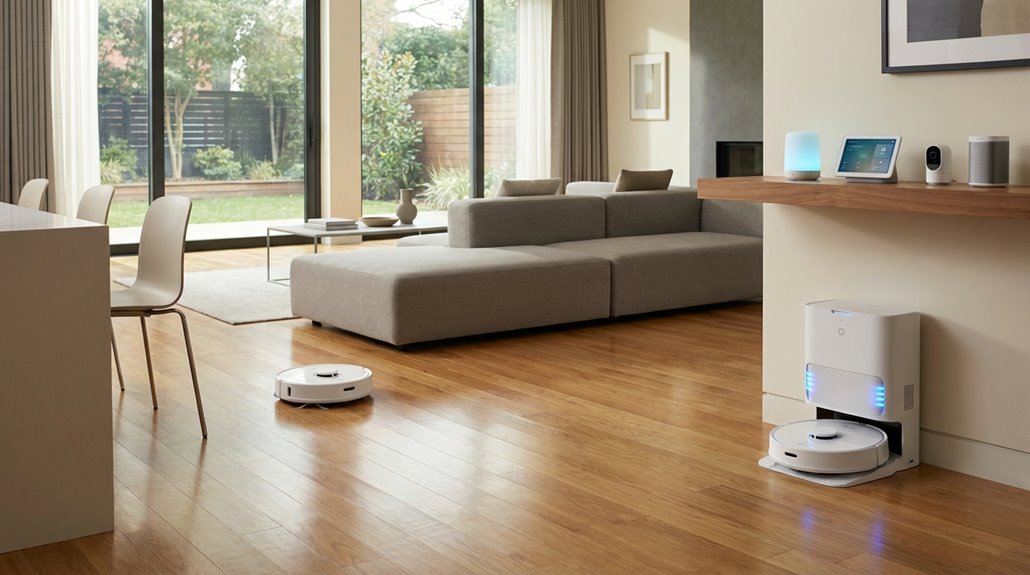
Hard floor homes accumulate fine debris and grit that standard robot vacuums scatter rather than capture — and low-clearance furniture eliminates units that cannot fit beneath it. We evaluated five robot mops against the specific demands of hard floor maintenance with height restrictions: debris containment on smooth surfaces, mopping precision without over-wetting, chassis clearance under low-profile furniture, and dock autonomy for hands-off operation.
The five units reviewed are the Shark Matrix Plus UR2650WS, eufy Omni C20, eufy X10 Pro Omni, Roborock Qrevo, and Roborock Saros 10R. Relevant technical constraints include Wi-Fi band compatibility, water tank capacity, and auto-empty cycle length.
By the end of this article, you will know which unit fits your floor type, furniture clearance, and maintenance tolerance.
Key Points
- The eufy X10 Pro Omni delivers 8,000 Pa suction, dual auto-lifting mops, and a self-washing dock covering up to 2,000 sq ft.
- The Roborock Qrevo combines 8,000 Pa suction, 200 RPM dual mops, and a full-rubber spiral brush that resists pet hair wrap.
- The Roborock Saros 10R features a 3.14-inch slim profile, Zero-Tangling brush, and Dock 4.0 storing up to 60 days of debris.
- The eufy Omni C20 offers 7,000 Pa suction with dual 180 RPM mops, though it only supports 2.4 GHz Wi-Fi networks.
- The Shark Matrix Plus UR2650WS uses sonic mopping at 100 strokes per minute and a HEPA base storing 30 days of debris.
| #5 Shark Matrix Plus Robot Vacuum and Mop (UR2650WS) |
|
Best for Mixed Floors
|
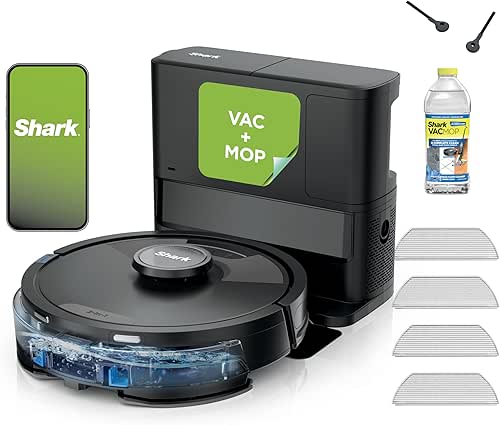
Suction Power: Not specified in Pa; described as ultra-powerful with self-cleaning brushroll | Mop System: Sonic mopping (100x per minute) with washable antimicrobial pads; Matrix Mop for targeted deep cleaning | Auto-Empty Base: Bagless HEPA self-empty base, up to 30 days capacity | VIEW LATEST PRICE | Read Our Analysis |
| #4 eufy Omni C20 Robot Vacuum and Mop Combo |
|
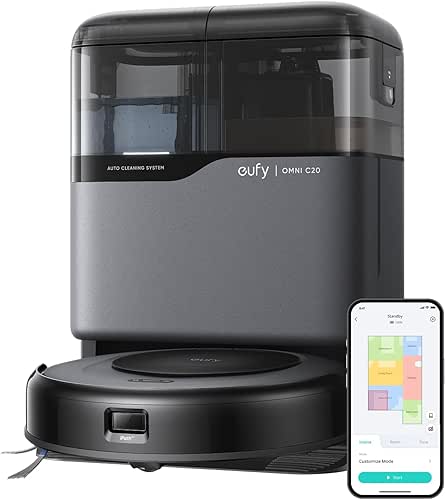
Budget-Friendly Pick | Suction Power: 7,000 Pa | Mop System: Dual rotating mops at 180 RPM with 6N pressure | Auto-Empty Base: Auto-emptying via all-in-one station | VIEW LATEST PRICE | Read Our Analysis |
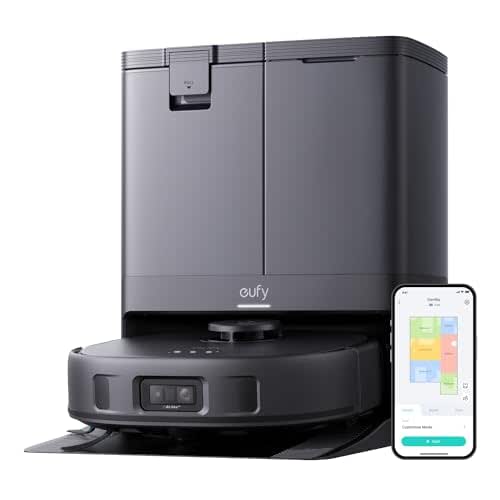
| #3 eufy X10 Pro Omni Robot Vacuum and Mop |
|
Best Value | Suction Power: 8,000 Pa | Mop System: Dual mops with MopMaster 2.0, 12 mm auto-lift on carpets | Auto-Empty Base: 2.5 L dust bag, replaces approximately every 2 months | VIEW LATEST PRICE | Read Our Analysis |
| #2 Roborock Qrevo Robot Vacuum and Mop (QV35A) |

|
Best for Dock Automation
|
Suction Power: 8,000 Pa | Mop System: Dual spinning mops at 200 RPM, 30 adjustable water levels, 10 mm carpet lift | Auto-Empty Base: Sealed 2.7 L dust bag, 7–9 weeks capacity | VIEW LATEST PRICE | Read Our Analysis |
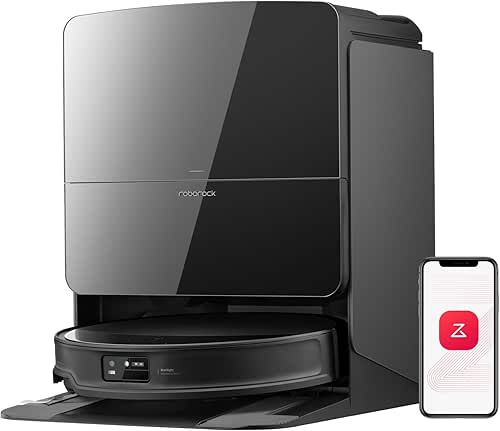
| #1 Roborock Saros 10R Self-Emptying Robot Vacuum and Mop |
|
Best Overall
|
Suction Power: 22,000 Pa | Mop System: Dual spinning mops with auto-lift on carpets; FlexiArm extends to corners/edges | Auto-Empty Base: 60-day automatic dust collection via Dock 4.0 | VIEW LATEST PRICE | Read Our Analysis |
More Details on Our Top Picks
-
Shark Matrix Plus Robot Vacuum and Mop (UR2650WS)
Shark Matrix Plus UR2650WS
A robot vacuum and mop for households with mixed flooring and pets that shed heavily.
Key Features:
- Matrix Clean grid pattern makes multiple passes for thorough carpet coverage
- Sonic mopping plate scrubs at 100 strokes per minute on hard floors
- HEPA self-empty base stores 30 days of debris without replacement bags
One limitation is that the onboard dust bin holds only 0.22 quarts, making frequent base-emptying necessary if the base is not available.
Suits hard floor homeowners who want automated cleaning across mixed surfaces without daily maintenance.
- Suction Power:Not specified in Pa; described as ultra-powerful with self-cleaning brushroll
- Mop System:Sonic mopping (100x per minute) with washable antimicrobial pads; Matrix Mop for targeted deep cleaning
- Auto-Empty Base:Bagless HEPA self-empty base, up to 30 days capacity
- Mop Washing & Drying:Not included; mopping pads are washable by user
- Navigation:360° LiDAR with Matrix Clean grid mapping and CleanEdge Detect
- Wi-Fi Connectivity:2.4 GHz and 5 GHz (not specified as limited); SharkClean app, Alexa, Google Assistant
- Additional Feature:CleanEdge air-blast detect
- Additional Feature:30-day bagless base
- Additional Feature:True HEPA anti-allergen seal
-
eufy Omni C20 Robot Vacuum and Mop Combo
The eufy Omni C20 is a robot vacuum and mop combo suited to households with mixed hard floor and low-pile carpet layouts. It delivers 7,000 Pa suction with dual rotating mops spinning at 180 RPM under 6N of downward pressure. The all-in-one dock empties, washes, and dries mops automatically using room-temperature air. The Pro-Detangle Comb reverses the roller brush and deploys a comb mechanism to clear wrapped hair. One limitation is that it only supports 2.4 GHz Wi-Fi, which creates compatibility issues if your router operates exclusively on 5 GHz. It suits homeowners who want automated post-clean maintenance without manual dock intervention.
- Suction Power:7,000 Pa
- Mop System:Dual rotating mops at 180 RPM with 6N pressure
- Auto-Empty Base:Auto-emptying via all-in-one station
- Mop Washing & Drying:Auto mop washing and room-temperature air drying via station
- Navigation:Not specified beyond app-based scheduling and control
- Wi-Fi Connectivity:2.4 GHz only; app control
- Additional Feature:3.35-inch low-profile
- Additional Feature:Transparent water tanks
- Additional Feature:Room-temp mop drying
-
eufy X10 Pro Omni Robot Vacuum and Mop
A self-maintaining robot vacuum and mop designed for pet-owning households with large hard-floor areas. Key features: 8,000 Pa suction for deep carpet cleaning; a pro-detangling roller brush that reduces pet hair maintenance intervals; dual mops that auto-lift 12 mm upon carpet detection, preventing wet contact with rugs. The dock self-washes, dries at 45°C, auto-empties, and refills from a 3 L tank covering up to 2,000 sq ft. One limitation is that it only supports 2.4 GHz Wi-Fi, which can complicate setup on dual-band routers. Recommended for hard floor homeowners managing large spaces who prioritize low-maintenance operation.
- Suction Power:8,000 Pa
- Mop System:Dual mops with MopMaster 2.0, 12 mm auto-lift on carpets
- Auto-Empty Base:2.5 L dust bag, replaces approximately every 2 months
- Mop Washing & Drying:Auto mop washing and heated drying at 45°C
- Navigation:iPath laser navigation with AI.See obstacle avoidance (100+ object types)
- Wi-Fi Connectivity:2.4 GHz only; app control with AI.Map 3.0
- Additional Feature:12 mm auto-lift mops
- Additional Feature:Heated 45°C drying
- Additional Feature:Cleans up to 2,000 sq ft
-
Roborock Qrevo Robot Vacuum and Mop (QV35A)
Roborock Qrevo (QV35A)
The Roborock Qrevo (QV35A) is a robot vacuum and mop designed for pet owners managing embedded fur and tracked-in debris. Its 8,000Pa suction extracts deep-set hair from carpets, and a full-rubber spiral brush resists hair wrap. Dual spinning mops operate at 200 RPM each, with 30 adjustable water levels for surface-specific flow control. The all-in-one dock empties into a sealed 2.7L bag and refills from a 4L water tank. One limitation is that it supports 2.4 GHz Wi-Fi only, which creates connectivity issues on routers that default to 5 GHz. Hard floor homeowners with mixed surface layouts will get consistent results from this unit.
- Suction Power:8,000 Pa
- Mop System:Dual spinning mops at 200 RPM, 30 adjustable water levels, 10 mm carpet lift
- Auto-Empty Base:Sealed 2.7 L dust bag, 7–9 weeks capacity
- Mop Washing & Drying:Dock washes and dries mopping pads
- Navigation:PreciSense LiDAR 360° real-time mapping, multi-floor support up to 4 levels
- Wi-Fi Connectivity:2.4 GHz only; Roborock app, smartwatch, and third-party voice control
- Additional Feature:30 water-level settings
- Additional Feature:4-floor map support
- Additional Feature:SGS-certified zero tangling
-
Roborock Saros 10R Self-Emptying Robot Vacuum and Mop
Best for Pet Hair
The Roborock Saros 10R is a robot vacuum and mop designed for households with long-haired pets and floor-level cable clutter. Its 3.14-inch profile allows access under low furniture. The Zero-Tangling DuoDivide brush resists hair jams through a divided bristle mechanism. The AdaptiLift chassis clears obstacles up to 4 cm, including cables. The Dock 4.0 washes mops at 176°F, dries them at 131°F, and stores up to 60 days of debris.
One limitation is that it only supports 2.4 GHz Wi-Fi, which may require router configuration adjustments on newer network setups.
Recommended for hard floor homeowners with low-clearance furniture or cluttered floor layouts who prioritize hands-off maintenance.- Suction Power:22,000 Pa
- Mop System:Dual spinning mops with auto-lift on carpets; FlexiArm extends to corners/edges
- Auto-Empty Base:60-day automatic dust collection via Dock 4.0
- Mop Washing & Drying:Hot water mop washing at 176°F and hot air drying at 131°F via Dock 4.0
- Navigation:StarSight Autonomous System 2.0 with 3D sensing, detects 108 obstacle types
- Wi-Fi Connectivity:2.4 GHz only; Roborock app, built-in Hello Rocky voice assistant
- Additional Feature:3.14-inch ultra-slim profile
- Additional Feature:Built-in RGB camera
- Additional Feature:176°F hot-water washing
Factors to Consider When Choosing Robot Mops
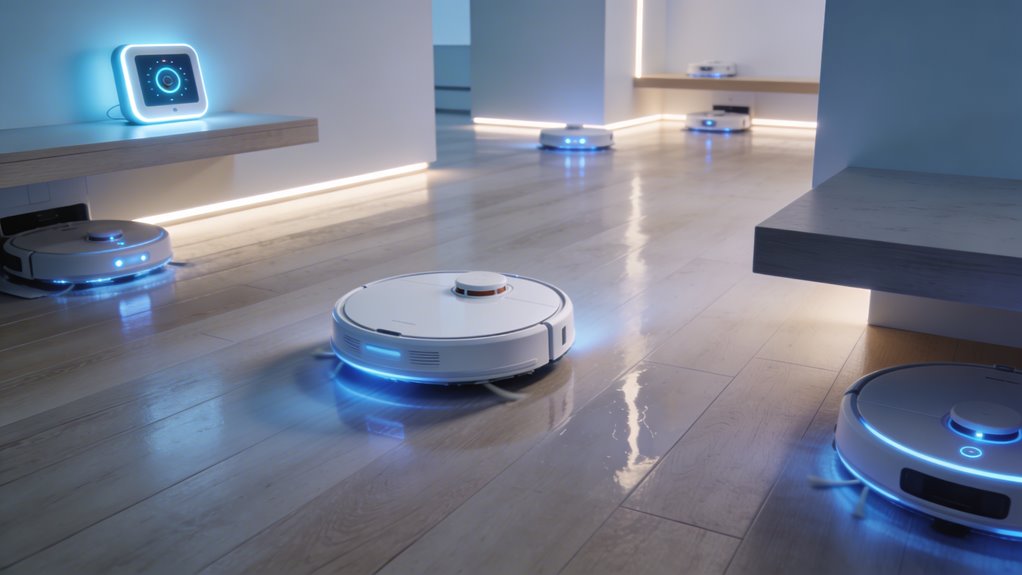
Picking the right robot mop comes down to a few specific things: how well the mopping system actually scrubs versus just dampening the floor, and whether the navigation can handle your furniture layout without constant rescues. Suction power matters if you want one machine to vacuum and mop, since weak suction on a combo unit leaves debris behind before the mop even touches the floor. You’ll also want to think about self-maintenance features like auto-emptying and self-cleaning mop pads, and whether the robot handles your specific floor types — hardwood, tile, and carpet each respond differently to water pressure and pad contact.
Mopping System Performance
Oscillating or rotating pads with measurable RPM and applied pressure scrub dried spills and grout lines rather than redistributing water across the floor. Pad movement spec is a more reliable performance indicator than water tank capacity alone.
Adjustable flow rates let users limit moisture on hardwood while delivering enough water to clean tile effectively. A single fixed-flow setting produces inconsistent results across surface types.
Docking stations with heated-dry cycles prevent bacterial growth in wet pads between uses. Pads left damp in a sealed dock degrade hygiene within hours.
Mop lift height, measured in millimeters, determines whether the system transitions from hard floors to carpet edges without saturating carpet fibers. Microfiber pad density and agitation frequency during dock washing cycles affect how long pads maintain scrubbing effectiveness before replacement.
Navigation and Obstacle Avoidance
Navigation accuracy and obstacle handling determine whether a robot mop covers a floor efficiently or wastes cycles on redundant passes.
LiDAR-based navigation produces consistent 360° mapping and methodical cleaning routes with measurable floor coverage. Multi-floor map storage with programmable virtual no-go zones keeps wet mop pads off rugs and out of restricted areas. Real-time AI obstacle detection identifies wires, toy wheels, and chair legs without interrupting the cleaning path. Carpet-detection with automatic mop-lift prevents wet pads from contacting soft flooring. Recharge-and-resume functionality allows the robot to dock, refill, and return to the precise stopping point, eliminating duplicated passes and skipped patches.
Suction Power Matters
Suction power is a measurable specification that directly affects how well a hybrid vacuum-mop unit cleans different floor types. Manufacturers rate suction in Pascals, with typical ranges spanning 2,000 to 22,000 Pa. Higher ratings pull embedded dirt and pet hair from carpet fibers rather than skimming the surface. On hard floors, strong suction prevents grit from being pushed forward during the mop pass. Higher suction draws more battery and raises noise output noticeably. Brush geometry also shapes debris pickup independently of airflow, so both the Pa rating and brush design should be evaluated together when comparing units.
Self-Maintenance Capabilities
Auto-empty docks hold debris for 30 to 60 days before requiring intervention. Stations use either replaceable bags, which add recurring cost but limit dust contact during emptying, or bagless collection, which eliminates that cost but requires direct handling. Self-washing stations that rinse, spin, and heat-dry mop pads prevent mildew without manual laundering. Separate clean and wastewater tanks with labeled capacity markings indicate how long the robot operates before refilling is needed. Brushrolls with anti-tangle mechanisms reduce the time spent removing hair buildup, which standard rollers accumulate with regular use.
Floor Type Compatibility
Floor type compatibility determines whether a robot mop performs correctly or causes damage across different surfaces. Hardwood and laminate require very low moisture levels, so adjustable water flow with precise low-end control matters more than a basic three-setting dial. Tile and sealed stone tolerate higher water volume without risk. Carpet detection prevents wet mopping pads from dragging across fibers, which embeds moisture into the pile. Pad type affects cleaning performance on sealed floors: sonic or rotating pads remove stuck-on grime more effectively than passive microfiber, which suits light dust only. Unsealed wood and cork require a dry-mop-only mode, as excess moisture causes swelling that results in costly floor repairs.
Connectivity and App Control
Wi-Fi band compatibility, app feature depth, and data privacy policies are the primary criteria for evaluating robot mop connectivity.
Most robot mops connect only on 2.4 GHz. If your router automatically assigns 5 GHz, setup will fail without an error message that identifies the band mismatch as the cause. Confirm band compatibility before purchase.
App functionality varies in ways that affect daily use. Room-by-room scheduling, no-go zones, multi-map support, and remote start/stop are the features that determine whether the app adds operational value or functions only as a setup tool. Alexa and Google Assistant integration matters if you run existing automation routines.
Floor map and usage data storage practices differ across manufacturers. Some devices store data locally; others upload it to cloud servers and require account login for basic operation. Review the privacy policy to determine which applies before connecting the device to your network.
Frequently Asked Questions
How Often Should I Replace the Mop Pads on a Robot Mop?
Mop pads typically need replacing every 2–3 months with regular use. If pads appear visibly worn, discolored, or have developed an odor, replacing them sooner helps maintain effective cleaning performance.
Can Robot Mops Sanitize Floors or Just Remove Visible Dirt?
Most robot mops are designed to remove visible dirt and grime, not to sanitize floors. Models with heated dock washing — such as the Roborock Saros 10R’s 176°F hot water mop cycle — reduce bacterial buildup in pads between runs, but do not constitute floor sanitization in the clinical sense.
Are Robot Mops Safe to Use on Hardwood Floors Daily?
Robot mops are safe to use on hardwood floors daily as long as the damp setting, not the wet setting, is selected. Regular use helps remove dirt and debris without causing damage, provided the floor’s finish is sealed and moisture-resistant.
Do Robot Mops Work Well on Grout Lines Between Tiles?
Robot mops remove surface dirt from grout lines effectively but cannot replicate the deep cleaning achieved through manual scrubbing. Models with rotating scrub pads — such as the Roborock Saros 10R or Roborock Qrevo QV35A — perform better on tiled floors with grout lines than passive pad designs.
Can Robot Mops and Vacuums Run While Pets Are Home?
Robot mops and vacuums can run safely while pets are home. Most animals adapt quickly, though some may startle during early sessions. Monitoring the first few interactions helps confirm your pet’s comfort and safety.
Conclusion
The Roborock Saros 10R leads this roundup for hard floor homes with low-clearance furniture. Its 22,000 Pa suction outperforms every other model here by a substantial margin, and the Dock 4.0’s 176°F hot water mop washing is the only system in this roundup that actively sanitises pads between runs rather than simply rinsing them — a meaningful difference for households where hygiene matters. The Roborock Qrevo QV35A is worth considering for buyers who want Roborock’s dock automation at a lower price point. Watch the full ranked video breakdown on the ProGadgetPicks YouTube channel for a side-by-side comparison of all five products. For more robot cleaning picks, read our best robot vacuums for pet hair roundup next.

Michael Haralson spent 15 years at Nokia Mobile Phones across six progressive global roles covering product marketing, sales operations, corporate strategy, and business development in Europe, China, and Asia Pacific. He evaluated hundreds of technology products and partnerships, managed roadmap sessions with operators including Vodafone, AT&T, and China Mobile, and launched 50+ products internationally. After Nokia Mobile Phones, he founded JetSpark Robotics with IBM Watson and Intel partnerships.
He currently writes on AI simulation, multi-sensor fusion, and synthetic data for a defense technology company. His 30+ published technical articles cover the same sensor architectures (LiDAR, RADAR, cameras, infrared) found inside the smart home products he evaluates. He holds four IBM AI certifications.
His approach: technology changes fast, so he takes a snapshot of what’s currently available in each product category, evaluates the set against real use cases, and picks the ones worth your money for the next two years. Because smart home products are multi-year investments that need to work with the rest of your home, he pays particular attention to interoperability — whether a product plays well with the other technology already in your house. He holds four IBM AI certifications and founded a robotics startup with IBM Watson and Intel partnerships.